

16
G. Altarelli and S. Forte
corresponding to m W 80.4 GeV. This very large value for the W (or the Z)
mass makes a drastic difference, compared with the massless photon and the infinite
range of the QED force. The direct experimental limit on the photon mass is [7]
m γ < 6 10 −17 eV. Thus, on the one hand, there is very good evidence that the
photon is massless. On the other hand, the weak bosons are very heavy. A unified
theory of EW interactions has to face this striking difference.
Another apparent obstacle in the way of EW unification is the chiral structure
of weak interactions: in the massless limit for fermions, only left-handed quarks
and leptons (and right-handed antiquarks and antileptons) are coupled to W ’s. This
clearly implies parity and charge-conjugation violation in weak interactions.
The universality of weak interactions and the algebraic properties of the electromagnetic and weak currents [the conservation of vector currents (CVC), the partial
conservation of axial currents (PCAC), the algebra of currents, etc.] have been
crucial in pointing to a symmetric role of electromagnetism and weak interactions
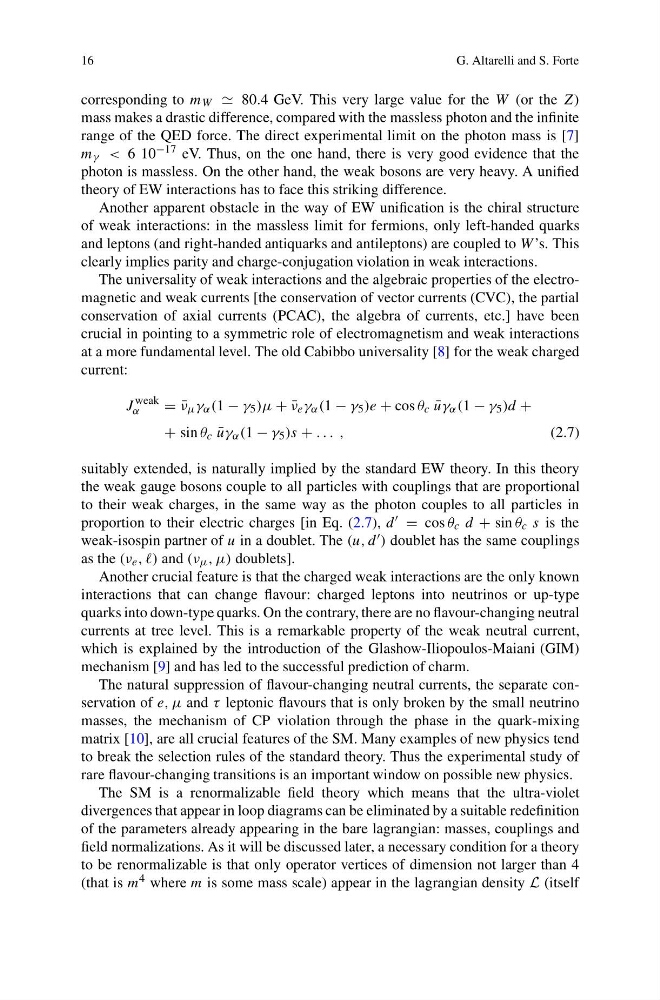
at a more fundamental level. The old Cabibbo universality [8] for the weak charged
current:
J
weak
α
= ¯
ν μ γ α (1 − γ 5 )μ + ¯
ν e γ α (1 − γ 5 )e + cos θ c ¯
uγ α (1 − γ 5 )d +
+ sin θ c ¯
uγ α (1 − γ 5 )s + . . . ,
(2.7)
suitably extended, is naturally implied by the standard EW theory. In this theory
the weak gauge bosons couple to all particles with couplings that are proportional
to their weak charges, in the same way as the photon couples to all particles in
proportion to their electric charges [in Eq. (2.7), d = cos θ c d + sin θ c s is the
weak-isospin partner of u in a doublet. The (u, d ) doublet has the same couplings
as the (ν e , ,) and (ν μ , μ) doublets].
Another crucial feature is that the charged weak interactions are the only known
interactions that can change flavour: charged leptons into neutrinos or up-type
quarks into down-type quarks. On the contrary, there are no flavour-changing neutral
currents at tree level. This is a remarkable property of the weak neutral current,
which is explained by the introduction of the Glashow-Iliopoulos-Maiani (GIM)
mechanism [9] and has led to the successful prediction of charm.
The natural suppression of flavour-changing neutral currents, the separate conservation of e, μ and τ leptonic flavours that is only broken by the small neutrino
masses, the mechanism of CP violation through the phase in the quark-mixing
matrix [10], are all crucial features of the SM. Many examples of new physics tend
to break the selection rules of the standard theory. Thus the experimental study of
rare flavour-changing transitions is an important window on possible new physics.
The SM is a renormalizable field theory which means that the ultra-violet
divergences that appear in loop diagrams can be eliminated by a suitable redefinition
of the parameters already appearing in the bare lagrangian: masses, couplings and
field normalizations. As it will be discussed later, a necessary condition for a theory
to be renormalizable is that only operator vertices of dimension not larger than 4
(that is m 4 where m is some mass scale) appear in the lagrangian density L (itself
G. Altarelli and S. Forte
corresponding to m W 80.4 GeV. This very large value for the W (or the Z)
mass makes a drastic difference, compared with the massless photon and the infinite
range of the QED force. The direct experimental limit on the photon mass is [7]
m γ < 6 10 −17 eV. Thus, on the one hand, there is very good evidence that the
photon is massless. On the other hand, the weak bosons are very heavy. A unified
theory of EW interactions has to face this striking difference.
Another apparent obstacle in the way of EW unification is the chiral structure
of weak interactions: in the massless limit for fermions, only left-handed quarks
and leptons (and right-handed antiquarks and antileptons) are coupled to W ’s. This
clearly implies parity and charge-conjugation violation in weak interactions.
The universality of weak interactions and the algebraic properties of the electromagnetic and weak currents [the conservation of vector currents (CVC), the partial
conservation of axial currents (PCAC), the algebra of currents, etc.] have been
crucial in pointing to a symmetric role of electromagnetism and weak interactions
at a more fundamental level. The old Cabibbo universality [8] for the weak charged
current:
J
weak
α
= ¯
ν μ γ α (1 − γ 5 )μ + ¯
ν e γ α (1 − γ 5 )e + cos θ c ¯
uγ α (1 − γ 5 )d +
+ sin θ c ¯
uγ α (1 − γ 5 )s + . . . ,
(2.7)
suitably extended, is naturally implied by the standard EW theory. In this theory
the weak gauge bosons couple to all particles with couplings that are proportional
to their weak charges, in the same way as the photon couples to all particles in
proportion to their electric charges [in Eq. (2.7), d = cos θ c d + sin θ c s is the
weak-isospin partner of u in a doublet. The (u, d ) doublet has the same couplings
as the (ν e , ,) and (ν μ , μ) doublets].
Another crucial feature is that the charged weak interactions are the only known
interactions that can change flavour: charged leptons into neutrinos or up-type
quarks into down-type quarks. On the contrary, there are no flavour-changing neutral
currents at tree level. This is a remarkable property of the weak neutral current,
which is explained by the introduction of the Glashow-Iliopoulos-Maiani (GIM)
mechanism [9] and has led to the successful prediction of charm.
The natural suppression of flavour-changing neutral currents, the separate conservation of e, μ and τ leptonic flavours that is only broken by the small neutrino
masses, the mechanism of CP violation through the phase in the quark-mixing
matrix [10], are all crucial features of the SM. Many examples of new physics tend
to break the selection rules of the standard theory. Thus the experimental study of
rare flavour-changing transitions is an important window on possible new physics.
The SM is a renormalizable field theory which means that the ultra-violet
divergences that appear in loop diagrams can be eliminated by a suitable redefinition
of the parameters already appearing in the bare lagrangian: masses, couplings and
field normalizations. As it will be discussed later, a necessary condition for a theory
to be renormalizable is that only operator vertices of dimension not larger than 4
(that is m 4 where m is some mass scale) appear in the lagrangian density L (itself