

204
H. Wittig
rather than the fundamental quarks and gluons. ChPT is parameterized in terms of a
set of empirical couplings, usually called “low-energy constants” (LECs). At lowest
order, the effective chiral Lagrangian (in Euclidean space-time) reads
L
(2)
eff
=
1
2 F 2
0
1
2 Tr
∂ μ U † ∂ μ U
− B 0 Tr
M(U + U † )
,
(5.170)
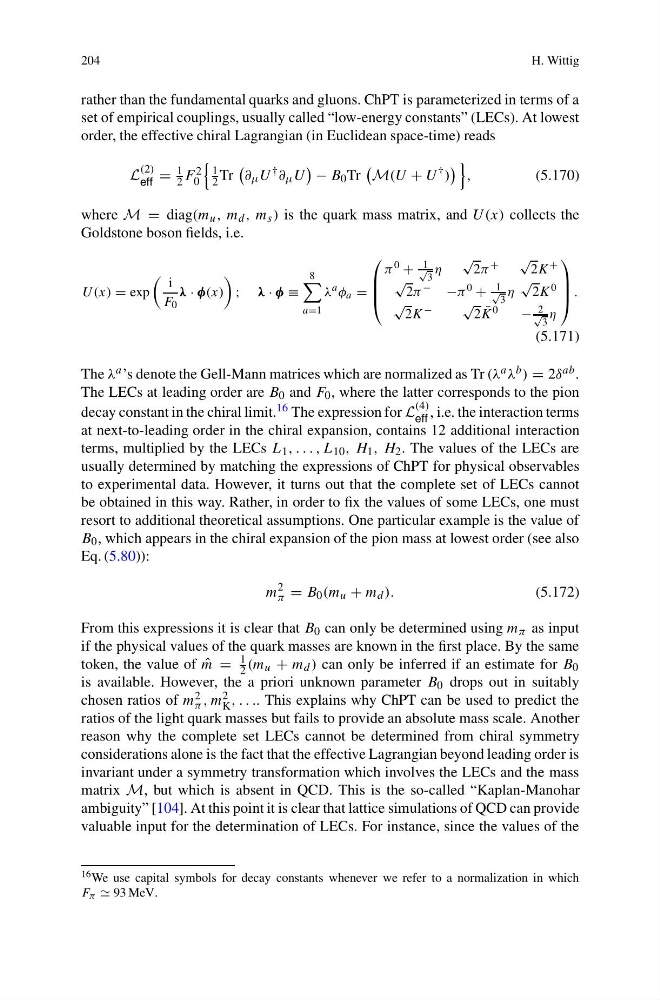
where M = diag(m u , m d , m s ) is the quark mass matrix, and U(x) collects the
Goldstone boson fields, i.e.
U(x) = exp
i
F 0
λ · φ(x)
; λ · φ ≡
8
a=1
λ
a φ a =
⎛
⎜
⎜
⎝
π 0 +
1
√
3
η
√
2π +
√
2K +
√
2π − −π 0 +
1
√
3
η
√
2K 0
√
2K −
√
2 ¯
K 0
−
2
√
3
η
⎞
⎟
⎟
⎠ .
(5.171)
The λ a ’s denote the Gell-Mann matrices which are normalized as Tr (λ a λ b ) = 2δ ab .
The LECs at leading order are B 0 and F 0 , where the latter corresponds to the pion
decay constant in the chiral limit. 16 The expression for L
(4)
eff , i.e. the interaction terms
at next-to-leading order in the chiral expansion, contains 12 additional interaction
terms, multiplied by the LECs L 1 , . . . , L 10 , H 1 , H 2 . The values of the LECs are
usually determined by matching the expressions of ChPT for physical observables
to experimental data. However, it turns out that the complete set of LECs cannot
be obtained in this way. Rather, in order to fix the values of some LECs, one must
resort to additional theoretical assumptions. One particular example is the value of
B 0 , which appears in the chiral expansion of the pion mass at lowest order (see also
Eq. (5.80)):
m
2
π = B 0 (m u + m d ).
(5.172)
From this expressions it is clear that B 0 can only be determined using m π as input
if the physical values of the quark masses are known in the first place. By the same
token, the value of ˆ
m =
1
2 (m u + m d ) can only be inferred if an estimate for B 0
is available. However, the a priori unknown parameter B 0 drops out in suitably
chosen ratios of m 2
π , m 2
K , . . .. This explains why ChPT can be used to predict the
ratios of the light quark masses but fails to provide an absolute mass scale. Another
reason why the complete set LECs cannot be determined from chiral symmetry
considerations alone is the fact that the effective Lagrangian beyond leading order is
invariant under a symmetry transformation which involves the LECs and the mass
matrix M, but which is absent in QCD. This is the so-called “Kaplan-Manohar
ambiguity” [104]. At this point it is clear that lattice simulations of QCD can provide
valuable input for the determination of LECs. For instance, since the values of the
16 We use capital symbols for decay constants whenever we refer to a normalization in which
F π 93 MeV.
H. Wittig
rather than the fundamental quarks and gluons. ChPT is parameterized in terms of a
set of empirical couplings, usually called “low-energy constants” (LECs). At lowest
order, the effective chiral Lagrangian (in Euclidean space-time) reads
L
(2)
eff
=
1
2 F 2
0
1
2 Tr
∂ μ U † ∂ μ U
− B 0 Tr
M(U + U † )
,
(5.170)
where M = diag(m u , m d , m s ) is the quark mass matrix, and U(x) collects the
Goldstone boson fields, i.e.
U(x) = exp
i
F 0
λ · φ(x)
; λ · φ ≡
8
a=1
λ
a φ a =
⎛
⎜
⎜
⎝
π 0 +
1
√
3
η
√
2π +
√
2K +
√
2π − −π 0 +
1
√
3
η
√
2K 0
√
2K −
√
2 ¯
K 0
−
2
√
3
η
⎞
⎟
⎟
⎠ .
(5.171)
The λ a ’s denote the Gell-Mann matrices which are normalized as Tr (λ a λ b ) = 2δ ab .
The LECs at leading order are B 0 and F 0 , where the latter corresponds to the pion
decay constant in the chiral limit. 16 The expression for L
(4)
eff , i.e. the interaction terms
at next-to-leading order in the chiral expansion, contains 12 additional interaction
terms, multiplied by the LECs L 1 , . . . , L 10 , H 1 , H 2 . The values of the LECs are
usually determined by matching the expressions of ChPT for physical observables
to experimental data. However, it turns out that the complete set of LECs cannot
be obtained in this way. Rather, in order to fix the values of some LECs, one must
resort to additional theoretical assumptions. One particular example is the value of
B 0 , which appears in the chiral expansion of the pion mass at lowest order (see also
Eq. (5.80)):
m
2
π = B 0 (m u + m d ).
(5.172)
From this expressions it is clear that B 0 can only be determined using m π as input
if the physical values of the quark masses are known in the first place. By the same
token, the value of ˆ
m =
1
2 (m u + m d ) can only be inferred if an estimate for B 0
is available. However, the a priori unknown parameter B 0 drops out in suitably
chosen ratios of m 2
π , m 2
K , . . .. This explains why ChPT can be used to predict the
ratios of the light quark masses but fails to provide an absolute mass scale. Another
reason why the complete set LECs cannot be determined from chiral symmetry
considerations alone is the fact that the effective Lagrangian beyond leading order is
invariant under a symmetry transformation which involves the LECs and the mass
matrix M, but which is absent in QCD. This is the so-called “Kaplan-Manohar
ambiguity” [104]. At this point it is clear that lattice simulations of QCD can provide
valuable input for the determination of LECs. For instance, since the values of the
16 We use capital symbols for decay constants whenever we refer to a normalization in which
F π 93 MeV.