

196
H. Wittig
fourth-root trick (see Sect. 5.2.6). In this approach, the coupling constant is defined
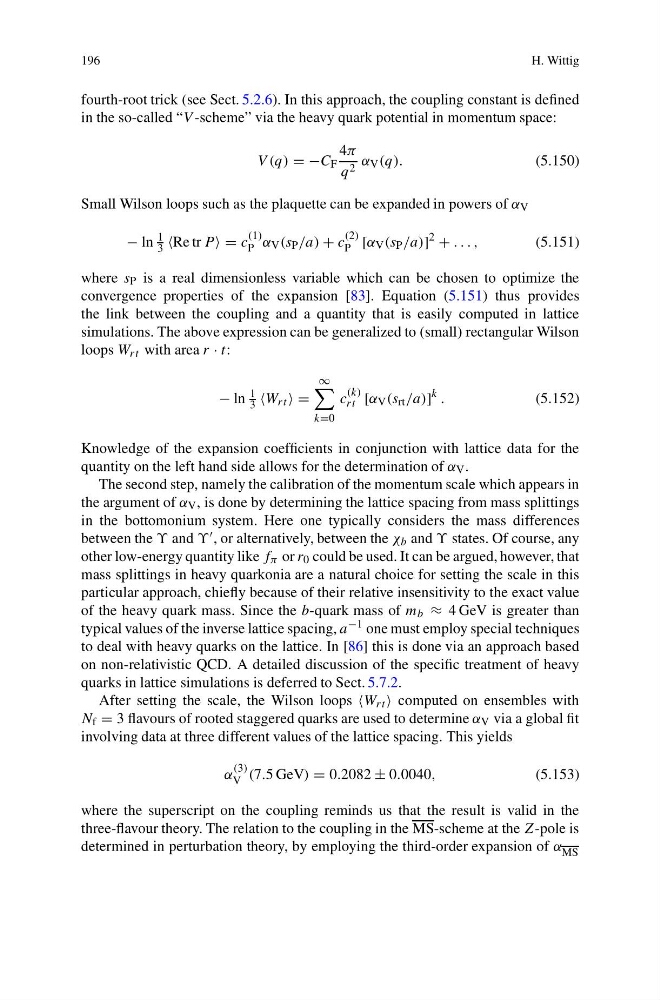
in the so-called “V -scheme” via the heavy quark potential in momentum space:
V (q) = −C F
4π
q 2 α V (q).
(5.150)
Small Wilson loops such as the plaquette can be expanded in powers of α V
− ln
1
3 Re tr P = c
(1)
P α V (s P /a) + c
(2)
P [α V (s P /a)]
2
+ . . . ,
(5.151)
where s P is a real dimensionless variable which can be chosen to optimize the
convergence properties of the expansion [83]. Equation (5.151) thus provides
the link between the coupling and a quantity that is easily computed in lattice
simulations. The above expression can be generalized to (small) rectangular Wilson
loops W rt with area r · t:
− ln
1
3 W rt =
∞
k=0
c
(k)
rt [α V (s rt /a)]
k .
(5.152)
Knowledge of the expansion coefficients in conjunction with lattice data for the
quantity on the left hand side allows for the determination of α V .
The second step, namely the calibration of the momentum scale which appears in
the argument of α V , is done by determining the lattice spacing from mass splittings
in the bottomonium system. Here one typically considers the mass differences
between the ϒ and ϒ , or alternatively, between the χ b and ϒ states. Of course, any
other low-energy quantity like f π or r 0 could be used. It can be argued, however, that
mass splittings in heavy quarkonia are a natural choice for setting the scale in this
particular approach, chiefly because of their relative insensitivity to the exact value
of the heavy quark mass. Since the b-quark mass of m b ≈ 4 GeV is greater than
typical values of the inverse lattice spacing, a −1 one must employ special techniques
to deal with heavy quarks on the lattice. In [86] this is done via an approach based
on non-relativistic QCD. A detailed discussion of the specific treatment of heavy
quarks in lattice simulations is deferred to Sect. 5.7.2.
After setting the scale, the Wilson loops W rt computed on ensembles with
N f = 3 flavours of rooted staggered quarks are used to determine α V via a global fit
involving data at three different values of the lattice spacing. This yields
α
(3)
V (7.5 GeV) = 0.2082 ± 0.0040,
(5.153)
where the superscript on the coupling reminds us that the result is valid in the
three-flavour theory. The relation to the coupling in the MS-scheme at the Z-pole is
determined in perturbation theory, by employing the third-order expansion of α MS
H. Wittig
fourth-root trick (see Sect. 5.2.6). In this approach, the coupling constant is defined
in the so-called “V -scheme” via the heavy quark potential in momentum space:
V (q) = −C F
4π
q 2 α V (q).
(5.150)
Small Wilson loops such as the plaquette can be expanded in powers of α V
− ln
1
3 Re tr P = c
(1)
P α V (s P /a) + c
(2)
P [α V (s P /a)]
2
+ . . . ,
(5.151)
where s P is a real dimensionless variable which can be chosen to optimize the
convergence properties of the expansion [83]. Equation (5.151) thus provides
the link between the coupling and a quantity that is easily computed in lattice
simulations. The above expression can be generalized to (small) rectangular Wilson
loops W rt with area r · t:
− ln
1
3 W rt =
∞
k=0
c
(k)
rt [α V (s rt /a)]
k .
(5.152)
Knowledge of the expansion coefficients in conjunction with lattice data for the
quantity on the left hand side allows for the determination of α V .
The second step, namely the calibration of the momentum scale which appears in
the argument of α V , is done by determining the lattice spacing from mass splittings
in the bottomonium system. Here one typically considers the mass differences
between the ϒ and ϒ , or alternatively, between the χ b and ϒ states. Of course, any
other low-energy quantity like f π or r 0 could be used. It can be argued, however, that
mass splittings in heavy quarkonia are a natural choice for setting the scale in this
particular approach, chiefly because of their relative insensitivity to the exact value
of the heavy quark mass. Since the b-quark mass of m b ≈ 4 GeV is greater than
typical values of the inverse lattice spacing, a −1 one must employ special techniques
to deal with heavy quarks on the lattice. In [86] this is done via an approach based
on non-relativistic QCD. A detailed discussion of the specific treatment of heavy
quarks in lattice simulations is deferred to Sect. 5.7.2.
After setting the scale, the Wilson loops W rt computed on ensembles with
N f = 3 flavours of rooted staggered quarks are used to determine α V via a global fit
involving data at three different values of the lattice spacing. This yields
α
(3)
V (7.5 GeV) = 0.2082 ± 0.0040,
(5.153)
where the superscript on the coupling reminds us that the result is valid in the
three-flavour theory. The relation to the coupling in the MS-scheme at the Z-pole is
determined in perturbation theory, by employing the third-order expansion of α MS