

192
H. Wittig
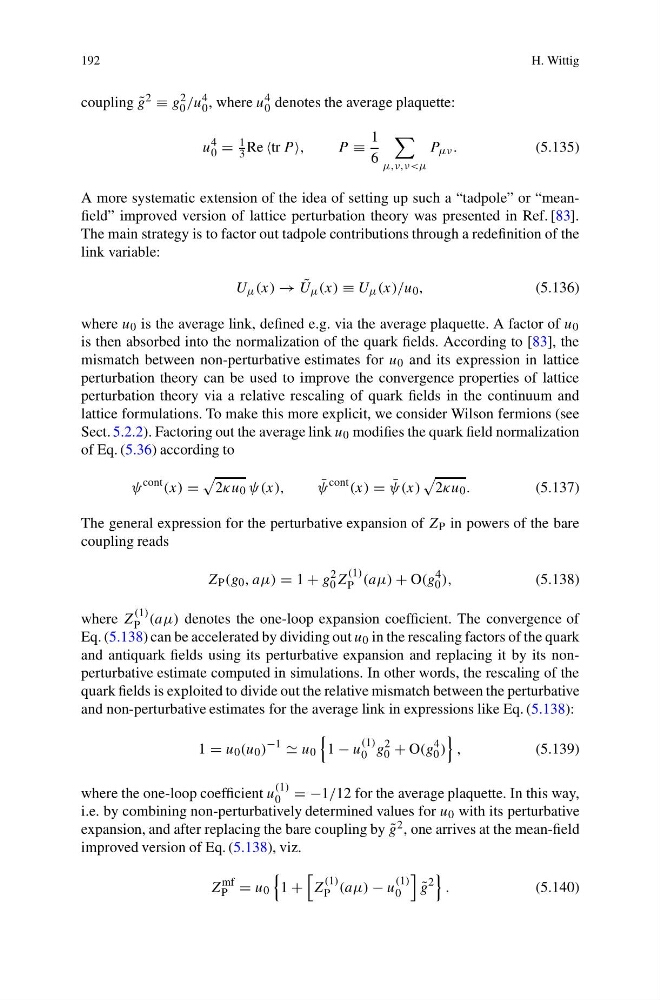
coupling ˜
g 2 ≡ g 2
0 /u 4
0 , where u 4
0 denotes the average plaquette:
u
4
0 =
1
3 Re tr P ,
P ≡
1
6
μ,ν,ν<μ
P μν .
(5.135)
A more systematic extension of the idea of setting up such a “tadpole” or “meanfield” improved version of lattice perturbation theory was presented in Ref. [83].
The main strategy is to factor out tadpole contributions through a redefinition of the
link variable:
U μ (x) → ˜
U μ (x) ≡ U μ (x)/u 0 ,
(5.136)
where u 0 is the average link, defined e.g. via the average plaquette. A factor of u 0
is then absorbed into the normalization of the quark fields. According to [83], the
mismatch between non-perturbative estimates for u 0 and its expression in lattice
perturbation theory can be used to improve the convergence properties of lattice
perturbation theory via a relative rescaling of quark fields in the continuum and
lattice formulations. To make this more explicit, we consider Wilson fermions (see
Sect. 5.2.2). Factoring out the average link u 0 modifies the quark field normalization
of Eq. (5.36) according to
ψ
cont (x) =
2κu 0 ψ(x),
¯
ψ
cont (x) = ¯
ψ(x)
2κu 0 .
(5.137)
The general expression for the perturbative expansion of Z P in powers of the bare
coupling reads
Z P (g 0 , aμ) = 1 + g
2
0 Z
(1)
P (aμ) + O(g
4
0 ),
(5.138)
where Z
(1)
P (aμ) denotes the one-loop expansion coefficient. The convergence of
Eq. (5.138) can be accelerated by dividing out u 0 in the rescaling factors of the quark
and antiquark fields using its perturbative expansion and replacing it by its nonperturbative estimate computed in simulations. In other words, the rescaling of the
quark fields is exploited to divide out the relative mismatch between the perturbative
and non-perturbative estimates for the average link in expressions like Eq. (5.138):
1 = u 0 (u 0 )
−1
u 0
1 − u
(1)
0 g
2
0 + O(g
4
0 )
,
(5.139)
where the one-loop coefficient u
(1)
0 = −1/12 for the average plaquette. In this way,
i.e. by combining non-perturbatively determined values for u 0 with its perturbative
expansion, and after replacing the bare coupling by ˜
g 2 , one arrives at the mean-field
improved version of Eq. (5.138), viz.
Z
mf
P = u 0
1 +
Z
(1)
P (aμ) − u
(1)
0
˜
g
2
.
(5.140)
H. Wittig
coupling ˜
g 2 ≡ g 2
0 /u 4
0 , where u 4
0 denotes the average plaquette:
u
4
0 =
1
3 Re tr P ,
P ≡
1
6
μ,ν,ν<μ
P μν .
(5.135)
A more systematic extension of the idea of setting up such a “tadpole” or “meanfield” improved version of lattice perturbation theory was presented in Ref. [83].
The main strategy is to factor out tadpole contributions through a redefinition of the
link variable:
U μ (x) → ˜
U μ (x) ≡ U μ (x)/u 0 ,
(5.136)
where u 0 is the average link, defined e.g. via the average plaquette. A factor of u 0
is then absorbed into the normalization of the quark fields. According to [83], the
mismatch between non-perturbative estimates for u 0 and its expression in lattice
perturbation theory can be used to improve the convergence properties of lattice
perturbation theory via a relative rescaling of quark fields in the continuum and
lattice formulations. To make this more explicit, we consider Wilson fermions (see
Sect. 5.2.2). Factoring out the average link u 0 modifies the quark field normalization
of Eq. (5.36) according to
ψ
cont (x) =
2κu 0 ψ(x),
¯
ψ
cont (x) = ¯
ψ(x)
2κu 0 .
(5.137)
The general expression for the perturbative expansion of Z P in powers of the bare
coupling reads
Z P (g 0 , aμ) = 1 + g
2
0 Z
(1)
P (aμ) + O(g
4
0 ),
(5.138)
where Z
(1)
P (aμ) denotes the one-loop expansion coefficient. The convergence of
Eq. (5.138) can be accelerated by dividing out u 0 in the rescaling factors of the quark
and antiquark fields using its perturbative expansion and replacing it by its nonperturbative estimate computed in simulations. In other words, the rescaling of the
quark fields is exploited to divide out the relative mismatch between the perturbative
and non-perturbative estimates for the average link in expressions like Eq. (5.138):
1 = u 0 (u 0 )
−1
u 0
1 − u
(1)
0 g
2
0 + O(g
4
0 )
,
(5.139)
where the one-loop coefficient u
(1)
0 = −1/12 for the average plaquette. In this way,
i.e. by combining non-perturbatively determined values for u 0 with its perturbative
expansion, and after replacing the bare coupling by ˜
g 2 , one arrives at the mean-field
improved version of Eq. (5.138), viz.
Z
mf
P = u 0
1 +
Z
(1)
P (aμ) − u
(1)
0
˜
g
2
.
(5.140)