

190
H. Wittig
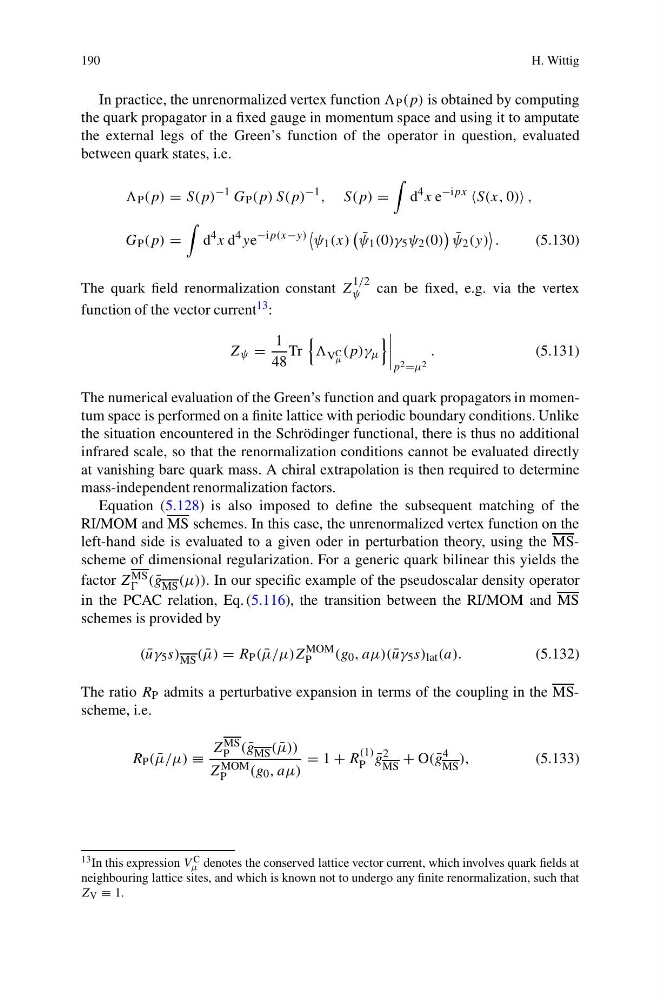
In practice, the unrenormalized vertex function P (p) is obtained by computing
the quark propagator in a fixed gauge in momentum space and using it to amputate
the external legs of the Green’s function of the operator in question, evaluated
between quark states, i.e.
P (p) = S(p)
−1 G P (p) S(p)
−1 , S(p) =
d
4 x e
−ipx
S(x, 0) ,
G P (p) =
d
4 x d
4 ye
−ip(x−y)
ψ 1 (x)
¯
ψ 1 (0)γ 5 ψ 2 (0)
¯
ψ 2 (y)
.
(5.130)
The quark field renormalization constant Z
1/2
ψ can be fixed, e.g. via the vertex
function of the vector current 13 :
Z ψ =
1
48
Tr
V C
μ
(p)γ μ
p 2 =μ 2
.
(5.131)
The numerical evaluation of the Green’s function and quark propagators in momentum space is performed on a finite lattice with periodic boundary conditions. Unlike
the situation encountered in the Schrödinger functional, there is thus no additional
infrared scale, so that the renormalization conditions cannot be evaluated directly
at vanishing bare quark mass. A chiral extrapolation is then required to determine
mass-independent renormalization factors.
Equation (5.128) is also imposed to define the subsequent matching of the
RI/MOM and MS schemes. In this case, the unrenormalized vertex function on the
left-hand side is evaluated to a given oder in perturbation theory, using the MSscheme of dimensional regularization. For a generic quark bilinear this yields the
factor Z MS
( ¯
g MS (μ)). In our specific example of the pseudoscalar density operator
in the PCAC relation, Eq. (5.116), the transition between the RI/MOM and MS
schemes is provided by
( ¯
uγ 5 s) MS ( ¯
μ) = R P ( ¯
μ/μ)Z
MOM
P
(g 0 , aμ)( ¯
uγ 5 s) lat (a).
(5.132)
The ratio R P admits a perturbative expansion in terms of the coupling in the MSscheme, i.e.
R P ( ¯
μ/μ) ≡
Z MS
P ( ¯
g MS ( ¯
μ))
Z MOM
P
(g 0 , aμ)
= 1 + R
(1)
P ¯
g
2
MS
+ O( ¯
g
4
MS
),
(5.133)
13 In this expression V C
μ denotes the conserved lattice vector current, which involves quark fields at
neighbouring lattice sites, and which is known not to undergo any finite renormalization, such that
Z V ≡ 1.
H. Wittig
In practice, the unrenormalized vertex function P (p) is obtained by computing
the quark propagator in a fixed gauge in momentum space and using it to amputate
the external legs of the Green’s function of the operator in question, evaluated
between quark states, i.e.
P (p) = S(p)
−1 G P (p) S(p)
−1 , S(p) =
d
4 x e
−ipx
S(x, 0) ,
G P (p) =
d
4 x d
4 ye
−ip(x−y)
ψ 1 (x)
¯
ψ 1 (0)γ 5 ψ 2 (0)
¯
ψ 2 (y)
.
(5.130)
The quark field renormalization constant Z
1/2
ψ can be fixed, e.g. via the vertex
function of the vector current 13 :
Z ψ =
1
48
Tr
V C
μ
(p)γ μ
p 2 =μ 2
.
(5.131)
The numerical evaluation of the Green’s function and quark propagators in momentum space is performed on a finite lattice with periodic boundary conditions. Unlike
the situation encountered in the Schrödinger functional, there is thus no additional
infrared scale, so that the renormalization conditions cannot be evaluated directly
at vanishing bare quark mass. A chiral extrapolation is then required to determine
mass-independent renormalization factors.
Equation (5.128) is also imposed to define the subsequent matching of the
RI/MOM and MS schemes. In this case, the unrenormalized vertex function on the
left-hand side is evaluated to a given oder in perturbation theory, using the MSscheme of dimensional regularization. For a generic quark bilinear this yields the
factor Z MS
( ¯
g MS (μ)). In our specific example of the pseudoscalar density operator
in the PCAC relation, Eq. (5.116), the transition between the RI/MOM and MS
schemes is provided by
( ¯
uγ 5 s) MS ( ¯
μ) = R P ( ¯
μ/μ)Z
MOM
P
(g 0 , aμ)( ¯
uγ 5 s) lat (a).
(5.132)
The ratio R P admits a perturbative expansion in terms of the coupling in the MSscheme, i.e.
R P ( ¯
μ/μ) ≡
Z MS
P ( ¯
g MS ( ¯
μ))
Z MOM
P
(g 0 , aμ)
= 1 + R
(1)
P ¯
g
2
MS
+ O( ¯
g
4
MS
),
(5.133)
13 In this expression V C
μ denotes the conserved lattice vector current, which involves quark fields at
neighbouring lattice sites, and which is known not to undergo any finite renormalization, such that
Z V ≡ 1.