

188
H. Wittig
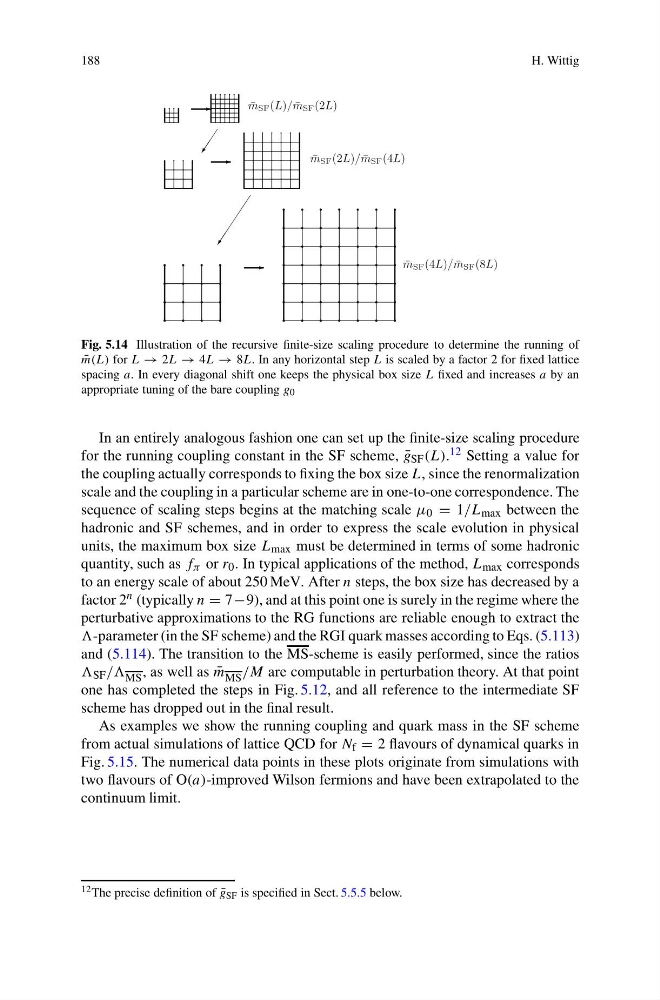
Fig. 5.14 Illustration of the recursive finite-size scaling procedure to determine the running of
¯
m(L) for L → 2L → 4L → 8L. In any horizontal step L is scaled by a factor 2 for fixed lattice
spacing a. In every diagonal shift one keeps the physical box size L fixed and increases a by an
appropriate tuning of the bare coupling g 0
In an entirely analogous fashion one can set up the finite-size scaling procedure
for the running coupling constant in the SF scheme, ¯
g SF (L). 12 Setting a value for
the coupling actually corresponds to fixing the box size L, since the renormalization
scale and the coupling in a particular scheme are in one-to-one correspondence. The
sequence of scaling steps begins at the matching scale μ 0 = 1/L max between the
hadronic and SF schemes, and in order to express the scale evolution in physical
units, the maximum box size L max must be determined in terms of some hadronic
quantity, such as f π or r 0 . In typical applications of the method, L max corresponds
to an energy scale of about 250 MeV. After n steps, the box size has decreased by a
factor 2 n (typically n = 7−9), and at this point one is surely in the regime where the
perturbative approximations to the RG functions are reliable enough to extract the
-parameter (in the SF scheme) and the RGI quark masses according to Eqs. (5.113)
and (5.114). The transition to the MS-scheme is easily performed, since the ratios
SF // MS , as well as ¯
m MS /M are computable in perturbation theory. At that point
one has completed the steps in Fig. 5.12, and all reference to the intermediate SF
scheme has dropped out in the final result.
As examples we show the running coupling and quark mass in the SF scheme
from actual simulations of lattice QCD for N f = 2 flavours of dynamical quarks in
Fig. 5.15. The numerical data points in these plots originate from simulations with
two flavours of O(a)-improved Wilson fermions and have been extrapolated to the
continuum limit.
12 The precise definition of ¯
g SF is specified in Sect. 5.5.5 below.
H. Wittig
Fig. 5.14 Illustration of the recursive finite-size scaling procedure to determine the running of
¯
m(L) for L → 2L → 4L → 8L. In any horizontal step L is scaled by a factor 2 for fixed lattice
spacing a. In every diagonal shift one keeps the physical box size L fixed and increases a by an
appropriate tuning of the bare coupling g 0
In an entirely analogous fashion one can set up the finite-size scaling procedure
for the running coupling constant in the SF scheme, ¯
g SF (L). 12 Setting a value for
the coupling actually corresponds to fixing the box size L, since the renormalization
scale and the coupling in a particular scheme are in one-to-one correspondence. The
sequence of scaling steps begins at the matching scale μ 0 = 1/L max between the
hadronic and SF schemes, and in order to express the scale evolution in physical
units, the maximum box size L max must be determined in terms of some hadronic
quantity, such as f π or r 0 . In typical applications of the method, L max corresponds
to an energy scale of about 250 MeV. After n steps, the box size has decreased by a
factor 2 n (typically n = 7−9), and at this point one is surely in the regime where the
perturbative approximations to the RG functions are reliable enough to extract the
-parameter (in the SF scheme) and the RGI quark masses according to Eqs. (5.113)
and (5.114). The transition to the MS-scheme is easily performed, since the ratios
SF // MS , as well as ¯
m MS /M are computable in perturbation theory. At that point
one has completed the steps in Fig. 5.12, and all reference to the intermediate SF
scheme has dropped out in the final result.
As examples we show the running coupling and quark mass in the SF scheme
from actual simulations of lattice QCD for N f = 2 flavours of dynamical quarks in
Fig. 5.15. The numerical data points in these plots originate from simulations with
two flavours of O(a)-improved Wilson fermions and have been extrapolated to the
continuum limit.
12 The precise definition of ¯
g SF is specified in Sect. 5.5.5 below.