

168
H. Wittig
deteriorates sharply when the lattice spacing is decreased and the masses of the
light (up and down) quarks are tuned to their physical values. The poor scaling
behaviour is driven by the condition number of the lattice Dirac operator D lat ,
i.e. the ratio of the largest to the smallest eigenvalue. This quantity is known to
grow inversely proportional to the lattice spacing and the quark mass. In particular,
the HMC algorithm scales with the second, perhaps the third power of the light
quark mass. Thus, simulations based on the Wilson-Dirac operator were found to be
unpractical for lattice spacings below 0.1 fm and quark masses significantly smaller
than half of the strange quark mass. 8 This is related to the afore-mentioned fact that
even the massive Wilson-Dirac operator is not protected against arbitrarily small
eigenvalues. Its condition number may thus fluctuate strongly in the course of the
simulation, leading not only to numerical instabilities, but also to large fluctuations
in the quark force term F F,μ (x), and, in turn, H . In order to keep a reasonably large
acceptance rate of well over 75%, one must reduce the step size τ accordingly,
and thus the numerical effort to integrate the equations of motion for an interval τ
of fixed length, increases.
Two basic strategies to address this problems have been followed: the first is
based on using fermionic discretizations that avoid the problem of arbitrarily small
eigenvalues, while the aim of the second approach is to improve the simulation
algorithms.
Staggered fermions have been advocated as a numerically more efficient alternative to the Wilson-Dirac formulation: since the staggered Dirac operator couples
one-component Grassmann fields rather than four-component spinors, fewer floating point operations are required for one application of the operator. Moreover, the
residual U(1) ⊗ U(1) symmetry protects the quark mass against additive renormalization and thus prevents the occurrence of very small eigenvalues. However,
the fact that the staggered formulation describes four “tastes” per quark flavour
makes a physical interpretation difficult. Technically, the degeneracy implies that
the statistical weight of the quark determinant is too large compared with that of
one physical flavour. An ad hoc method to compensate for this is to take fractional
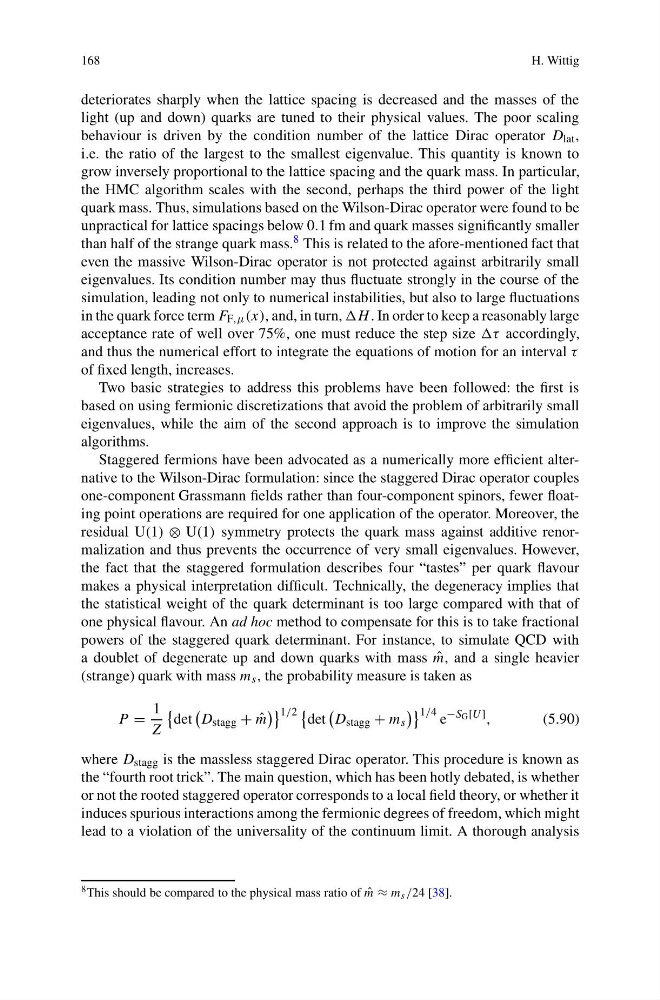
powers of the staggered quark determinant. For instance, to simulate QCD with
a doublet of degenerate up and down quarks with mass ˆ
m, and a single heavier
(strange) quark with mass m s , the probability measure is taken as
P =
1
Z
det
D stagg + ˆ
m
1/2
det
D stagg + m s
1/4 e
−S G [U ] ,
(5.90)
where D stagg is the massless staggered Dirac operator. This procedure is known as
the “fourth root trick”. The main question, which has been hotly debated, is whether
or not the rooted staggered operator corresponds to a local field theory, or whether it
induces spurious interactions among the fermionic degrees of freedom, which might
lead to a violation of the universality of the continuum limit. A thorough analysis
8 This should be compared to the physical mass ratio of ˆ
m ≈ m s /24 [38].
H. Wittig
deteriorates sharply when the lattice spacing is decreased and the masses of the
light (up and down) quarks are tuned to their physical values. The poor scaling
behaviour is driven by the condition number of the lattice Dirac operator D lat ,
i.e. the ratio of the largest to the smallest eigenvalue. This quantity is known to
grow inversely proportional to the lattice spacing and the quark mass. In particular,
the HMC algorithm scales with the second, perhaps the third power of the light
quark mass. Thus, simulations based on the Wilson-Dirac operator were found to be
unpractical for lattice spacings below 0.1 fm and quark masses significantly smaller
than half of the strange quark mass. 8 This is related to the afore-mentioned fact that
even the massive Wilson-Dirac operator is not protected against arbitrarily small
eigenvalues. Its condition number may thus fluctuate strongly in the course of the
simulation, leading not only to numerical instabilities, but also to large fluctuations
in the quark force term F F,μ (x), and, in turn, H . In order to keep a reasonably large
acceptance rate of well over 75%, one must reduce the step size τ accordingly,
and thus the numerical effort to integrate the equations of motion for an interval τ
of fixed length, increases.
Two basic strategies to address this problems have been followed: the first is
based on using fermionic discretizations that avoid the problem of arbitrarily small
eigenvalues, while the aim of the second approach is to improve the simulation
algorithms.
Staggered fermions have been advocated as a numerically more efficient alternative to the Wilson-Dirac formulation: since the staggered Dirac operator couples
one-component Grassmann fields rather than four-component spinors, fewer floating point operations are required for one application of the operator. Moreover, the
residual U(1) ⊗ U(1) symmetry protects the quark mass against additive renormalization and thus prevents the occurrence of very small eigenvalues. However,
the fact that the staggered formulation describes four “tastes” per quark flavour
makes a physical interpretation difficult. Technically, the degeneracy implies that
the statistical weight of the quark determinant is too large compared with that of
one physical flavour. An ad hoc method to compensate for this is to take fractional
powers of the staggered quark determinant. For instance, to simulate QCD with
a doublet of degenerate up and down quarks with mass ˆ
m, and a single heavier
(strange) quark with mass m s , the probability measure is taken as
P =
1
Z
det
D stagg + ˆ
m
1/2
det
D stagg + m s
1/4 e
−S G [U ] ,
(5.90)
where D stagg is the massless staggered Dirac operator. This procedure is known as
the “fourth root trick”. The main question, which has been hotly debated, is whether
or not the rooted staggered operator corresponds to a local field theory, or whether it
induces spurious interactions among the fermionic degrees of freedom, which might
lead to a violation of the universality of the continuum limit. A thorough analysis
8 This should be compared to the physical mass ratio of ˆ
m ≈ m s /24 [38].