

144
H. Wittig
A consistent and manifestly gauge invariant discretization of QCD is obtained by
identifying the gauge degrees of freedom with the link variables U μ (x), which
transform under the gauge group as
U μ (x) → g(x) U μ (x) g(x + a ˆ
μ)
−1 , g(x), g(x + a ˆ
μ) ∈ SU(3).
(5.22)
The connection with the gauge potential A μ (x) is somewhat subtle: if U μ (x)
denotes a given link variable in the discretized theory, it can be used to define a
vector field A μ (x) as an element of the Lie algebra of SU(3) via
e
aA μ (x)
≡ U μ (x).
(5.23)
In turn, if A c
μ is a given gauge potential in the continuum theory, one can always
find a link variable which approximates A c
μ up to cutoff effects.
Now we turn to the problem of defining a discretized version of the Yang–Mills
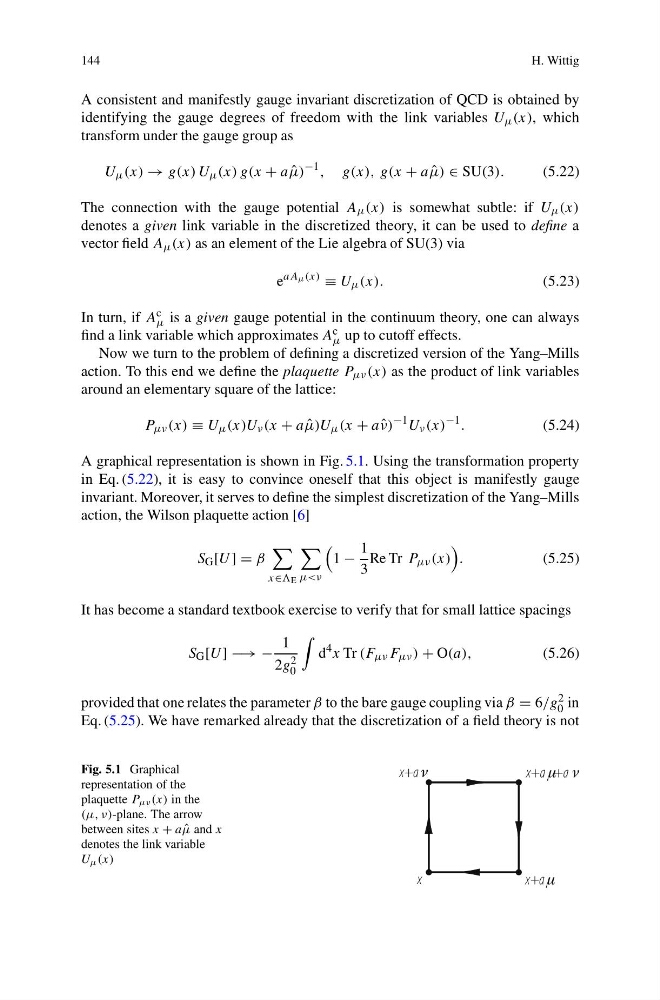
action. To this end we define the plaquette P μν (x) as the product of link variables
around an elementary square of the lattice:
P μν (x) ≡ U μ (x)U ν (x + a ˆ
μ)U μ (x + a ˆ
ν)
−1 U ν (x)
−1 .
(5.24)
A graphical representation is shown in Fig. 5.1. Using the transformation property
in Eq. (5.22), it is easy to convince oneself that this object is manifestly gauge
invariant. Moreover, it serves to define the simplest discretization of the Yang–Mills
action, the Wilson plaquette action [6]
S G [U ] = β
x∈ E
μ<ν
1 −
1
3
Re Tr P μν (x)
.
(5.25)
It has become a standard textbook exercise to verify that for small lattice spacings
S G [U ] −→ −
1
2g 2
0
d
4 x Tr (F μν F μν ) + O(a),
(5.26)
provided that one relates the parameter β to the bare gauge coupling via β = 6/g 2
0 in
Eq. (5.25). We have remarked already that the discretization of a field theory is not
Fig. 5.1 Graphical
representation of the
plaquette P μν (x) in the
(μ, ν)-plane. The arrow
between sites x + a ˆ
μ and x
denotes the link variable
U μ (x)
x+a
x+a +a
x
x+a
H. Wittig
A consistent and manifestly gauge invariant discretization of QCD is obtained by
identifying the gauge degrees of freedom with the link variables U μ (x), which
transform under the gauge group as
U μ (x) → g(x) U μ (x) g(x + a ˆ
μ)
−1 , g(x), g(x + a ˆ
μ) ∈ SU(3).
(5.22)
The connection with the gauge potential A μ (x) is somewhat subtle: if U μ (x)
denotes a given link variable in the discretized theory, it can be used to define a
vector field A μ (x) as an element of the Lie algebra of SU(3) via
e
aA μ (x)
≡ U μ (x).
(5.23)
In turn, if A c
μ is a given gauge potential in the continuum theory, one can always
find a link variable which approximates A c
μ up to cutoff effects.
Now we turn to the problem of defining a discretized version of the Yang–Mills
action. To this end we define the plaquette P μν (x) as the product of link variables
around an elementary square of the lattice:
P μν (x) ≡ U μ (x)U ν (x + a ˆ
μ)U μ (x + a ˆ
ν)
−1 U ν (x)
−1 .
(5.24)
A graphical representation is shown in Fig. 5.1. Using the transformation property
in Eq. (5.22), it is easy to convince oneself that this object is manifestly gauge
invariant. Moreover, it serves to define the simplest discretization of the Yang–Mills
action, the Wilson plaquette action [6]
S G [U ] = β
x∈ E
μ<ν
1 −
1
3
Re Tr P μν (x)
.
(5.25)
It has become a standard textbook exercise to verify that for small lattice spacings
S G [U ] −→ −
1
2g 2
0
d
4 x Tr (F μν F μν ) + O(a),
(5.26)
provided that one relates the parameter β to the bare gauge coupling via β = 6/g 2
0 in
Eq. (5.25). We have remarked already that the discretization of a field theory is not
Fig. 5.1 Graphical
representation of the
plaquette P μν (x) in the
(μ, ν)-plane. The arrow
between sites x + a ˆ
μ and x
denotes the link variable
U μ (x)
x+a
x+a +a
x
x+a