

4 QCD: The Theory of Strong Interactions
131
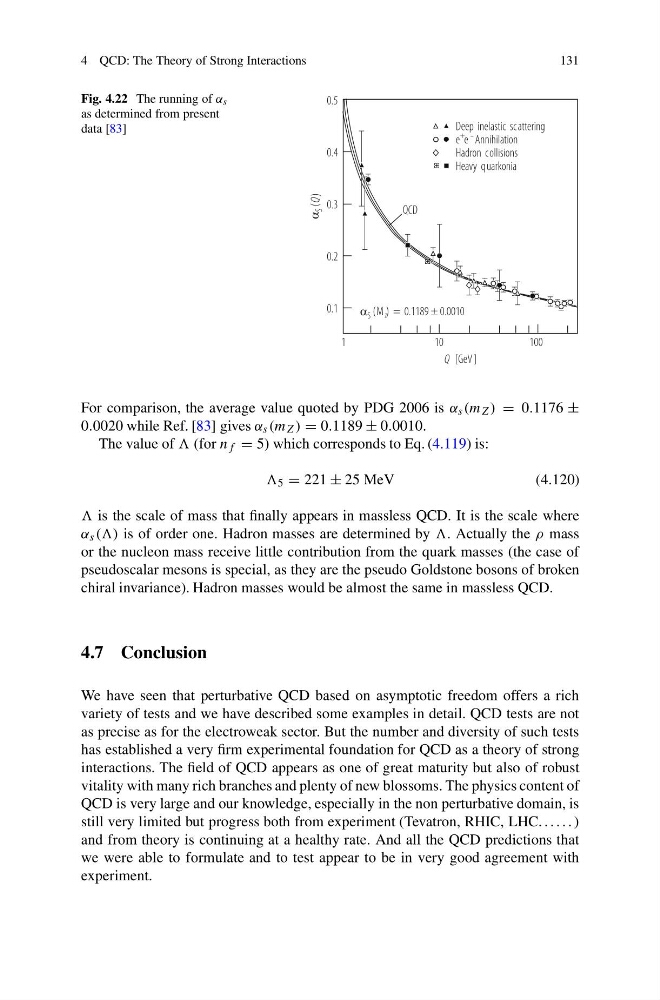
Fig. 4.22 The running of α s
as determined from present
data [83]
0.5
0.4
0.3
0.2
0.1
1
10
100
Q [GeV ]
QCD
(M ) = 0.1189 ± 0.0010
Z
D S
Deep inelastic scattering
e e - Annihilation
Hadron collisions
Heavy quarkonia
+
(Q)
D S
For comparison, the average value quoted by PDG 2006 is α s (m Z ) = 0.1176 ±
0.0020 while Ref. [83] gives α s (m Z ) = 0.1189 ± 0.0010.
The value of (for n f = 5) which corresponds to Eq. (4.119) is:
5 = 221 ± 25 MeV
(4.120)
is the scale of mass that finally appears in massless QCD. It is the scale where
α s (() is of order one. Hadron masses are determined by . Actually the ρ mass
or the nucleon mass receive little contribution from the quark masses (the case of
pseudoscalar mesons is special, as they are the pseudo Goldstone bosons of broken
chiral invariance). Hadron masses would be almost the same in massless QCD.
4.7 Conclusion
We have seen that perturbative QCD based on asymptotic freedom offers a rich
variety of tests and we have described some examples in detail. QCD tests are not
as precise as for the electroweak sector. But the number and diversity of such tests
has established a very firm experimental foundation for QCD as a theory of strong
interactions. The field of QCD appears as one of great maturity but also of robust
vitality with many rich branches and plenty of new blossoms. The physics content of
QCD is very large and our knowledge, especially in the non perturbative domain, is
still very limited but progress both from experiment (Tevatron, RHIC, LHC. . . . . . )
and from theory is continuing at a healthy rate. And all the QCD predictions that
we were able to formulate and to test appear to be in very good agreement with
experiment.
131
Fig. 4.22 The running of α s
as determined from present
data [83]
0.5
0.4
0.3
0.2
0.1
1
10
100
Q [GeV ]
QCD
(M ) = 0.1189 ± 0.0010
Z
D S
Deep inelastic scattering
e e - Annihilation
Hadron collisions
Heavy quarkonia
+
(Q)
D S
For comparison, the average value quoted by PDG 2006 is α s (m Z ) = 0.1176 ±
0.0020 while Ref. [83] gives α s (m Z ) = 0.1189 ± 0.0010.
The value of (for n f = 5) which corresponds to Eq. (4.119) is:
5 = 221 ± 25 MeV
(4.120)
is the scale of mass that finally appears in massless QCD. It is the scale where
α s (() is of order one. Hadron masses are determined by . Actually the ρ mass
or the nucleon mass receive little contribution from the quark masses (the case of
pseudoscalar mesons is special, as they are the pseudo Goldstone bosons of broken
chiral invariance). Hadron masses would be almost the same in massless QCD.
4.7 Conclusion
We have seen that perturbative QCD based on asymptotic freedom offers a rich
variety of tests and we have described some examples in detail. QCD tests are not
as precise as for the electroweak sector. But the number and diversity of such tests
has established a very firm experimental foundation for QCD as a theory of strong
interactions. The field of QCD appears as one of great maturity but also of robust
vitality with many rich branches and plenty of new blossoms. The physics content of
QCD is very large and our knowledge, especially in the non perturbative domain, is
still very limited but progress both from experiment (Tevatron, RHIC, LHC. . . . . . )
and from theory is continuing at a healthy rate. And all the QCD predictions that
we were able to formulate and to test appear to be in very good agreement with
experiment.