

120
G. Altarelli and S. Forte
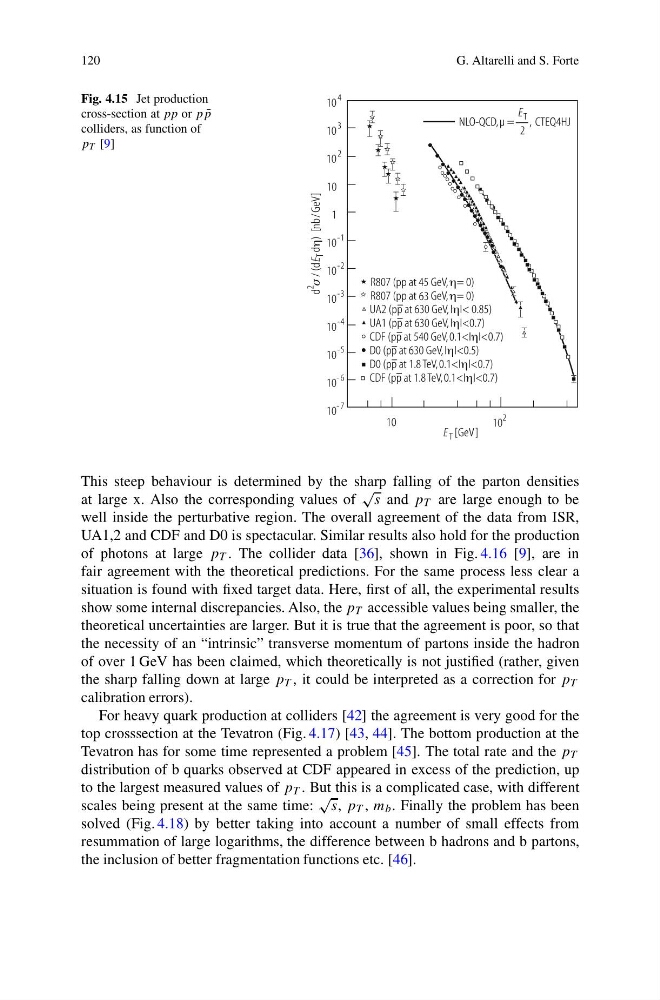
Fig. 4.15 Jet production
cross-section at pp or p ¯
p
colliders, as function of
p T [9]
This steep behaviour is determined by the sharp falling of the parton densities
at large x. Also the corresponding values of
√
s and p T are large enough to be
well inside the perturbative region. The overall agreement of the data from ISR,
UA1,2 and CDF and D0 is spectacular. Similar results also hold for the production
of photons at large p T . The collider data [36], shown in Fig. 4.16 [9], are in
fair agreement with the theoretical predictions. For the same process less clear a
situation is found with fixed target data. Here, first of all, the experimental results
show some internal discrepancies. Also, the p T accessible values being smaller, the
theoretical uncertainties are larger. But it is true that the agreement is poor, so that
the necessity of an “intrinsic” transverse momentum of partons inside the hadron
of over 1 GeV has been claimed, which theoretically is not justified (rather, given
the sharp falling down at large p T , it could be interpreted as a correction for p T
calibration errors).
For heavy quark production at colliders [42] the agreement is very good for the
top crosssection at the Tevatron (Fig. 4.17) [43, 44]. The bottom production at the
Tevatron has for some time represented a problem [45]. The total rate and the p T
distribution of b quarks observed at CDF appeared in excess of the prediction, up
to the largest measured values of p T . But this is a complicated case, with different
scales being present at the same time:
√
s, p T , m b . Finally the problem has been
solved (Fig. 4.18) by better taking into account a number of small effects from
resummation of large logarithms, the difference between b hadrons and b partons,
the inclusion of better fragmentation functions etc. [46].
G. Altarelli and S. Forte
Fig. 4.15 Jet production
cross-section at pp or p ¯
p
colliders, as function of
p T [9]
This steep behaviour is determined by the sharp falling of the parton densities
at large x. Also the corresponding values of
√
s and p T are large enough to be
well inside the perturbative region. The overall agreement of the data from ISR,
UA1,2 and CDF and D0 is spectacular. Similar results also hold for the production
of photons at large p T . The collider data [36], shown in Fig. 4.16 [9], are in
fair agreement with the theoretical predictions. For the same process less clear a
situation is found with fixed target data. Here, first of all, the experimental results
show some internal discrepancies. Also, the p T accessible values being smaller, the
theoretical uncertainties are larger. But it is true that the agreement is poor, so that
the necessity of an “intrinsic” transverse momentum of partons inside the hadron
of over 1 GeV has been claimed, which theoretically is not justified (rather, given
the sharp falling down at large p T , it could be interpreted as a correction for p T
calibration errors).
For heavy quark production at colliders [42] the agreement is very good for the
top crosssection at the Tevatron (Fig. 4.17) [43, 44]. The bottom production at the
Tevatron has for some time represented a problem [45]. The total rate and the p T
distribution of b quarks observed at CDF appeared in excess of the prediction, up
to the largest measured values of p T . But this is a complicated case, with different
scales being present at the same time:
√
s, p T , m b . Finally the problem has been
solved (Fig. 4.18) by better taking into account a number of small effects from
resummation of large logarithms, the difference between b hadrons and b partons,
the inclusion of better fragmentation functions etc. [46].