

96
G. Altarelli and S. Forte
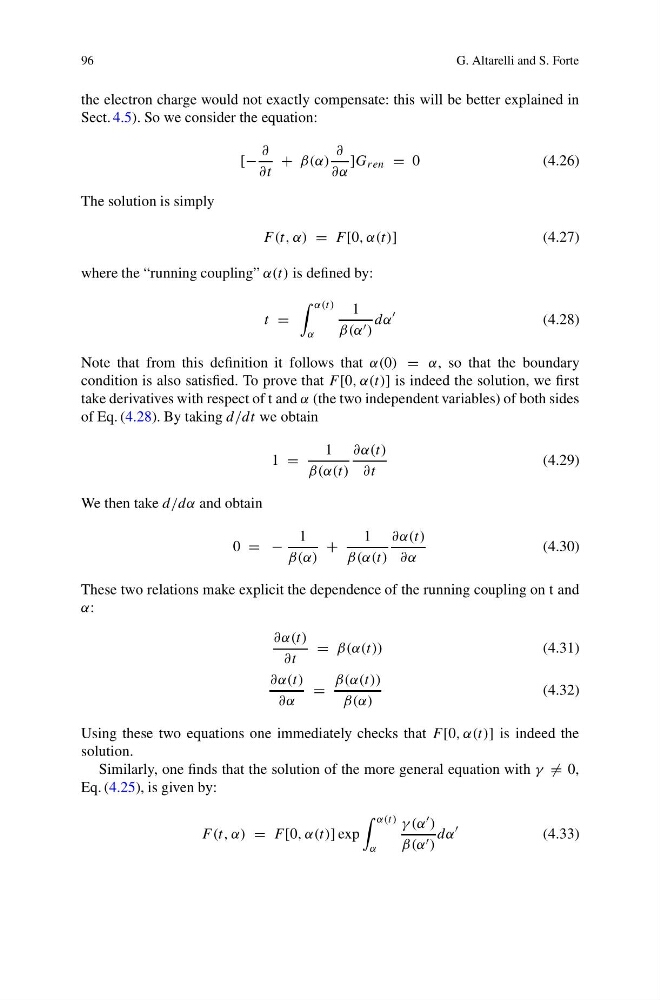
the electron charge would not exactly compensate: this will be better explained in
Sect. 4.5). So we consider the equation:
[−
∂
∂t
+ β(α)
∂
∂α
]G ren = 0
(4.26)
The solution is simply
F (t, α) = F [0, α(t)]
(4.27)
where the “running coupling” α(t) is defined by:
t =
α(t)
α
1
β(α )
dα
(4.28)
Note that from this definition it follows that α(0) = α, so that the boundary
condition is also satisfied. To prove that F [0, α(t)] is indeed the solution, we first
take derivatives with respect of t and α (the two independent variables) of both sides
of Eq. (4.28). By taking d/dt we obtain
1 =
1
β(α(t)
∂α(t)
∂t
(4.29)
We then take d/dα and obtain
0 = −
1
β(α)
+
1
β(α(t)
∂α(t)
∂α
(4.30)
These two relations make explicit the dependence of the running coupling on t and
α:
∂α(t)
∂t
= β(α(t))
(4.31)
∂α(t)
∂α
=
β(α(t))
β(α)
(4.32)
Using these two equations one immediately checks that F [0, α(t)] is indeed the
solution.
Similarly, one finds that the solution of the more general equation with γ = 0,
Eq. (4.25), is given by:
F (t, α) = F [0, α(t)] exp
α(t)
α
γ (α )
β(α )
dα
(4.33)
G. Altarelli and S. Forte
the electron charge would not exactly compensate: this will be better explained in
Sect. 4.5). So we consider the equation:
[−
∂
∂t
+ β(α)
∂
∂α
]G ren = 0
(4.26)
The solution is simply
F (t, α) = F [0, α(t)]
(4.27)
where the “running coupling” α(t) is defined by:
t =
α(t)
α
1
β(α )
dα
(4.28)
Note that from this definition it follows that α(0) = α, so that the boundary
condition is also satisfied. To prove that F [0, α(t)] is indeed the solution, we first
take derivatives with respect of t and α (the two independent variables) of both sides
of Eq. (4.28). By taking d/dt we obtain
1 =
1
β(α(t)
∂α(t)
∂t
(4.29)
We then take d/dα and obtain
0 = −
1
β(α)
+
1
β(α(t)
∂α(t)
∂α
(4.30)
These two relations make explicit the dependence of the running coupling on t and
α:
∂α(t)
∂t
= β(α(t))
(4.31)
∂α(t)
∂α
=
β(α(t))
β(α)
(4.32)
Using these two equations one immediately checks that F [0, α(t)] is indeed the
solution.
Similarly, one finds that the solution of the more general equation with γ = 0,
Eq. (4.25), is given by:
F (t, α) = F [0, α(t)] exp
α(t)
α
γ (α )
β(α )
dα
(4.33)