

2
1 Introduction
widely discontinued, as ‘hederagonic acid’ had already been coined as trivial
name.
[9]
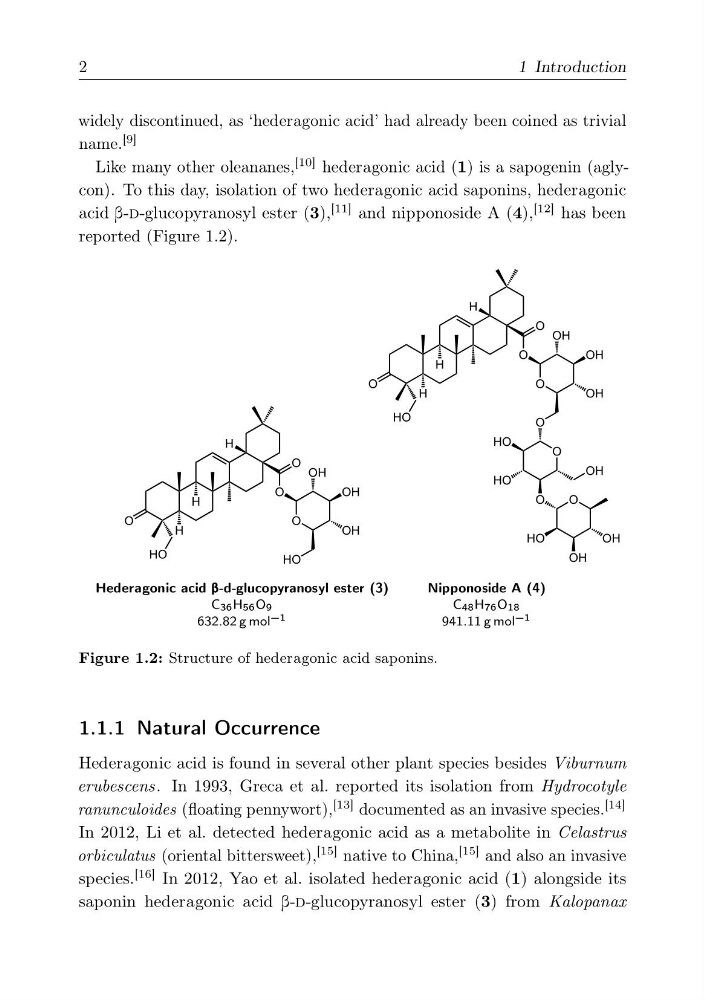
Like many other oleananes,
[10] hederagonic acid (1) is a sapogenin (aglycon). To this day, isolation of two hederagonic acid saponins, hederagonic
acid β-d-glucopyranosyl ester (3),
[11] and nipponoside A (4),
[12] has been
reported (Figure 1.2).
O
H
H
O
O
H
HO
O
H
H
O
O
H
HO
O
O
O
O
O
O
HO
OH
OH
HO
HO
OH
OH
OH
OH
OH
OH
OH
HO
Hederagonic acid β-d-glucopyranosyl ester (3)
C36H56O9
632.82 g mol −1
Nipponoside A (4)
C48H76O18
941.11 g mol −1
Figure 1.2: Structure of hederagonic acid saponins.
1.1.1 Natural Occurrence
Hederagonic acid is found in several other plant species besides Viburnum
erubescens. In 1993, Greca et al. reported its isolation from Hydrocotyle
ranunculoides (floating pennywort),
[13] documented as an invasive species.
[14]
In 2012, Li et al. detected hederagonic acid as a metabolite in Celastrus
orbiculatus (oriental bittersweet),
[15] native to China,
[15] and also an invasive
species.
[16] In 2012, Yao et al. isolated hederagonic acid (1) alongside its
saponin hederagonic acid β-d-glucopyranosyl ester (3) from Kalopanax
1 Introduction
widely discontinued, as ‘hederagonic acid’ had already been coined as trivial
name.
[9]
Like many other oleananes,
[10] hederagonic acid (1) is a sapogenin (aglycon). To this day, isolation of two hederagonic acid saponins, hederagonic
acid β-d-glucopyranosyl ester (3),
[11] and nipponoside A (4),
[12] has been
reported (Figure 1.2).
O
H
H
O
O
H
HO
O
H
H
O
O
H
HO
O
O
O
O
O
O
HO
OH
OH
HO
HO
OH
OH
OH
OH
OH
OH
OH
HO
Hederagonic acid β-d-glucopyranosyl ester (3)
C36H56O9
632.82 g mol −1
Nipponoside A (4)
C48H76O18
941.11 g mol −1
Figure 1.2: Structure of hederagonic acid saponins.
1.1.1 Natural Occurrence
Hederagonic acid is found in several other plant species besides Viburnum
erubescens. In 1993, Greca et al. reported its isolation from Hydrocotyle
ranunculoides (floating pennywort),
[13] documented as an invasive species.
[14]
In 2012, Li et al. detected hederagonic acid as a metabolite in Celastrus
orbiculatus (oriental bittersweet),
[15] native to China,
[15] and also an invasive
species.
[16] In 2012, Yao et al. isolated hederagonic acid (1) alongside its
saponin hederagonic acid β-d-glucopyranosyl ester (3) from Kalopanax