

84
P. Lecoq
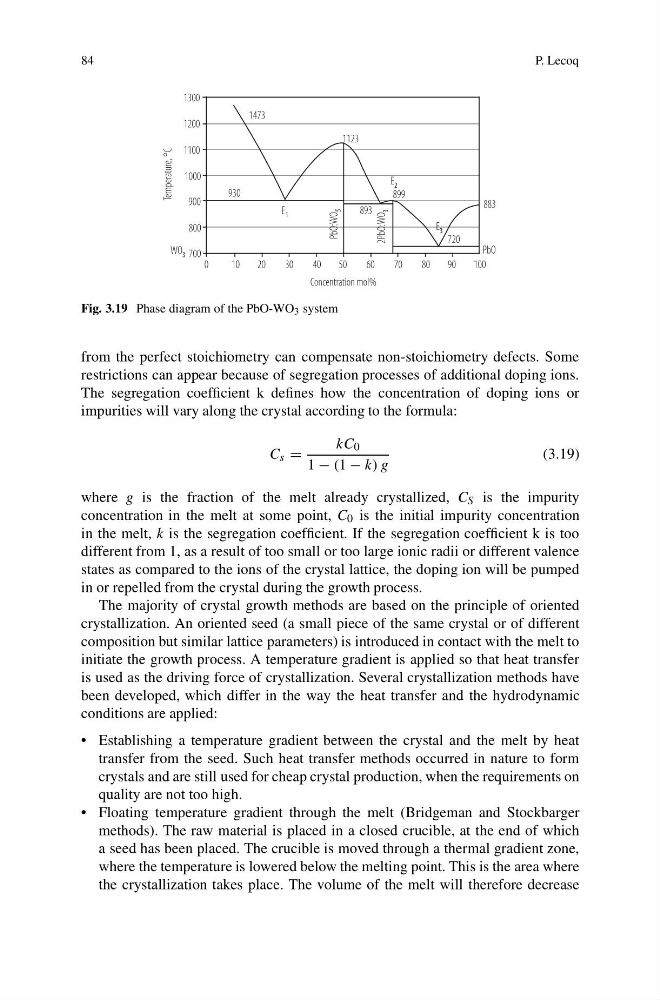
Fig. 3.19 Phase diagram of the PbO-WO 3 system
from the perfect stoichiometry can compensate non-stoichiometry defects. Some
restrictions can appear because of segregation processes of additional doping ions.
The segregation coefficient k defines how the concentration of doping ions or
impurities will vary along the crystal according to the formula:
C s =
kC 0
1 − (1 − k) g
(3.19)
where g is the fraction of the melt already crystallized, C S is the impurity
concentration in the melt at some point, C 0 is the initial impurity concentration
in the melt, k is the segregation coefficient. If the segregation coefficient k is too
different from 1, as a result of too small or too large ionic radii or different valence
states as compared to the ions of the crystal lattice, the doping ion will be pumped
in or repelled from the crystal during the growth process.
The majority of crystal growth methods are based on the principle of oriented
crystallization. An oriented seed (a small piece of the same crystal or of different
composition but similar lattice parameters) is introduced in contact with the melt to
initiate the growth process. A temperature gradient is applied so that heat transfer
is used as the driving force of crystallization. Several crystallization methods have
been developed, which differ in the way the heat transfer and the hydrodynamic
conditions are applied:
• Establishing a temperature gradient between the crystal and the melt by heat
transfer from the seed. Such heat transfer methods occurred in nature to form
crystals and are still used for cheap crystal production, when the requirements on
quality are not too high.
• Floating temperature gradient through the melt (Bridgeman and Stockbarger
methods). The raw material is placed in a closed crucible, at the end of which
a seed has been placed. The crucible is moved through a thermal gradient zone,
where the temperature is lowered below the melting point. This is the area where
the crystallization takes place. The volume of the melt will therefore decrease
P. Lecoq
Fig. 3.19 Phase diagram of the PbO-WO 3 system
from the perfect stoichiometry can compensate non-stoichiometry defects. Some
restrictions can appear because of segregation processes of additional doping ions.
The segregation coefficient k defines how the concentration of doping ions or
impurities will vary along the crystal according to the formula:
C s =
kC 0
1 − (1 − k) g
(3.19)
where g is the fraction of the melt already crystallized, C S is the impurity
concentration in the melt at some point, C 0 is the initial impurity concentration
in the melt, k is the segregation coefficient. If the segregation coefficient k is too
different from 1, as a result of too small or too large ionic radii or different valence
states as compared to the ions of the crystal lattice, the doping ion will be pumped
in or repelled from the crystal during the growth process.
The majority of crystal growth methods are based on the principle of oriented
crystallization. An oriented seed (a small piece of the same crystal or of different
composition but similar lattice parameters) is introduced in contact with the melt to
initiate the growth process. A temperature gradient is applied so that heat transfer
is used as the driving force of crystallization. Several crystallization methods have
been developed, which differ in the way the heat transfer and the hydrodynamic
conditions are applied:
• Establishing a temperature gradient between the crystal and the melt by heat
transfer from the seed. Such heat transfer methods occurred in nature to form
crystals and are still used for cheap crystal production, when the requirements on
quality are not too high.
• Floating temperature gradient through the melt (Bridgeman and Stockbarger
methods). The raw material is placed in a closed crucible, at the end of which
a seed has been placed. The crucible is moved through a thermal gradient zone,
where the temperature is lowered below the melting point. This is the area where
the crystallization takes place. The volume of the melt will therefore decrease