

16 Integration of Detectors into a Large Experiment: Examples from ATLAS. . .
757
Relative resolution
0.05
0.015
0.01
0.005
=
+
+ 0.66%
2
2
2
0
0.045
0.04
0.035
0.03
0.025
0.02
0.015
0.01
0.005
0
0 20 40 60 80 100
20
40
60
80
100
Energy [GeV]
Energy [GeV]
120
ATLAS
CMS Barrel EM calorimeter
E (3×3)/E(5×5) > 0.943
ε γ ≈ 70%
140 160 180 200
eff [E
meas /E
true ]
|η| = 0.3
|η| = 1.1
|η| = 2.0
E
√E
E
σ
3.6%
0.185 GeV 2
[ ] [
]
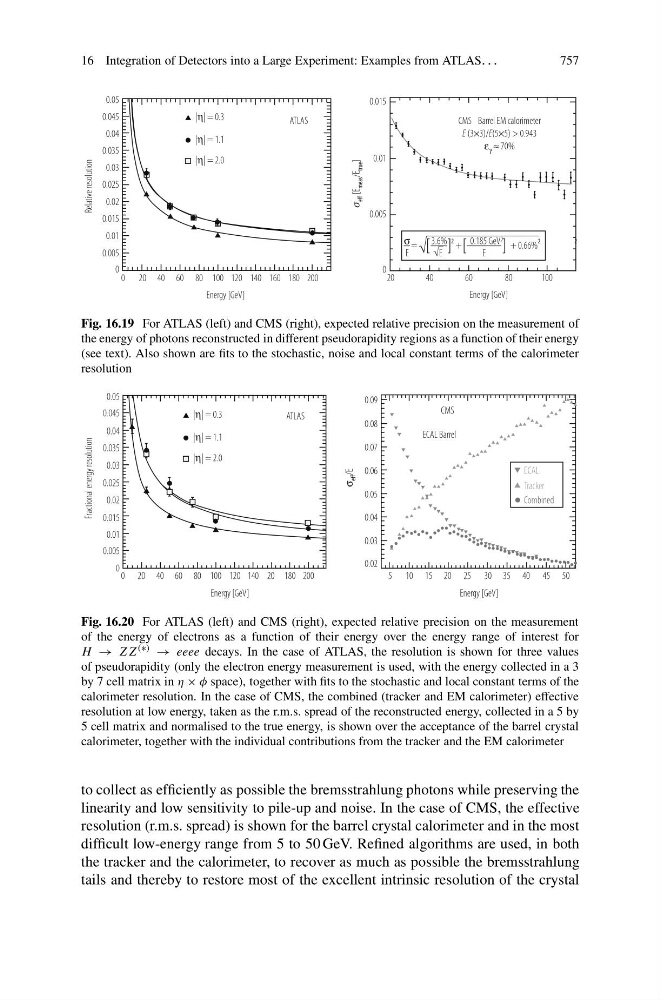
Fig. 16.19 For ATLAS (left) and CMS (right), expected relative precision on the measurement of
the energy of photons reconstructed in different pseudorapidity regions as a function of their energy
(see text). Also shown are fits to the stochastic, noise and local constant terms of the calorimeter
resolution
Fractional energy resolution
0.05
0.045
0.04
0.035
σ
eff /E
0.09
0.08
0.07
0.06
0.05
0.04
0.03
0.02
0.03
0.025
0.02
0.015
0.01
0.005
0
0 20 40 60 80 100 120
Energy [GeV]
Energy [GeV]
140
ATLAS
CMS
20 180 200
5 10 15 20 25 30 35 40 45
Combined
50
|η| = 0.3
|η| = 1.1
|η| = 2.0
ECAL
ECAL Barrel
Tracker
Fig. 16.20 For ATLAS (left) and CMS (right), expected relative precision on the measurement
of the energy of electrons as a function of their energy over the energy range of interest for
H → ZZ (∗) → eeee decays. In the case of ATLAS, the resolution is shown for three values
of pseudorapidity (only the electron energy measurement is used, with the energy collected in a 3
by 7 cell matrix in η × φ space), together with fits to the stochastic and local constant terms of the
calorimeter resolution. In the case of CMS, the combined (tracker and EM calorimeter) effective
resolution at low energy, taken as the r.m.s. spread of the reconstructed energy, collected in a 5 by
5 cell matrix and normalised to the true energy, is shown over the acceptance of the barrel crystal
calorimeter, together with the individual contributions from the tracker and the EM calorimeter
to collect as efficiently as possible the bremsstrahlung photons while preserving the
linearity and low sensitivity to pile-up and noise. In the case of CMS, the effective
resolution (r.m.s. spread) is shown for the barrel crystal calorimeter and in the most
difficult low-energy range from 5 to 50 GeV. Refined algorithms are used, in both
the tracker and the calorimeter, to recover as much as possible the bremsstrahlung
tails and thereby to restore most of the excellent intrinsic resolution of the crystal