

754
D. Froidevaux
both modes of operation will occur, i.e. that there will be data samples, which are
selected and perhaps processed further in an organised manner by large groups of
the collaboration, but also samples created by individuals. The relative fraction of
each will be driven to a large extent by the resources that will be available at any
given time.
The last element of the analysis model is a distributed analysis system which
allows for the remote submission of jobs from any location. This system splits, in
an automated way, an analysis job into a number of smaller jobs that run on subsets
of the input data. The results of the job may be merged to form an output dataset.
Partial results from these jobs are made available to the user before the full set of
jobs runs to completion. Finally, the distributed analysis system will ensure that all
jobs and resulting datasets are properly catalogued for future reference.
16.8 Expected Performance of Installed Detectors
16.8.1 Tracker Performance
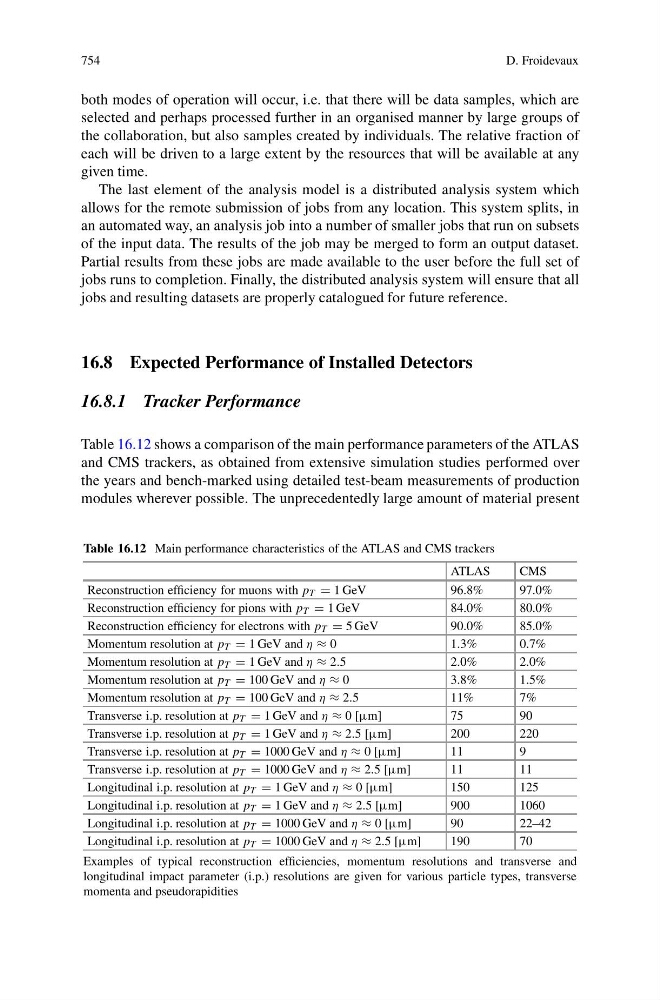
Table 16.12 shows a comparison of the main performance parameters of the ATLAS
and CMS trackers, as obtained from extensive simulation studies performed over
the years and bench-marked using detailed test-beam measurements of production
modules wherever possible. The unprecedentedly large amount of material present
Table 16.12 Main performance characteristics of the ATLAS and CMS trackers
ATLAS
CMS
Reconstruction efficiency for muons with p T = 1 GeV
96.8%
97.0%
Reconstruction efficiency for pions with p T = 1 GeV
84.0%
80.0%
Reconstruction efficiency for electrons with p T = 5 GeV
90.0%
85.0%
Momentum resolution at p T = 1 GeV and η ≈ 0
1.3%
0.7%
Momentum resolution at p T = 1 GeV and η ≈ 2.5
2.0%
2.0%
Momentum resolution at p T = 100 GeV and η ≈ 0
3.8%
1.5%
Momentum resolution at p T = 100 GeV and η ≈ 2.5
11%
7%
Transverse i.p. resolution at p T = 1 GeV and η ≈ 0 [μm]
75
90
Transverse i.p. resolution at p T = 1 GeV and η ≈ 2.5 [μm]
200
220
Transverse i.p. resolution at p T = 1000 GeV and η ≈ 0 [μm]
11
9
Transverse i.p. resolution at p T = 1000 GeV and η ≈ 2.5 [μm]
11
11
Longitudinal i.p. resolution at p T = 1 GeV and η ≈ 0 [μm]
150
125
Longitudinal i.p. resolution at p T = 1 GeV and η ≈ 2.5 [μm]
900
1060
Longitudinal i.p. resolution at p T = 1000 GeV and η ≈ 0 [μm]
90
22–42
Longitudinal i.p. resolution at p T = 1000 GeV and η ≈ 2.5 [μm]
190
70
Examples of typical reconstruction efficiencies, momentum resolutions and transverse and
longitudinal impact parameter (i.p.) resolutions are given for various particle types, transverse
momenta and pseudorapidities