

16 Integration of Detectors into a Large Experiment: Examples from ATLAS. . .
725
–0.1
0.1
–0.05
0.05
ATLAS pixel module before irradiation
ATLAS pixel module after irradiation
1.1·10
15 n eq /cm
2
0
Residual [mm]
σ Rφ = 8 μm
σ Rφ = 10 μm
–0.1
0.1
0
–0.05
0.05
Residual [mm]
Fig. 16.11 Residuals from Rφ measurements of production-grade ATLAS pixel module before
irradiation (left) and after being irradiated with a total equivalent fluence corresponding to about
10 15 neutrons per cm 2 (right), as obtained from test-beam data taken in 2004. The contribution
of the track extrapolation to the width of the residuals is about 5 μm (it should be subtracted in
quadrature from the overall residual widths quoted in the figure to obtain the intrinsic resolution of
the tested module)
LAr electromagnetic
end-cap [EMEC]
LAr electromagnetic
barrel
LAr hadronic
end-cap [HEC]
Tile barrel
Tile extended barrel
LAr forward [FCal]
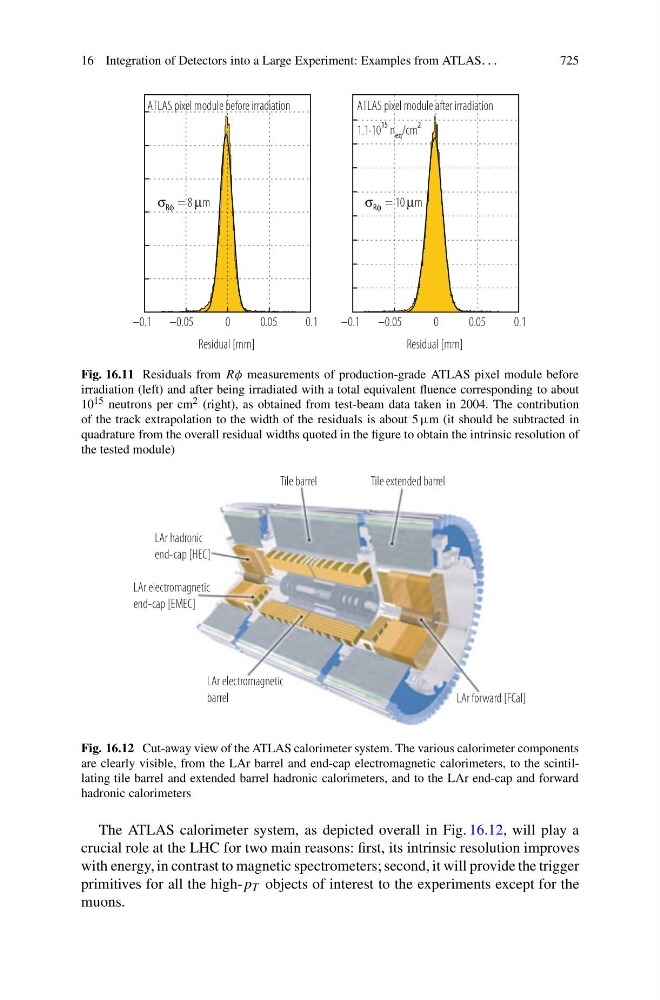
Fig. 16.12 Cut-away view of the ATLAS calorimeter system. The various calorimeter components
are clearly visible, from the LAr barrel and end-cap electromagnetic calorimeters, to the scintillating tile barrel and extended barrel hadronic calorimeters, and to the LAr end-cap and forward
hadronic calorimeters
The ATLAS calorimeter system, as depicted overall in Fig. 16.12, will play a
crucial role at the LHC for two main reasons: first, its intrinsic resolution improves
with energy, in contrast to magnetic spectrometers; second, it will provide the trigger
primitives for all the high-p T objects of interest to the experiments except for the
muons.