

716
D. Froidevaux
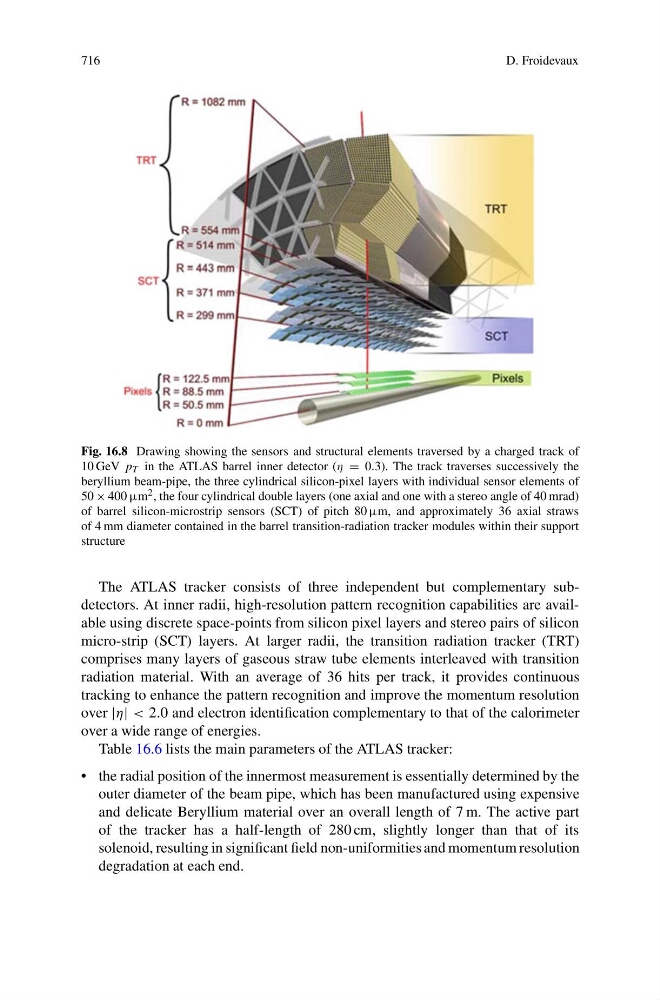
Fig. 16.8 Drawing showing the sensors and structural elements traversed by a charged track of
10 GeV p T in the ATLAS barrel inner detector (η = 0.3). The track traverses successively the
beryllium beam-pipe, the three cylindrical silicon-pixel layers with individual sensor elements of
50 × 400 μm 2 , the four cylindrical double layers (one axial and one with a stereo angle of 40 mrad)
of barrel silicon-microstrip sensors (SCT) of pitch 80 μm, and approximately 36 axial straws
of 4 mm diameter contained in the barrel transition-radiation tracker modules within their support
structure
The ATLAS tracker consists of three independent but complementary subdetectors. At inner radii, high-resolution pattern recognition capabilities are available using discrete space-points from silicon pixel layers and stereo pairs of silicon
micro-strip (SCT) layers. At larger radii, the transition radiation tracker (TRT)
comprises many layers of gaseous straw tube elements interleaved with transition
radiation material. With an average of 36 hits per track, it provides continuous
tracking to enhance the pattern recognition and improve the momentum resolution
over |η| < 2.0 and electron identification complementary to that of the calorimeter
over a wide range of energies.
Table 16.6 lists the main parameters of the ATLAS tracker:
• the radial position of the innermost measurement is essentially determined by the
outer diameter of the beam pipe, which has been manufactured using expensive
and delicate Beryllium material over an overall length of 7 m. The active part
of the tracker has a half-length of 280 cm, slightly longer than that of its
solenoid, resulting in significant field non-uniformities and momentum resolution
degradation at each end.