

700
D. Froidevaux
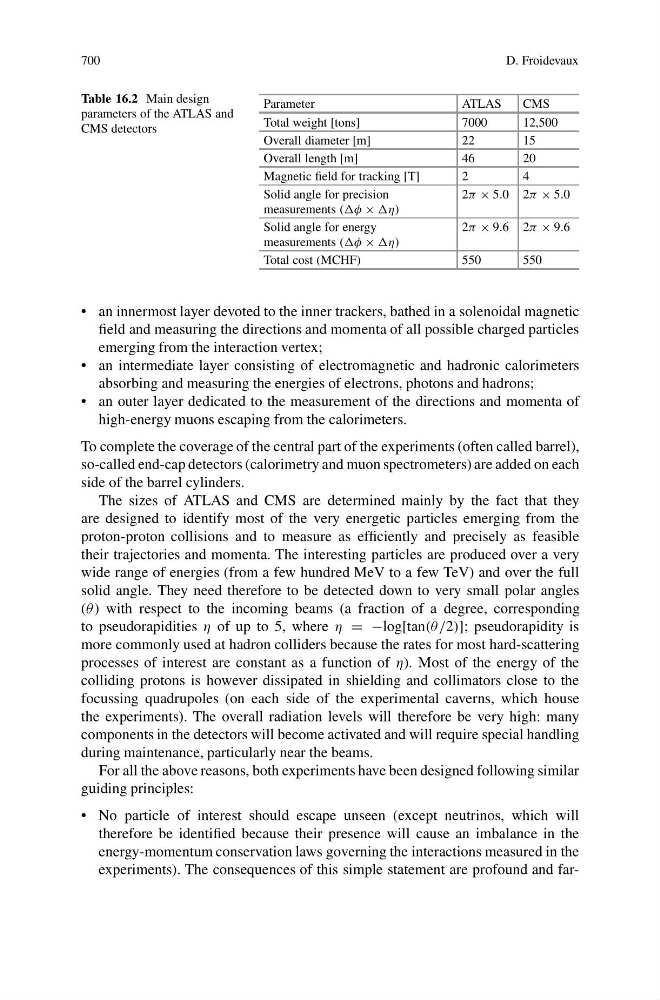
Table 16.2 Main design
parameters of the ATLAS and
CMS detectors
Parameter
ATLAS
CMS
Total weight [tons]
7000
12,500
Overall diameter [m]
22
15
Overall length [m]
46
20
Magnetic field for tracking [T]
2
4
Solid angle for precision
measurements (φ ×
2π × 5.0 2π × 5.0
Solid angle for energy
measurements ( ×
2π × 9.6 2π × 9.6
Total cost (MCHF)
550
550
• an innermost layer devoted to the inner trackers, bathed in a solenoidal magnetic
field and measuring the directions and momenta of all possible charged particles
emerging from the interaction vertex;
• an intermediate layer consisting of electromagnetic and hadronic calorimeters
absorbing and measuring the energies of electrons, photons and hadrons;
• an outer layer dedicated to the measurement of the directions and momenta of
high-energy muons escaping from the calorimeters.
To complete the coverage of the central part of the experiments (often called barrel),
so-called end-cap detectors (calorimetry and muon spectrometers) are added on each
side of the barrel cylinders.
The sizes of ATLAS and CMS are determined mainly by the fact that they
are designed to identify most of the very energetic particles emerging from the
proton-proton collisions and to measure as efficiently and precisely as feasible
their trajectories and momenta. The interesting particles are produced over a very
wide range of energies (from a few hundred MeV to a few TeV) and over the full
solid angle. They need therefore to be detected down to very small polar angles
(θ ) with respect to the incoming beams (a fraction of a degree, corresponding
to pseudorapidities η of up to 5, where η = −log[tan(θ/2)]; pseudorapidity is
more commonly used at hadron colliders because the rates for most hard-scattering
processes of interest are constant as a function of η). Most of the energy of the
colliding protons is however dissipated in shielding and collimators close to the
focussing quadrupoles (on each side of the experimental caverns, which house
the experiments). The overall radiation levels will therefore be very high: many
components in the detectors will become activated and will require special handling
during maintenance, particularly near the beams.
For all the above reasons, both experiments have been designed following similar
guiding principles:
• No particle of interest should escape unseen (except neutrinos, which will
therefore be identified because their presence will cause an imbalance in the
energy-momentum conservation laws governing the interactions measured in the
experiments). The consequences of this simple statement are profound and far-