

664
L. Lyons
6
5
4
3
2
1
0
Mean
μ
–2
–1
0
3
2
1
4
Measured Mean x
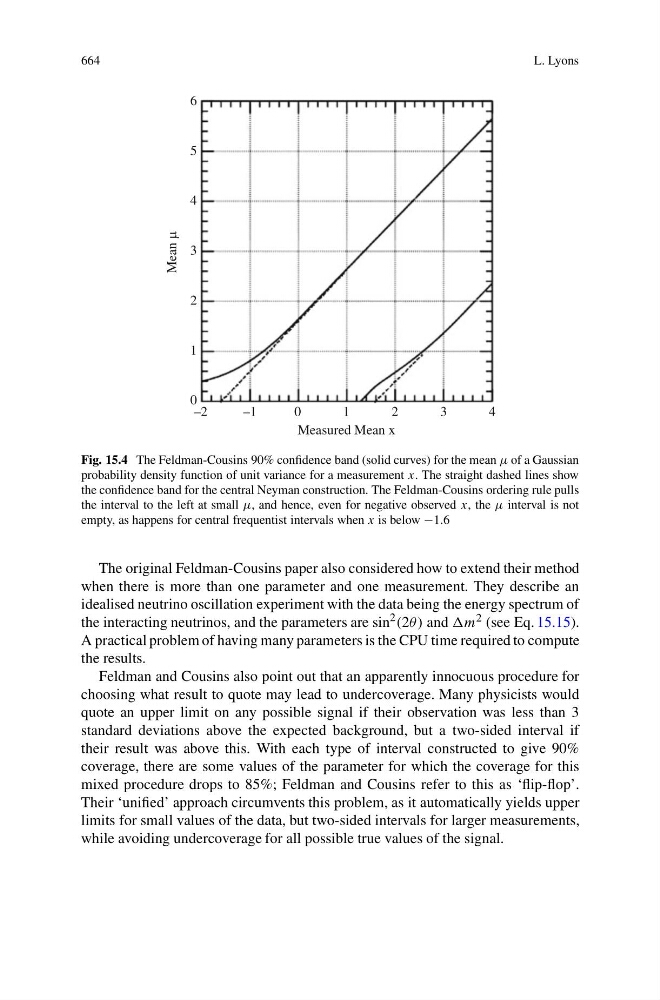
Fig. 15.4 The Feldman-Cousins 90% confidence band (solid curves) for the mean μ of a Gaussian
probability density function of unit variance for a measurement x. The straight dashed lines show
the confidence band for the central Neyman construction. The Feldman-Cousins ordering rule pulls
the interval to the left at small μ, and hence, even for negative observed x, the μ interval is not
empty, as happens for central frequentist intervals when x is below −1.6
The original Feldman-Cousins paper also considered how to extend their method
when there is more than one parameter and one measurement. They describe an
idealised neutrino oscillation experiment with the data being the energy spectrum of
the interacting neutrinos, and the parameters are sin
2 (2θ) and m 2 (see Eq. 15.15).
A practical problem of having many parameters is the CPU time required to compute
the results.
Feldman and Cousins also point out that an apparently innocuous procedure for
choosing what result to quote may lead to undercoverage. Many physicists would
quote an upper limit on any possible signal if their observation was less than 3
standard deviations above the expected background, but a two-sided interval if
their result was above this. With each type of interval constructed to give 90%
coverage, there are some values of the parameter for which the coverage for this
mixed procedure drops to 85%; Feldman and Cousins refer to this as ‘flip-flop’.
Their ‘unified’ approach circumvents this problem, as it automatically yields upper
limits for small values of the data, but two-sided intervals for larger measurements,
while avoiding undercoverage for all possible true values of the signal.