

656
L. Lyons
(a) Low momentum
(b) High momentum
π
K
π
K
TOF
TOF
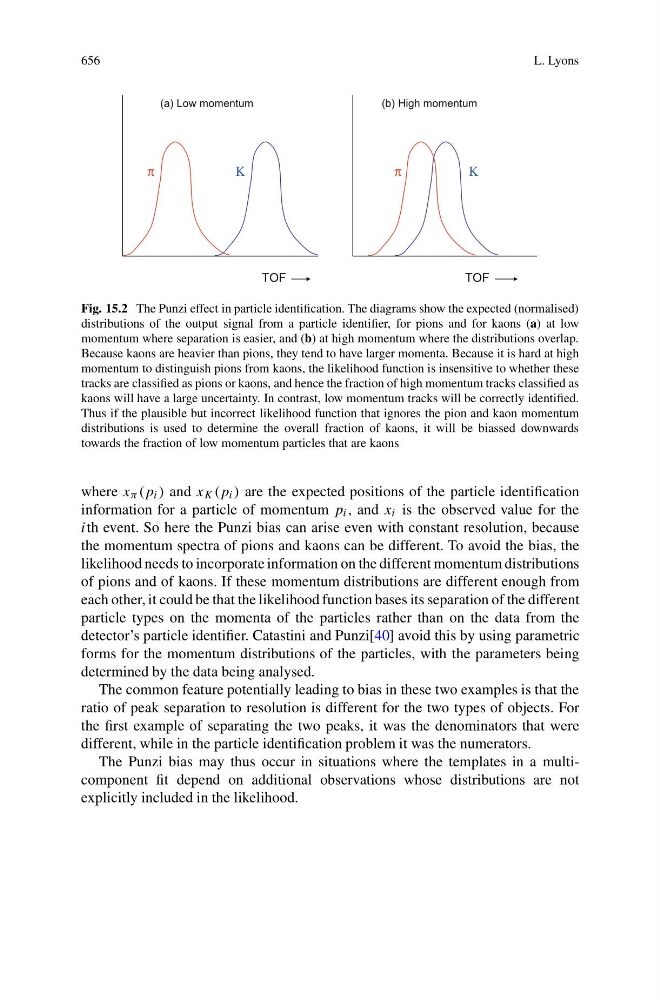
Fig. 15.2 The Punzi effect in particle identification. The diagrams show the expected (normalised)
distributions of the output signal from a particle identifier, for pions and for kaons (a) at low
momentum where separation is easier, and (b) at high momentum where the distributions overlap.
Because kaons are heavier than pions, they tend to have larger momenta. Because it is hard at high
momentum to distinguish pions from kaons, the likelihood function is insensitive to whether these
tracks are classified as pions or kaons, and hence the fraction of high momentum tracks classified as
kaons will have a large uncertainty. In contrast, low momentum tracks will be correctly identified.
Thus if the plausible but incorrect likelihood function that ignores the pion and kaon momentum
distributions is used to determine the overall fraction of kaons, it will be biassed downwards
towards the fraction of low momentum particles that are kaons
where x π (p i ) and x K (p i ) are the expected positions of the particle identification
information for a particle of momentum p i , and x i is the observed value for the
ith event. So here the Punzi bias can arise even with constant resolution, because
the momentum spectra of pions and kaons can be different. To avoid the bias, the
likelihood needs to incorporate information on the different momentum distributions
of pions and of kaons. If these momentum distributions are different enough from
each other, it could be that the likelihood function bases its separation of the different
particle types on the momenta of the particles rather than on the data from the
detector’s particle identifier. Catastini and Punzi[40] avoid this by using parametric
forms for the momentum distributions of the particles, with the parameters being
determined by the data being analysed.
The common feature potentially leading to bias in these two examples is that the
ratio of peak separation to resolution is different for the two types of objects. For
the first example of separating the two peaks, it was the denominators that were
different, while in the particle identification problem it was the numerators.
The Punzi bias may thus occur in situations where the templates in a multicomponent fit depend on additional observations whose distributions are not
explicitly included in the likelihood.