

14 Distributed Computing
617
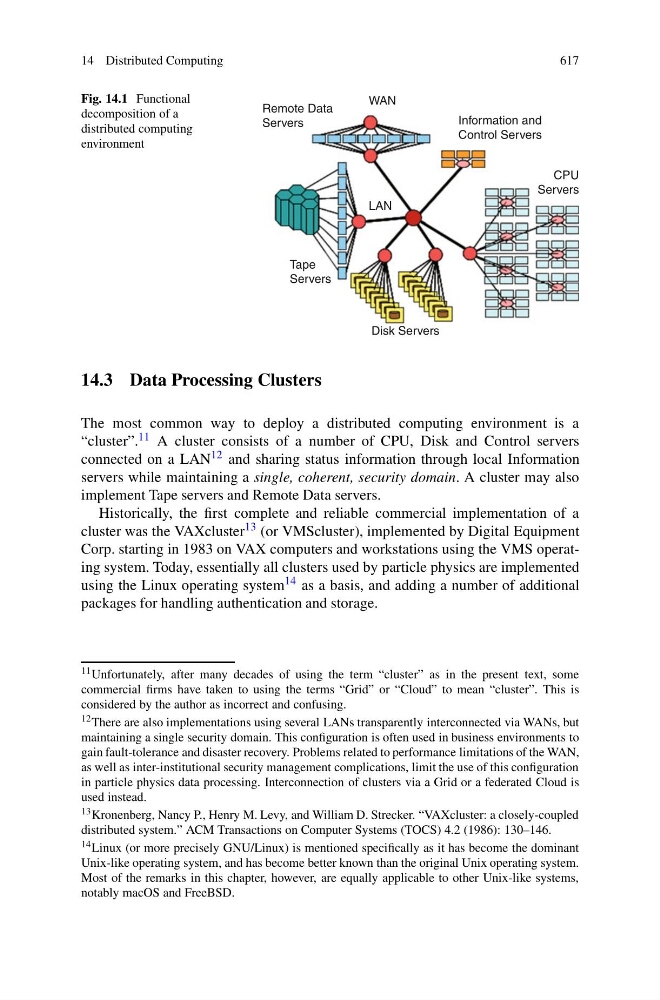
Fig. 14.1 Functional
decomposition of a
distributed computing
environment
Remote Data
Servers
WAN
LAN
Information and
Control Servers
CPU
Servers
Disk Servers
Tape
Servers
14.3 Data Processing Clusters
The most common way to deploy a distributed computing environment is a
“cluster”. 11 A cluster consists of a number of CPU, Disk and Control servers
connected on a LAN 12 and sharing status information through local Information
servers while maintaining a single, coherent, security domain. A cluster may also
implement Tape servers and Remote Data servers.
Historically, the first complete and reliable commercial implementation of a
cluster was the VAXcluster 13 (or VMScluster), implemented by Digital Equipment
Corp. starting in 1983 on VAX computers and workstations using the VMS operating system. Today, essentially all clusters used by particle physics are implemented
using the Linux operating system 14 as a basis, and adding a number of additional
packages for handling authentication and storage.
11 Unfortunately, after many decades of using the term “cluster” as in the present text, some
commercial firms have taken to using the terms “Grid” or “Cloud” to mean “cluster”. This is
considered by the author as incorrect and confusing.
12 There are also implementations using several LANs transparently interconnected via WANs, but
maintaining a single security domain. This configuration is often used in business environments to
gain fault-tolerance and disaster recovery. Problems related to performance limitations of the WAN,
as well as inter-institutional security management complications, limit the use of this configuration
in particle physics data processing. Interconnection of clusters via a Grid or a federated Cloud is
used instead.
13 Kronenberg, Nancy P., Henry M. Levy, and William D. Strecker. “VAXcluster: a closely-coupled
distributed system.” ACM Transactions on Computer Systems (TOCS) 4.2 (1986): 130–146.
14 Linux (or more precisely GNU/Linux) is mentioned specifically as it has become the dominant
Unix-like operating system, and has become better known than the original Unix operating system.
Most of the remarks in this chapter, however, are equally applicable to other Unix-like systems,
notably macOS and FreeBSD.