

13 Pattern Recognition and Reconstruction
605
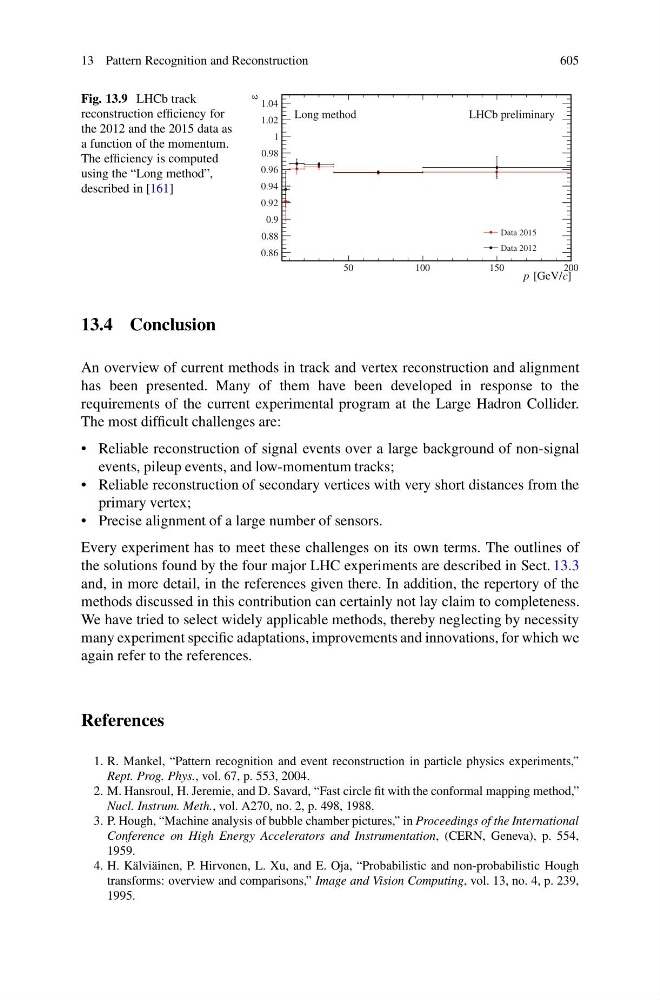
Fig. 13.9 LHCb track
reconstruction efficiency for
the 2012 and the 2015 data as
a function of the momentum.
The efficiency is computed
using the “Long method”,
described in [161]
]
c
[GeV/
p
50
100
150
200
ε
0.86
0.88
0.9
0.92
0.94
0.96
0.98
1
1.02
1.04
LHCb preliminary
Long method
Data 2015
Data 2012
13.4 Conclusion
An overview of current methods in track and vertex reconstruction and alignment
has been presented. Many of them have been developed in response to the
requirements of the current experimental program at the Large Hadron Collider.
The most difficult challenges are:
• Reliable reconstruction of signal events over a large background of non-signal
events, pileup events, and low-momentum tracks;
• Reliable reconstruction of secondary vertices with very short distances from the
primary vertex;
• Precise alignment of a large number of sensors.
Every experiment has to meet these challenges on its own terms. The outlines of
the solutions found by the four major LHC experiments are described in Sect. 13.3
and, in more detail, in the references given there. In addition, the repertory of the
methods discussed in this contribution can certainly not lay claim to completeness.
We have tried to select widely applicable methods, thereby neglecting by necessity
many experiment specific adaptations, improvements and innovations, for which we
again refer to the references.
References
1. R. Mankel, “Pattern recognition and event reconstruction in particle physics experiments,”
Rept. Prog. Phys., vol. 67, p. 553, 2004.
2. M. Hansroul, H. Jeremie, and D. Savard, “Fast circle fit with the conformal mapping method,”
Nucl. Instrum. Meth., vol. A270, no. 2, p. 498, 1988.
3. P. Hough, “Machine analysis of bubble chamber pictures,” in Proceedings of the International
Conference on High Energy Accelerators and Instrumentation, (CERN, Geneva), p. 554,
1959.
4. H. Kälviäinen, P. Hirvonen, L. Xu, and E. Oja, “Probabilistic and non-probabilistic Hough
transforms: overview and comparisons,” Image and Vision Computing, vol. 13, no. 4, p. 239,
1995.