

600
R. Frühwirth et al.
η
2.5
−
2
− 1.5
−
1
− 0.5
−
0 0.5 1 1.5 2 2.5
Track reconstruction efficiency
0.6
0.65
0.7
0.75
0.8
0.85
0.9
0.95
1
Minimum Bias MC
| < 2.5
η
> 500 MeV, |
T
p
1,
≥
sel
n
= 13 TeV
s
ATLAS Simulation Preliminary
[GeV]
T
p
1
10
Track reconstruction efficiency
0.76
0.78
0.8
0.82
0.84
0.86
0.88
0.9
0.92
Minimum Bias MC
| < 2.5
η
> 500 MeV, |
T
p
1,
≥
sel
n
= 13 TeV
s
ATLAS Simulation Preliminary
(a)
η
2.5
−
2
− 1.5
−
1
− 0.5
−
0 0.5 1 1.5 2 2.5
Track reconstruction efficiency
0.6
0.65
0.7
0.75
0.8
0.85
0.9
0.95
1
Minimum Bias MC
| < 2.5
η
> 500 MeV, |
T
p
1,
≥
sel
n
= 13 TeV
s
ATLAS Simulation Preliminary
[GeV]
T
p
1
10
Track reconstruction efficiency
0.76
0.78
0.8
0.82
0.84
0.86
0.88
0.9
0.92
Minimum Bias MC
| < 2.5
η
> 500 MeV, |
T
p
1,
≥
sel
n
= 13 TeV
s
ATLAS Simulation Preliminary
(b)
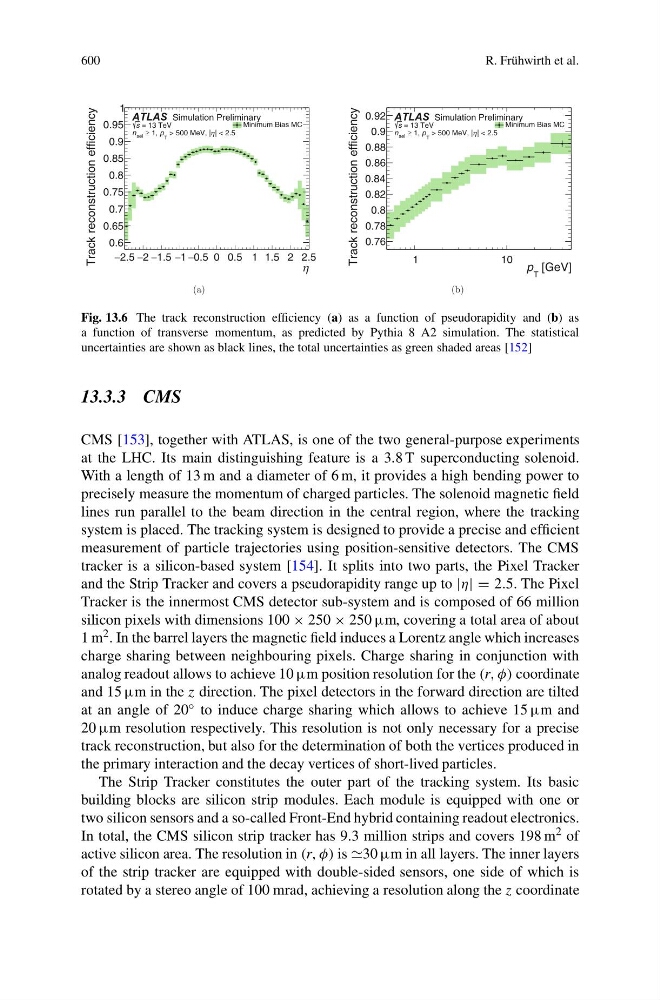
Fig. 13.6 The track reconstruction efficiency (a) as a function of pseudorapidity and (b) as
a function of transverse momentum, as predicted by Pythia 8 A2 simulation. The statistical
uncertainties are shown as black lines, the total uncertainties as green shaded areas [152]
13.3.3 CMS
CMS [153], together with ATLAS, is one of the two general-purpose experiments
at the LHC. Its main distinguishing feature is a 3.8 T superconducting solenoid.
With a length of 13 m and a diameter of 6 m, it provides a high bending power to
precisely measure the momentum of charged particles. The solenoid magnetic field
lines run parallel to the beam direction in the central region, where the tracking
system is placed. The tracking system is designed to provide a precise and efficient
measurement of particle trajectories using position-sensitive detectors. The CMS
tracker is a silicon-based system [154]. It splits into two parts, the Pixel Tracker
and the Strip Tracker and covers a pseudorapidity range up to |η| = 2.5. The Pixel
Tracker is the innermost CMS detector sub-system and is composed of 66 million
silicon pixels with dimensions 100 × 250 × 250 μm, covering a total area of about
1 m 2 . In the barrel layers the magnetic field induces a Lorentz angle which increases
charge sharing between neighbouring pixels. Charge sharing in conjunction with
analog readout allows to achieve 10 μm position resolution for the (r, φ) coordinate
and 15 μm in the z direction. The pixel detectors in the forward direction are tilted
at an angle of 20 ◦ to induce charge sharing which allows to achieve 15 μm and
20 μm resolution respectively. This resolution is not only necessary for a precise
track reconstruction, but also for the determination of both the vertices produced in
the primary interaction and the decay vertices of short-lived particles.
The Strip Tracker constitutes the outer part of the tracking system. Its basic
building blocks are silicon strip modules. Each module is equipped with one or
two silicon sensors and a so-called Front-End hybrid containing readout electronics.
In total, the CMS silicon strip tracker has 9.3 million strips and covers 198 m 2 of
active silicon area. The resolution in (r, φ) is 30 μm in all layers. The inner layers
of the strip tracker are equipped with double-sided sensors, one side of which is
rotated by a stereo angle of 100 mrad, achieving a resolution along the z coordinate
R. Frühwirth et al.
η
2.5
−
2
− 1.5
−
1
− 0.5
−
0 0.5 1 1.5 2 2.5
Track reconstruction efficiency
0.6
0.65
0.7
0.75
0.8
0.85
0.9
0.95
1
Minimum Bias MC
| < 2.5
η
> 500 MeV, |
T
p
1,
≥
sel
n
= 13 TeV
s
ATLAS Simulation Preliminary
[GeV]
T
p
1
10
Track reconstruction efficiency
0.76
0.78
0.8
0.82
0.84
0.86
0.88
0.9
0.92
Minimum Bias MC
| < 2.5
η
> 500 MeV, |
T
p
1,
≥
sel
n
= 13 TeV
s
ATLAS Simulation Preliminary
(a)
η
2.5
−
2
− 1.5
−
1
− 0.5
−
0 0.5 1 1.5 2 2.5
Track reconstruction efficiency
0.6
0.65
0.7
0.75
0.8
0.85
0.9
0.95
1
Minimum Bias MC
| < 2.5
η
> 500 MeV, |
T
p
1,
≥
sel
n
= 13 TeV
s
ATLAS Simulation Preliminary
[GeV]
T
p
1
10
Track reconstruction efficiency
0.76
0.78
0.8
0.82
0.84
0.86
0.88
0.9
0.92
Minimum Bias MC
| < 2.5
η
> 500 MeV, |
T
p
1,
≥
sel
n
= 13 TeV
s
ATLAS Simulation Preliminary
(b)
Fig. 13.6 The track reconstruction efficiency (a) as a function of pseudorapidity and (b) as
a function of transverse momentum, as predicted by Pythia 8 A2 simulation. The statistical
uncertainties are shown as black lines, the total uncertainties as green shaded areas [152]
13.3.3 CMS
CMS [153], together with ATLAS, is one of the two general-purpose experiments
at the LHC. Its main distinguishing feature is a 3.8 T superconducting solenoid.
With a length of 13 m and a diameter of 6 m, it provides a high bending power to
precisely measure the momentum of charged particles. The solenoid magnetic field
lines run parallel to the beam direction in the central region, where the tracking
system is placed. The tracking system is designed to provide a precise and efficient
measurement of particle trajectories using position-sensitive detectors. The CMS
tracker is a silicon-based system [154]. It splits into two parts, the Pixel Tracker
and the Strip Tracker and covers a pseudorapidity range up to |η| = 2.5. The Pixel
Tracker is the innermost CMS detector sub-system and is composed of 66 million
silicon pixels with dimensions 100 × 250 × 250 μm, covering a total area of about
1 m 2 . In the barrel layers the magnetic field induces a Lorentz angle which increases
charge sharing between neighbouring pixels. Charge sharing in conjunction with
analog readout allows to achieve 10 μm position resolution for the (r, φ) coordinate
and 15 μm in the z direction. The pixel detectors in the forward direction are tilted
at an angle of 20 ◦ to induce charge sharing which allows to achieve 15 μm and
20 μm resolution respectively. This resolution is not only necessary for a precise
track reconstruction, but also for the determination of both the vertices produced in
the primary interaction and the decay vertices of short-lived particles.
The Strip Tracker constitutes the outer part of the tracking system. Its basic
building blocks are silicon strip modules. Each module is equipped with one or
two silicon sensors and a so-called Front-End hybrid containing readout electronics.
In total, the CMS silicon strip tracker has 9.3 million strips and covers 198 m 2 of
active silicon area. The resolution in (r, φ) is 30 μm in all layers. The inner layers
of the strip tracker are equipped with double-sided sensors, one side of which is
rotated by a stereo angle of 100 mrad, achieving a resolution along the z coordinate