

592
R. Frühwirth et al.
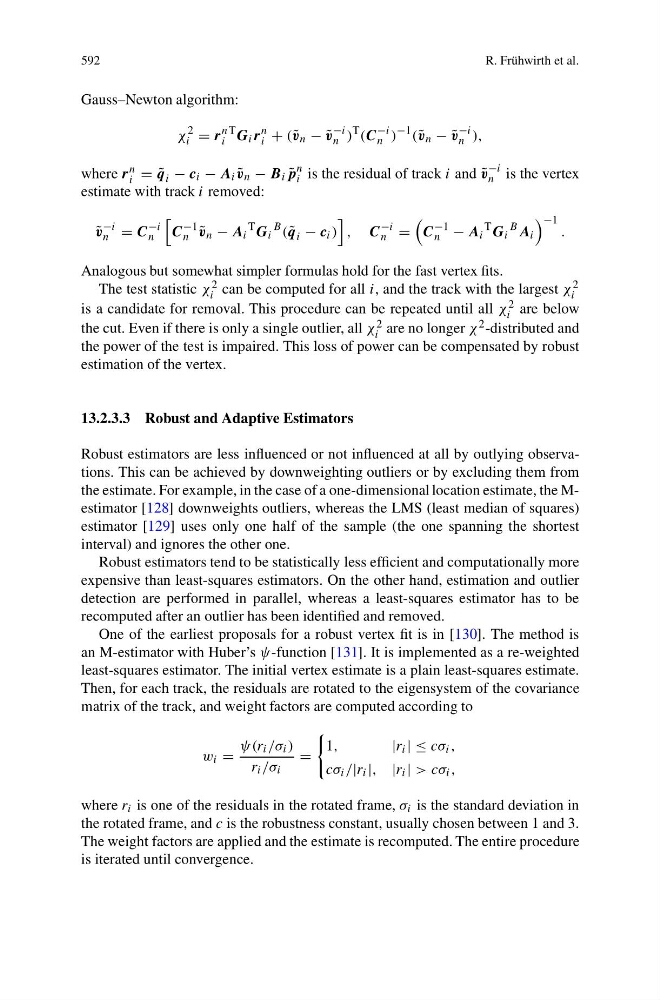
Gauss–Newton algorithm:
χ
2
i = r
n
i
T G i r
n
i + (˜ v n − ˜
v
−i
n )
T (C
−i
n )
−1 (˜ v n − ˜
v
−i
n ),
where r
n
i = ˜
q i − c i − A i ˜
v n − B i ˜
p
n
i is the residual of track i and ˜
v
−i
n is the vertex
estimate with track i removed:
˜
v
−i
n = C
−i
n
C
−1
n ˜
v n − A i
T G i
B ( ˜
q i − c i )
, C
−i
n =
C
−1
n − A i
T G i
B A i
−1
.
Analogous but somewhat simpler formulas hold for the fast vertex fits.
The test statistic χ 2
i can be computed for all i, and the track with the largest χ 2
i
is a candidate for removal. This procedure can be repeated until all χ 2
i are below
the cut. Even if there is only a single outlier, all χ 2
i are no longer χ 2 -distributed and
the power of the test is impaired. This loss of power can be compensated by robust
estimation of the vertex.
13.2.3.3 Robust and Adaptive Estimators
Robust estimators are less influenced or not influenced at all by outlying observations. This can be achieved by downweighting outliers or by excluding them from
the estimate. For example, in the case of a one-dimensional location estimate, the Mestimator [128] downweights outliers, whereas the LMS (least median of squares)
estimator [129] uses only one half of the sample (the one spanning the shortest
interval) and ignores the other one.
Robust estimators tend to be statistically less efficient and computationally more
expensive than least-squares estimators. On the other hand, estimation and outlier
detection are performed in parallel, whereas a least-squares estimator has to be
recomputed after an outlier has been identified and removed.
One of the earliest proposals for a robust vertex fit is in [130]. The method is
an M-estimator with Huber’s ψ-function [131]. It is implemented as a re-weighted
least-squares estimator. The initial vertex estimate is a plain least-squares estimate.
Then, for each track, the residuals are rotated to the eigensystem of the covariance
matrix of the track, and weight factors are computed according to
w i =
ψ(r i /σ i )
r i /σ i
=
1,
|r i | ≤ cσ i ,
cσ i /|r i |, |r i | > cσ i ,
where r i is one of the residuals in the rotated frame, σ i is the standard deviation in
the rotated frame, and c is the robustness constant, usually chosen between 1 and 3.
The weight factors are applied and the estimate is recomputed. The entire procedure
is iterated until convergence.
R. Frühwirth et al.
Gauss–Newton algorithm:
χ
2
i = r
n
i
T G i r
n
i + (˜ v n − ˜
v
−i
n )
T (C
−i
n )
−1 (˜ v n − ˜
v
−i
n ),
where r
n
i = ˜
q i − c i − A i ˜
v n − B i ˜
p
n
i is the residual of track i and ˜
v
−i
n is the vertex
estimate with track i removed:
˜
v
−i
n = C
−i
n
C
−1
n ˜
v n − A i
T G i
B ( ˜
q i − c i )
, C
−i
n =
C
−1
n − A i
T G i
B A i
−1
.
Analogous but somewhat simpler formulas hold for the fast vertex fits.
The test statistic χ 2
i can be computed for all i, and the track with the largest χ 2
i
is a candidate for removal. This procedure can be repeated until all χ 2
i are below
the cut. Even if there is only a single outlier, all χ 2
i are no longer χ 2 -distributed and
the power of the test is impaired. This loss of power can be compensated by robust
estimation of the vertex.
13.2.3.3 Robust and Adaptive Estimators
Robust estimators are less influenced or not influenced at all by outlying observations. This can be achieved by downweighting outliers or by excluding them from
the estimate. For example, in the case of a one-dimensional location estimate, the Mestimator [128] downweights outliers, whereas the LMS (least median of squares)
estimator [129] uses only one half of the sample (the one spanning the shortest
interval) and ignores the other one.
Robust estimators tend to be statistically less efficient and computationally more
expensive than least-squares estimators. On the other hand, estimation and outlier
detection are performed in parallel, whereas a least-squares estimator has to be
recomputed after an outlier has been identified and removed.
One of the earliest proposals for a robust vertex fit is in [130]. The method is
an M-estimator with Huber’s ψ-function [131]. It is implemented as a re-weighted
least-squares estimator. The initial vertex estimate is a plain least-squares estimate.
Then, for each track, the residuals are rotated to the eigensystem of the covariance
matrix of the track, and weight factors are computed according to
w i =
ψ(r i /σ i )
r i /σ i
=
1,
|r i | ≤ cσ i ,
cσ i /|r i |, |r i | > cσ i ,
where r i is one of the residuals in the rotated frame, σ i is the standard deviation in
the rotated frame, and c is the robustness constant, usually chosen between 1 and 3.
The weight factors are applied and the estimate is recomputed. The entire procedure
is iterated until convergence.