

576
R. Frühwirth et al.
13.1.4.1 General Overview
The basis of all track-based alignment algorithms is an extended track model d,
where the measurements m depend not only on the true track-parameters q 0 , but
also on a set of alignment parameters p 0 that describe the effects of sufficiently
small deviations from the ideal geometry:
m = d(q 0 , p 0 ) + γ , cov(γ ) = V .
The stochastic term γ , which describes the intrinsic resolution of the tracking
devices and the effects of multiple scattering, is dealt with via its covariance matrix
V . Since typically high momentum particles are used, energy-loss effects can be
assumed to be deterministic and hence directly taken care of in the track model d
itself.
With an initial guess ˘
q for the track parameters and ˘
p for the alignment
parameters, this model allows to define residuals that are functions of the unknowns
q and p:
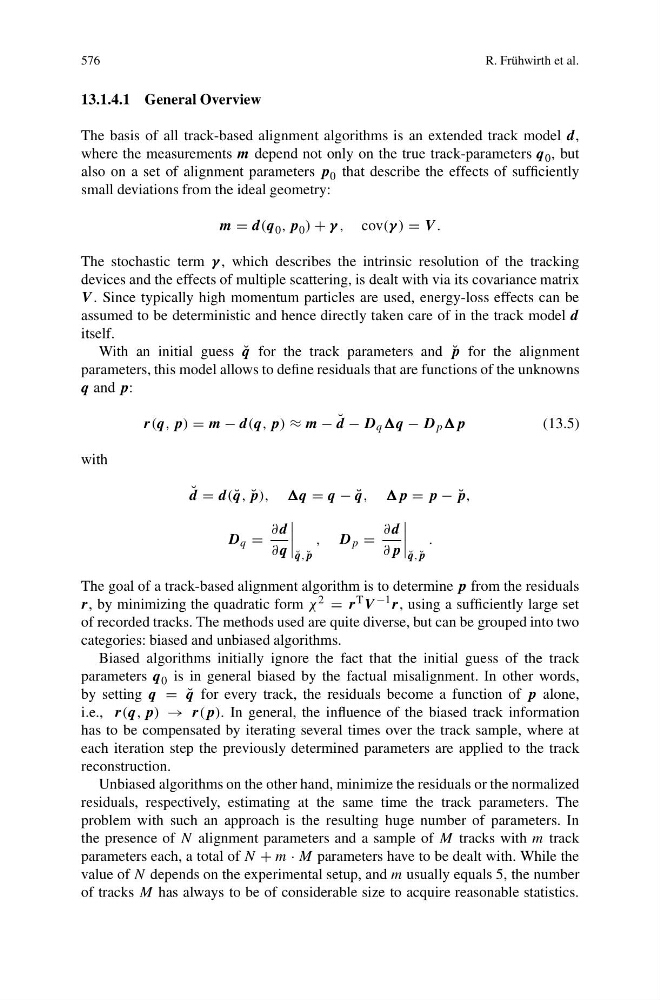
r(q, p) = m − d(q, p) ≈ m − ˘
d − D q − D p p
(13.5)
with
˘
d = d( ˘
q, ˘
p), = q − ˘
q, = p − ˘
p,
D q =
∂d
∂q
˘
q, ˘
p
, D p =
∂d
∂p
˘
q, ˘
p
.
The goal of a track-based alignment algorithm is to determine p from the residuals
r, by minimizing the quadratic form χ 2 = r T V −1 r, using a sufficiently large set
of recorded tracks. The methods used are quite diverse, but can be grouped into two
categories: biased and unbiased algorithms.
Biased algorithms initially ignore the fact that the initial guess of the track
parameters q 0 is in general biased by the factual misalignment. In other words,
by setting q = ˘
q for every track, the residuals become a function of p alone,
i.e., r(q, p) → r(p). In general, the influence of the biased track information
has to be compensated by iterating several times over the track sample, where at
each iteration step the previously determined parameters are applied to the track
reconstruction.
Unbiased algorithms on the other hand, minimize the residuals or the normalized
residuals, respectively, estimating at the same time the track parameters. The
problem with such an approach is the resulting huge number of parameters. In
the presence of N alignment parameters and a sample of M tracks with m track
parameters each, a total of N + m · M parameters have to be dealt with. While the
value of N depends on the experimental setup, and m usually equals 5, the number
of tracks M has always to be of considerable size to acquire reasonable statistics.
R. Frühwirth et al.
13.1.4.1 General Overview
The basis of all track-based alignment algorithms is an extended track model d,
where the measurements m depend not only on the true track-parameters q 0 , but
also on a set of alignment parameters p 0 that describe the effects of sufficiently
small deviations from the ideal geometry:
m = d(q 0 , p 0 ) + γ , cov(γ ) = V .
The stochastic term γ , which describes the intrinsic resolution of the tracking
devices and the effects of multiple scattering, is dealt with via its covariance matrix
V . Since typically high momentum particles are used, energy-loss effects can be
assumed to be deterministic and hence directly taken care of in the track model d
itself.
With an initial guess ˘
q for the track parameters and ˘
p for the alignment
parameters, this model allows to define residuals that are functions of the unknowns
q and p:
r(q, p) = m − d(q, p) ≈ m − ˘
d − D q − D p p
(13.5)
with
˘
d = d( ˘
q, ˘
p), = q − ˘
q, = p − ˘
p,
D q =
∂d
∂q
˘
q, ˘
p
, D p =
∂d
∂p
˘
q, ˘
p
.
The goal of a track-based alignment algorithm is to determine p from the residuals
r, by minimizing the quadratic form χ 2 = r T V −1 r, using a sufficiently large set
of recorded tracks. The methods used are quite diverse, but can be grouped into two
categories: biased and unbiased algorithms.
Biased algorithms initially ignore the fact that the initial guess of the track
parameters q 0 is in general biased by the factual misalignment. In other words,
by setting q = ˘
q for every track, the residuals become a function of p alone,
i.e., r(q, p) → r(p). In general, the influence of the biased track information
has to be compensated by iterating several times over the track sample, where at
each iteration step the previously determined parameters are applied to the track
reconstruction.
Unbiased algorithms on the other hand, minimize the residuals or the normalized
residuals, respectively, estimating at the same time the track parameters. The
problem with such an approach is the resulting huge number of parameters. In
the presence of N alignment parameters and a sample of M tracks with m track
parameters each, a total of N + m · M parameters have to be dealt with. While the
value of N depends on the experimental setup, and m usually equals 5, the number
of tracks M has always to be of considerable size to acquire reasonable statistics.