

574
R. Frühwirth et al.
13.1.3.6 Jet Reconstruction
Jets are bundles of collimated hadrons, reflecting hard scattering processes at
the parton level. In order to carry out detailed comparisons between parton-level
predictions and hadron-level observations a well-defined “jet finder” is required. In
the jet finding information from both the tracking devices and the calorimeters is
used.
Jet finding can be understood as finding clusters in the set of reconstructed tracks,
including neutral tracks. As in the case of vertex finding (see Sect. 13.2.2), various
types of clustering methods have been proposed and investigated. The performance
strongly depends on the underlying physics, and usually a jet finder is optimized for
specific physics requirements. For instance, the widely used k ⊥ clustering algorithm
comes in several versions, for instance one for e + e − collisions [67], and one for
hadron-hadron collisions [68].
Hierarchical cluster algorithms offer a large variety of jet finders, differing
mainly by the definition of the measure of distance between objects (tracks and jets),
but sometimes also by the order in which the objects are combined. Some examples
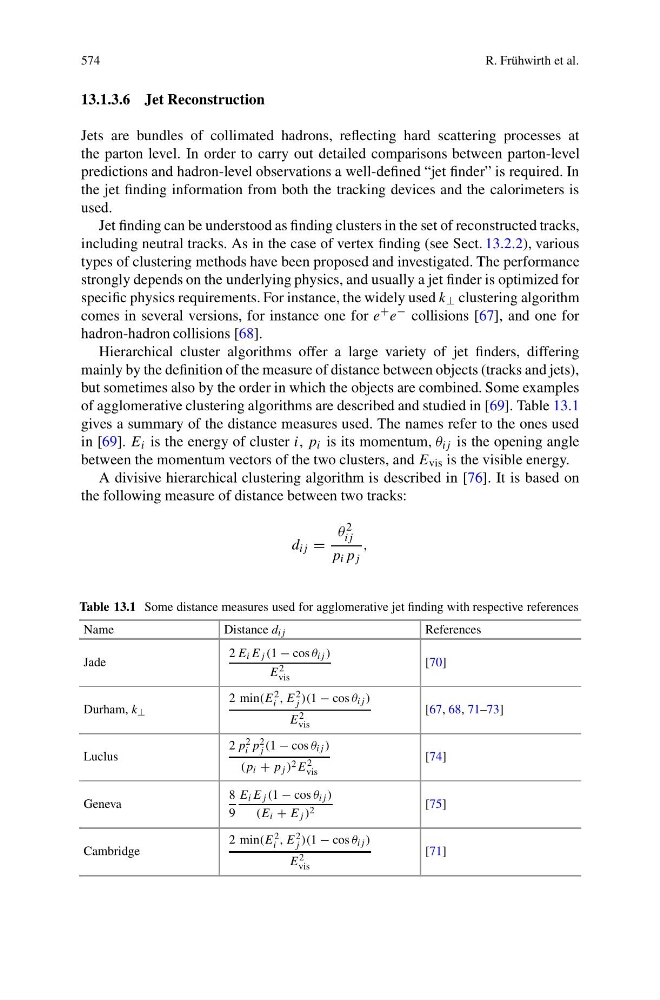
of agglomerative clustering algorithms are described and studied in [69]. Table 13.1
gives a summary of the distance measures used. The names refer to the ones used
in [69]. E i is the energy of cluster i, p i is its momentum, θ ij is the opening angle
between the momentum vectors of the two clusters, and E vis is the visible energy.
A divisive hierarchical clustering algorithm is described in [76]. It is based on
the following measure of distance between two tracks:
d ij =
θ 2
ij
p i p j
,
Table 13.1 Some distance measures used for agglomerative jet finding with respective references
Name
Distance d ij
References
Jade
2 E i E j (1 − cos θ ij )
E 2
vis
[70]
Durham, k ⊥
2 min(E 2
i , E 2
j )(1 − cos θ ij )
E 2
vis
[67, 68, 71–73]
Luclus
2 p 2
i p 2
j (1 − cos θ ij )
(p i + p j ) 2 E 2
vis
[74]
Geneva
8
9
E i E j (1 − cos θ ij )
(E i + E j ) 2
[75]
Cambridge
2 min(E 2
i , E 2
j )(1 − cos θ ij )
E 2
vis
[71]
R. Frühwirth et al.
13.1.3.6 Jet Reconstruction
Jets are bundles of collimated hadrons, reflecting hard scattering processes at
the parton level. In order to carry out detailed comparisons between parton-level
predictions and hadron-level observations a well-defined “jet finder” is required. In
the jet finding information from both the tracking devices and the calorimeters is
used.
Jet finding can be understood as finding clusters in the set of reconstructed tracks,
including neutral tracks. As in the case of vertex finding (see Sect. 13.2.2), various
types of clustering methods have been proposed and investigated. The performance
strongly depends on the underlying physics, and usually a jet finder is optimized for
specific physics requirements. For instance, the widely used k ⊥ clustering algorithm
comes in several versions, for instance one for e + e − collisions [67], and one for
hadron-hadron collisions [68].
Hierarchical cluster algorithms offer a large variety of jet finders, differing
mainly by the definition of the measure of distance between objects (tracks and jets),
but sometimes also by the order in which the objects are combined. Some examples
of agglomerative clustering algorithms are described and studied in [69]. Table 13.1
gives a summary of the distance measures used. The names refer to the ones used
in [69]. E i is the energy of cluster i, p i is its momentum, θ ij is the opening angle
between the momentum vectors of the two clusters, and E vis is the visible energy.
A divisive hierarchical clustering algorithm is described in [76]. It is based on
the following measure of distance between two tracks:
d ij =
θ 2
ij
p i p j
,
Table 13.1 Some distance measures used for agglomerative jet finding with respective references
Name
Distance d ij
References
Jade
2 E i E j (1 − cos θ ij )
E 2
vis
[70]
Durham, k ⊥
2 min(E 2
i , E 2
j )(1 − cos θ ij )
E 2
vis
[67, 68, 71–73]
Luclus
2 p 2
i p 2
j (1 − cos θ ij )
(p i + p j ) 2 E 2
vis
[74]
Geneva
8
9
E i E j (1 − cos θ ij )
(E i + E j ) 2
[75]
Cambridge
2 min(E 2
i , E 2
j )(1 − cos θ ij )
E 2
vis
[71]