

3 Scintillation Detectors for Charged Particles and Photons
49
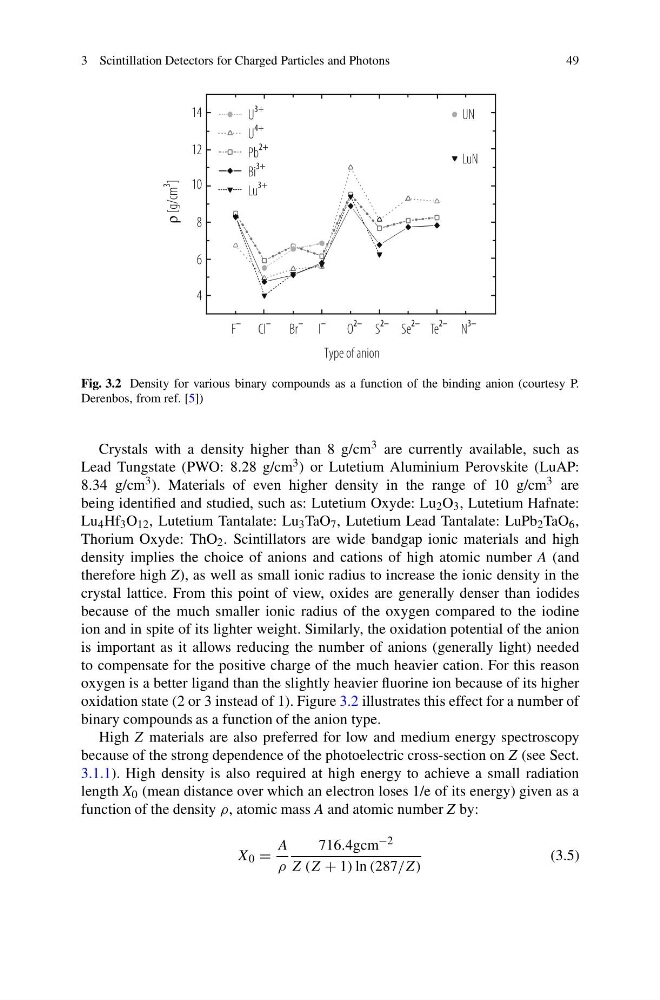
Fig. 3.2 Density for various binary compounds as a function of the binding anion (courtesy P.
Derenbos, from ref. [5])
Crystals with a density higher than 8 g/cm 3 are currently available, such as
Lead Tungstate (PWO: 8.28 g/cm 3 ) or Lutetium Aluminium Perovskite (LuAP:
8.34 g/cm 3 ). Materials of even higher density in the range of 10 g/cm 3 are
being identified and studied, such as: Lutetium Oxyde: Lu 2 O 3 , Lutetium Hafnate:
Lu 4 Hf 3 O 12 , Lutetium Tantalate: Lu 3 TaO 7 , Lutetium Lead Tantalate: LuPb 2 TaO 6 ,
Thorium Oxyde: ThO 2 . Scintillators are wide bandgap ionic materials and high
density implies the choice of anions and cations of high atomic number A (and
therefore high Z), as well as small ionic radius to increase the ionic density in the
crystal lattice. From this point of view, oxides are generally denser than iodides
because of the much smaller ionic radius of the oxygen compared to the iodine
ion and in spite of its lighter weight. Similarly, the oxidation potential of the anion
is important as it allows reducing the number of anions (generally light) needed
to compensate for the positive charge of the much heavier cation. For this reason
oxygen is a better ligand than the slightly heavier fluorine ion because of its higher
oxidation state (2 or 3 instead of 1). Figure 3.2 illustrates this effect for a number of
binary compounds as a function of the anion type.
High Z materials are also preferred for low and medium energy spectroscopy
because of the strong dependence of the photoelectric cross-section on Z (see Sect.
3.1.1). High density is also required at high energy to achieve a small radiation
length X 0 (mean distance over which an electron loses 1/e of its energy) given as a
function of the density ρ, atomic mass A and atomic number Z by:
X 0 =
A
ρ
716.4gcm −2
Z (Z + 1) ln (287/Z)
(3.5)
49
Fig. 3.2 Density for various binary compounds as a function of the binding anion (courtesy P.
Derenbos, from ref. [5])
Crystals with a density higher than 8 g/cm 3 are currently available, such as
Lead Tungstate (PWO: 8.28 g/cm 3 ) or Lutetium Aluminium Perovskite (LuAP:
8.34 g/cm 3 ). Materials of even higher density in the range of 10 g/cm 3 are
being identified and studied, such as: Lutetium Oxyde: Lu 2 O 3 , Lutetium Hafnate:
Lu 4 Hf 3 O 12 , Lutetium Tantalate: Lu 3 TaO 7 , Lutetium Lead Tantalate: LuPb 2 TaO 6 ,
Thorium Oxyde: ThO 2 . Scintillators are wide bandgap ionic materials and high
density implies the choice of anions and cations of high atomic number A (and
therefore high Z), as well as small ionic radius to increase the ionic density in the
crystal lattice. From this point of view, oxides are generally denser than iodides
because of the much smaller ionic radius of the oxygen compared to the iodine
ion and in spite of its lighter weight. Similarly, the oxidation potential of the anion
is important as it allows reducing the number of anions (generally light) needed
to compensate for the positive charge of the much heavier cation. For this reason
oxygen is a better ligand than the slightly heavier fluorine ion because of its higher
oxidation state (2 or 3 instead of 1). Figure 3.2 illustrates this effect for a number of
binary compounds as a function of the anion type.
High Z materials are also preferred for low and medium energy spectroscopy
because of the strong dependence of the photoelectric cross-section on Z (see Sect.
3.1.1). High density is also required at high energy to achieve a small radiation
length X 0 (mean distance over which an electron loses 1/e of its energy) given as a
function of the density ρ, atomic mass A and atomic number Z by:
X 0 =
A
ρ
716.4gcm −2
Z (Z + 1) ln (287/Z)
(3.5)