

13 Pattern Recognition and Reconstruction
565
In most cases the function h k (q k ) includes a transformation of the state vector
q k into the local coordinate system of the detector. For use in track reconstruction,
the Jacobian of this transformation is needed:
H k =
∂m k
∂q k
˘
q k
,
(13.3)
where ˘
q k is the expansion point in surface k. In many cases the Jacobian contains
only rotations and projections, and thus can be computed analytically.
The measurement is always smeared by a measurement error:
m k = h k (q k ) + ε k .
The mean value and the covariance matrix of ε k depend on the detector type
and the detector geometry and have therefore in general to be calibrated for each
detector unit independently. The measurement error is often assumed to follow a
Gaussian distribution, but frequently exhibits tails which are incompatible with this
assumption. In this case a Gaussian mixture is a more appropriate model.
13.1.3.3 Material Effects
A charged particle crossing a tracking detector interacts with the material of
the detector. The most important types of interactions in track reconstruction
are multiple Coulomb scattering, energy loss by ionization, and energy loss by
bremsstrahlung. For an in-depth treatment of material effects see Chapter 2.
Multiple Coulomb Scattering
Elastic Coulomb scattering of particles heavier than the electron is dominated by
the atomic nucleus. For small angles the differential cross-section is approximately
equal to
dσ
dθ
= 2π
2Ze 2
pv
2 1
θ 3 ,
where θ is the polar angle of the scattering, Z is the charge of the nucleus in units
of the elementary charge e, v is the velocity of the scattered particle, and p is its
momentum [42]. Because of screening effects and the finite size of the nucleus the
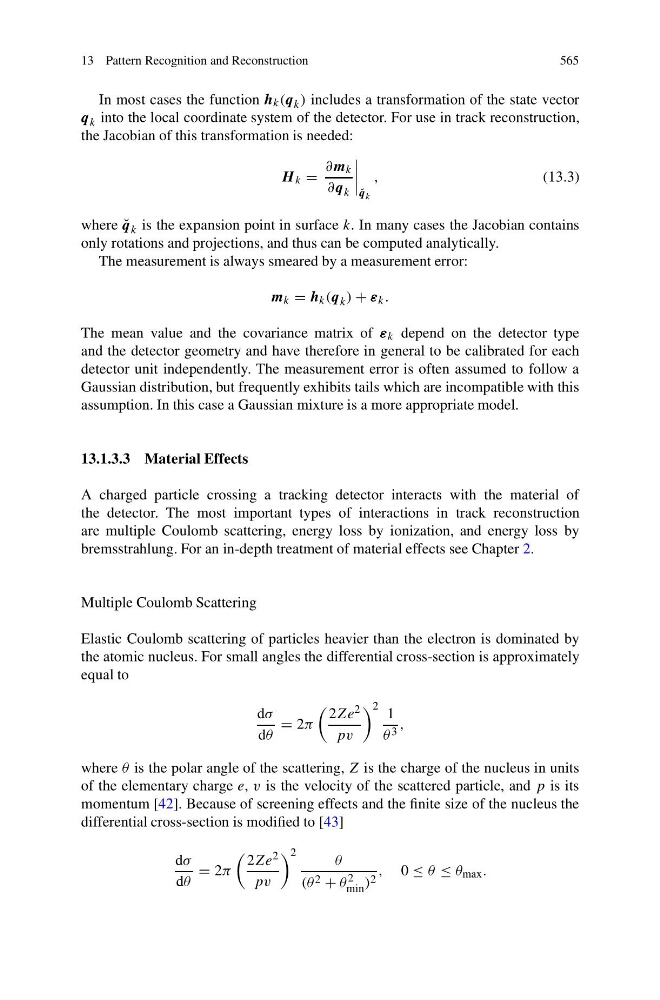
differential cross-section is modified to [43]
dσ
dθ
= 2π
2Ze 2
pv
2
θ
(θ 2 + θ 2
min ) 2
, 0 ≤ θ ≤ θ max .
565
In most cases the function h k (q k ) includes a transformation of the state vector
q k into the local coordinate system of the detector. For use in track reconstruction,
the Jacobian of this transformation is needed:
H k =
∂m k
∂q k
˘
q k
,
(13.3)
where ˘
q k is the expansion point in surface k. In many cases the Jacobian contains
only rotations and projections, and thus can be computed analytically.
The measurement is always smeared by a measurement error:
m k = h k (q k ) + ε k .
The mean value and the covariance matrix of ε k depend on the detector type
and the detector geometry and have therefore in general to be calibrated for each
detector unit independently. The measurement error is often assumed to follow a
Gaussian distribution, but frequently exhibits tails which are incompatible with this
assumption. In this case a Gaussian mixture is a more appropriate model.
13.1.3.3 Material Effects
A charged particle crossing a tracking detector interacts with the material of
the detector. The most important types of interactions in track reconstruction
are multiple Coulomb scattering, energy loss by ionization, and energy loss by
bremsstrahlung. For an in-depth treatment of material effects see Chapter 2.
Multiple Coulomb Scattering
Elastic Coulomb scattering of particles heavier than the electron is dominated by
the atomic nucleus. For small angles the differential cross-section is approximately
equal to
dσ
dθ
= 2π
2Ze 2
pv
2 1
θ 3 ,
where θ is the polar angle of the scattering, Z is the charge of the nucleus in units
of the elementary charge e, v is the velocity of the scattered particle, and p is its
momentum [42]. Because of screening effects and the finite size of the nucleus the
differential cross-section is modified to [43]
dσ
dθ
= 2π
2Ze 2
pv
2
θ
(θ 2 + θ 2
min ) 2
, 0 ≤ θ ≤ θ max .