

13 Pattern Recognition and Reconstruction
559
For track finding in drift tubes, with their inherent left-right ambiguity, the drift
circles can be transformed to sine curves in the (r, θ ) space by applying a Legendre
transform [5]. The peaks at the intersections of several sine curves represent the
common tangents to a set of several circles.
Neural Networks
Recurrent neural networks of the Hopfield type [6] are used in finding solutions
to certain kinds of combinatorial optimization problems, i.e., problems that can be
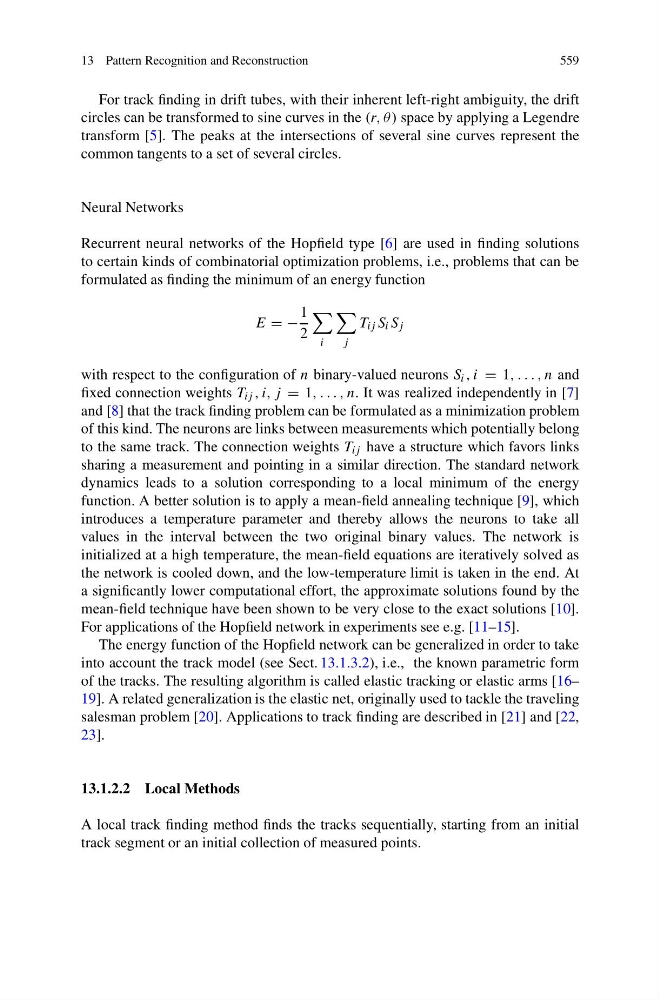
formulated as finding the minimum of an energy function
E = −
1
2
i
j
T ij S i S j
with respect to the configuration of n binary-valued neurons S i , i = 1, . . . , n and
fixed connection weights T ij , i, j = 1, . . . , n. It was realized independently in [7]
and [8] that the track finding problem can be formulated as a minimization problem
of this kind. The neurons are links between measurements which potentially belong
to the same track. The connection weights T ij have a structure which favors links
sharing a measurement and pointing in a similar direction. The standard network
dynamics leads to a solution corresponding to a local minimum of the energy
function. A better solution is to apply a mean-field annealing technique [9], which
introduces a temperature parameter and thereby allows the neurons to take all
values in the interval between the two original binary values. The network is
initialized at a high temperature, the mean-field equations are iteratively solved as
the network is cooled down, and the low-temperature limit is taken in the end. At
a significantly lower computational effort, the approximate solutions found by the
mean-field technique have been shown to be very close to the exact solutions [10].
For applications of the Hopfield network in experiments see e.g. [11–15].
The energy function of the Hopfield network can be generalized in order to take
into account the track model (see Sect. 13.1.3.2), i.e., the known parametric form
of the tracks. The resulting algorithm is called elastic tracking or elastic arms [16–
19]. A related generalization is the elastic net, originally used to tackle the traveling
salesman problem [20]. Applications to track finding are described in [21] and [22,
23].
13.1.2.2 Local Methods
A local track finding method finds the tracks sequentially, starting from an initial
track segment or an initial collection of measured points.
559
For track finding in drift tubes, with their inherent left-right ambiguity, the drift
circles can be transformed to sine curves in the (r, θ ) space by applying a Legendre
transform [5]. The peaks at the intersections of several sine curves represent the
common tangents to a set of several circles.
Neural Networks
Recurrent neural networks of the Hopfield type [6] are used in finding solutions
to certain kinds of combinatorial optimization problems, i.e., problems that can be
formulated as finding the minimum of an energy function
E = −
1
2
i
j
T ij S i S j
with respect to the configuration of n binary-valued neurons S i , i = 1, . . . , n and
fixed connection weights T ij , i, j = 1, . . . , n. It was realized independently in [7]
and [8] that the track finding problem can be formulated as a minimization problem
of this kind. The neurons are links between measurements which potentially belong
to the same track. The connection weights T ij have a structure which favors links
sharing a measurement and pointing in a similar direction. The standard network
dynamics leads to a solution corresponding to a local minimum of the energy
function. A better solution is to apply a mean-field annealing technique [9], which
introduces a temperature parameter and thereby allows the neurons to take all
values in the interval between the two original binary values. The network is
initialized at a high temperature, the mean-field equations are iteratively solved as
the network is cooled down, and the low-temperature limit is taken in the end. At
a significantly lower computational effort, the approximate solutions found by the
mean-field technique have been shown to be very close to the exact solutions [10].
For applications of the Hopfield network in experiments see e.g. [11–15].
The energy function of the Hopfield network can be generalized in order to take
into account the track model (see Sect. 13.1.3.2), i.e., the known parametric form
of the tracks. The resulting algorithm is called elastic tracking or elastic arms [16–
19]. A related generalization is the elastic net, originally used to tackle the traveling
salesman problem [20]. Applications to track finding are described in [21] and [22,
23].
13.1.2.2 Local Methods
A local track finding method finds the tracks sequentially, starting from an initial
track segment or an initial collection of measured points.