

11 Detector Simulation
507
order to achieve the required computing time per event, while influencing the most
important results as little as possible.
The simulation time for each particle type is proportional to the number of steps,
and typically the energy of a particle (so long as it does not escape the setup).
The large number of electron and gamma particles in an EM or hadronic shower
necessitates that these tracks are key to reducing the computation time. For this,
either the treatment of each track must be simplified, or the average track length
must be greatly reduced, or the number of particles tracked must be reduced. The
use of a tracking cut reduces the average track length, and the use of a production
threshold reduces the number of tracks simulated.
A number of methods are widely practiced to reduce the computing time by
simulating only the more important particles: to generate only particles whose
energy is above a threshold energy (production threshold); to kill tracks once they
fall below an energy threshold (tracking cut), or to treat neutrons via their average
cross section (multi-group).
In other setups the interest is to estimate the fraction of particles passing through
or around a shielding barrier, which e.g. could stop all but one particle in a million.
In such cases, a method to speed up the simulation is needed. To estimate the flux of
particles passing through such a barrier the transport mechanics must be changed.
Most changes will favor paths which have already crossed part of the barrier or
are likelier to cross—e.g. because they have higher energy [105]. There are many
methods to achieve this, all of which assign a weight to a particle track. Most involve
the creation of extra copies of tracks or the killing of tracks. Some of the most
common are importance biasing; leading particle biasing and weight window.
Importance biasing involves separating the geometry into regions of high and low
numerical importance. At the boundary between such regions particles that go from
low importance to high importance are enhanced in number (splitting), and their
weight is reduced in proportion. Particles moving in the opposite sense are reduced
in number (Russian roulette) and each one’s weight is increased.
Leading particle biasing involves sampling the results of an interaction, favoring
particles that have the highest energy (and most chance to penetrate) while sampling
other particles in a representative way. In all cases surviving particles from
populations, which are suppressed, are given higher weight in proportion to the
difficulty of survival. On the other hand, enhanced particles (where two particle
tracks are created from a single one) are given reduced weight. A single event can
be split into a large number of ‘histories’, trial tracks that carry a different weight.
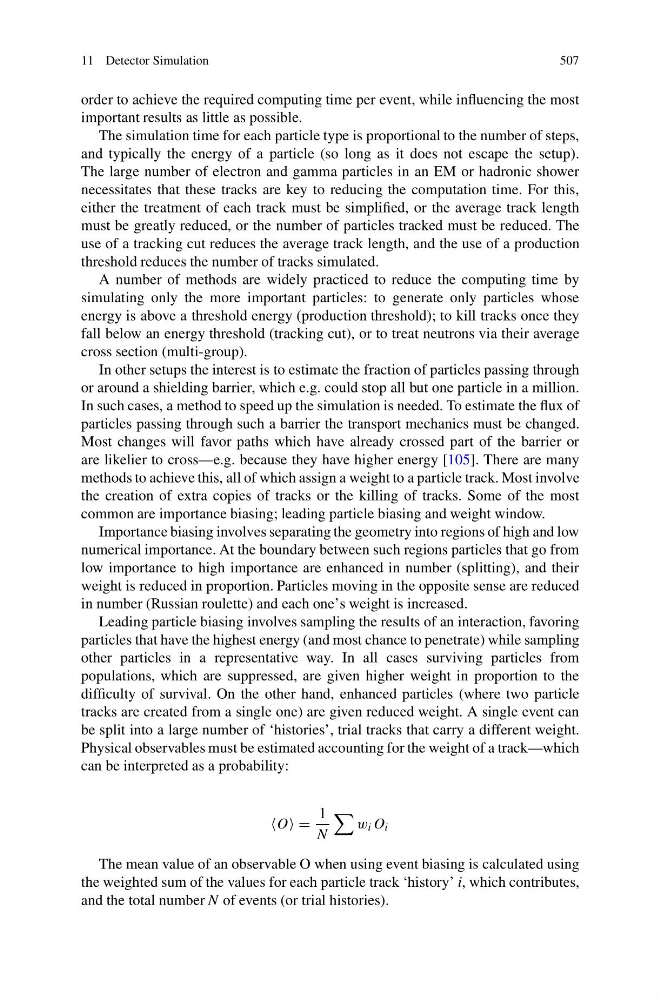
Physical observables must be estimated accounting for the weight of a track—which
can be interpreted as a probability:
O =
1
N
w i O i
The mean value of an observable O when using event biasing is calculated using
the weighted sum of the values for each particle track ‘history’ i, which contributes,
and the total number N of events (or trial histories).
507
order to achieve the required computing time per event, while influencing the most
important results as little as possible.
The simulation time for each particle type is proportional to the number of steps,
and typically the energy of a particle (so long as it does not escape the setup).
The large number of electron and gamma particles in an EM or hadronic shower
necessitates that these tracks are key to reducing the computation time. For this,
either the treatment of each track must be simplified, or the average track length
must be greatly reduced, or the number of particles tracked must be reduced. The
use of a tracking cut reduces the average track length, and the use of a production
threshold reduces the number of tracks simulated.
A number of methods are widely practiced to reduce the computing time by
simulating only the more important particles: to generate only particles whose
energy is above a threshold energy (production threshold); to kill tracks once they
fall below an energy threshold (tracking cut), or to treat neutrons via their average
cross section (multi-group).
In other setups the interest is to estimate the fraction of particles passing through
or around a shielding barrier, which e.g. could stop all but one particle in a million.
In such cases, a method to speed up the simulation is needed. To estimate the flux of
particles passing through such a barrier the transport mechanics must be changed.
Most changes will favor paths which have already crossed part of the barrier or
are likelier to cross—e.g. because they have higher energy [105]. There are many
methods to achieve this, all of which assign a weight to a particle track. Most involve
the creation of extra copies of tracks or the killing of tracks. Some of the most
common are importance biasing; leading particle biasing and weight window.
Importance biasing involves separating the geometry into regions of high and low
numerical importance. At the boundary between such regions particles that go from
low importance to high importance are enhanced in number (splitting), and their
weight is reduced in proportion. Particles moving in the opposite sense are reduced
in number (Russian roulette) and each one’s weight is increased.
Leading particle biasing involves sampling the results of an interaction, favoring
particles that have the highest energy (and most chance to penetrate) while sampling
other particles in a representative way. In all cases surviving particles from
populations, which are suppressed, are given higher weight in proportion to the
difficulty of survival. On the other hand, enhanced particles (where two particle
tracks are created from a single one) are given reduced weight. A single event can
be split into a large number of ‘histories’, trial tracks that carry a different weight.
Physical observables must be estimated accounting for the weight of a track—which
can be interpreted as a probability:
O =
1
N
w i O i
The mean value of an observable O when using event biasing is calculated using
the weighted sum of the values for each particle track ‘history’ i, which contributes,
and the total number N of events (or trial histories).