

504
J. Apostolakis
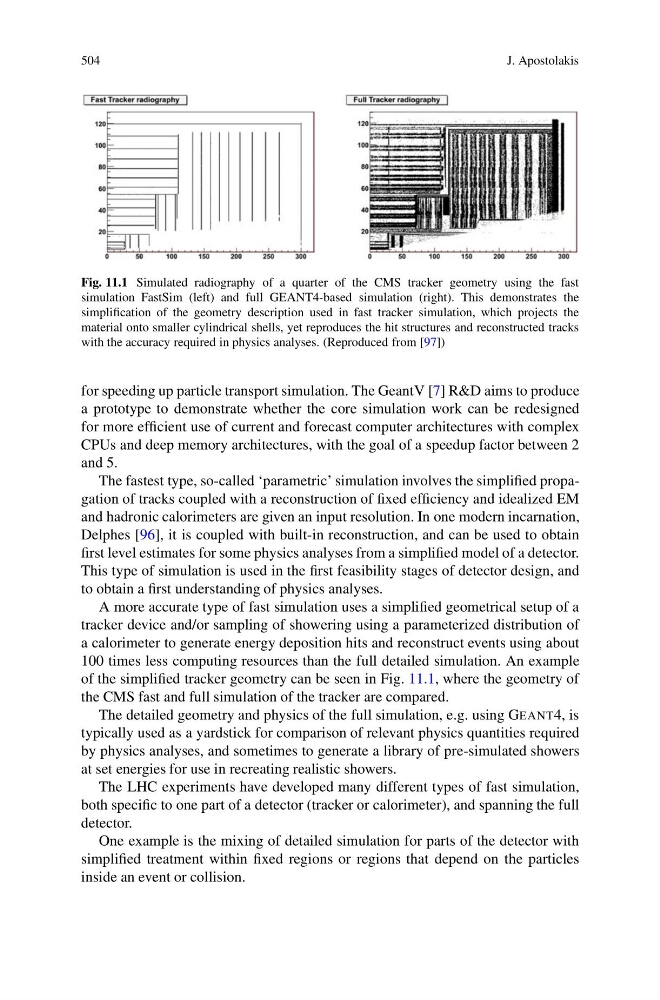
Fig. 11.1 Simulated radiography of a quarter of the CMS tracker geometry using the fast
simulation FastSim (left) and full GEANT4-based simulation (right). This demonstrates the
simplification of the geometry description used in fast tracker simulation, which projects the
material onto smaller cylindrical shells, yet reproduces the hit structures and reconstructed tracks
with the accuracy required in physics analyses. (Reproduced from [97])
for speeding up particle transport simulation. The GeantV [7] R&D aims to produce
a prototype to demonstrate whether the core simulation work can be redesigned
for more efficient use of current and forecast computer architectures with complex
CPUs and deep memory architectures, with the goal of a speedup factor between 2
and 5.
The fastest type, so-called ‘parametric’ simulation involves the simplified propagation of tracks coupled with a reconstruction of fixed efficiency and idealized EM
and hadronic calorimeters are given an input resolution. In one modern incarnation,
Delphes [96], it is coupled with built-in reconstruction, and can be used to obtain
first level estimates for some physics analyses from a simplified model of a detector.
This type of simulation is used in the first feasibility stages of detector design, and
to obtain a first understanding of physics analyses.
A more accurate type of fast simulation uses a simplified geometrical setup of a
tracker device and/or sampling of showering using a parameterized distribution of
a calorimeter to generate energy deposition hits and reconstruct events using about
100 times less computing resources than the full detailed simulation. An example
of the simplified tracker geometry can be seen in Fig. 11.1, where the geometry of
the CMS fast and full simulation of the tracker are compared.
The detailed geometry and physics of the full simulation, e.g. using GEANT4, is
typically used as a yardstick for comparison of relevant physics quantities required
by physics analyses, and sometimes to generate a library of pre-simulated showers
at set energies for use in recreating realistic showers.
The LHC experiments have developed many different types of fast simulation,
both specific to one part of a detector (tracker or calorimeter), and spanning the full
detector.
One example is the mixing of detailed simulation for parts of the detector with
simplified treatment within fixed regions or regions that depend on the particles
inside an event or collision.
J. Apostolakis
Fig. 11.1 Simulated radiography of a quarter of the CMS tracker geometry using the fast
simulation FastSim (left) and full GEANT4-based simulation (right). This demonstrates the
simplification of the geometry description used in fast tracker simulation, which projects the
material onto smaller cylindrical shells, yet reproduces the hit structures and reconstructed tracks
with the accuracy required in physics analyses. (Reproduced from [97])
for speeding up particle transport simulation. The GeantV [7] R&D aims to produce
a prototype to demonstrate whether the core simulation work can be redesigned
for more efficient use of current and forecast computer architectures with complex
CPUs and deep memory architectures, with the goal of a speedup factor between 2
and 5.
The fastest type, so-called ‘parametric’ simulation involves the simplified propagation of tracks coupled with a reconstruction of fixed efficiency and idealized EM
and hadronic calorimeters are given an input resolution. In one modern incarnation,
Delphes [96], it is coupled with built-in reconstruction, and can be used to obtain
first level estimates for some physics analyses from a simplified model of a detector.
This type of simulation is used in the first feasibility stages of detector design, and
to obtain a first understanding of physics analyses.
A more accurate type of fast simulation uses a simplified geometrical setup of a
tracker device and/or sampling of showering using a parameterized distribution of
a calorimeter to generate energy deposition hits and reconstruct events using about
100 times less computing resources than the full detailed simulation. An example
of the simplified tracker geometry can be seen in Fig. 11.1, where the geometry of
the CMS fast and full simulation of the tracker are compared.
The detailed geometry and physics of the full simulation, e.g. using GEANT4, is
typically used as a yardstick for comparison of relevant physics quantities required
by physics analyses, and sometimes to generate a library of pre-simulated showers
at set energies for use in recreating realistic showers.
The LHC experiments have developed many different types of fast simulation,
both specific to one part of a detector (tracker or calorimeter), and spanning the full
detector.
One example is the mixing of detailed simulation for parts of the detector with
simplified treatment within fixed regions or regions that depend on the particles
inside an event or collision.