

494
J. Apostolakis
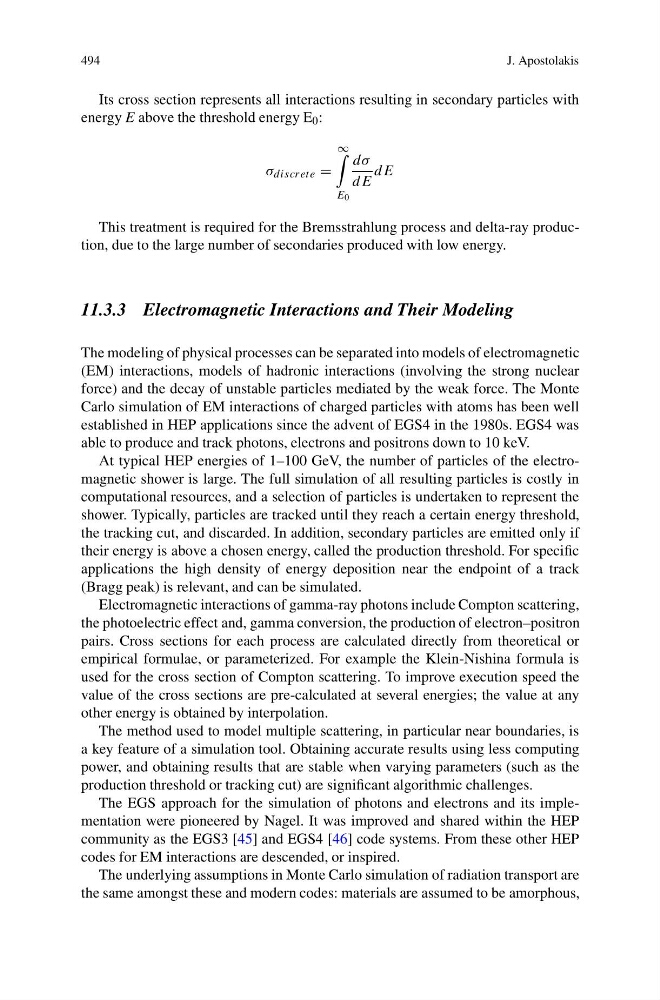
Its cross section represents all interactions resulting in secondary particles with
energy E above the threshold energy E 0 :
σ discrete =
∞
E 0
dσ
dE
dE
This treatment is required for the Bremsstrahlung process and delta-ray production, due to the large number of secondaries produced with low energy.
11.3.3 Electromagnetic Interactions and Their Modeling
The modeling of physical processes can be separated into models of electromagnetic
(EM) interactions, models of hadronic interactions (involving the strong nuclear
force) and the decay of unstable particles mediated by the weak force. The Monte
Carlo simulation of EM interactions of charged particles with atoms has been well
established in HEP applications since the advent of EGS4 in the 1980s. EGS4 was
able to produce and track photons, electrons and positrons down to 10 keV.
At typical HEP energies of 1–100 GeV, the number of particles of the electromagnetic shower is large. The full simulation of all resulting particles is costly in
computational resources, and a selection of particles is undertaken to represent the
shower. Typically, particles are tracked until they reach a certain energy threshold,
the tracking cut, and discarded. In addition, secondary particles are emitted only if
their energy is above a chosen energy, called the production threshold. For specific
applications the high density of energy deposition near the endpoint of a track
(Bragg peak) is relevant, and can be simulated.
Electromagnetic interactions of gamma-ray photons include Compton scattering,
the photoelectric effect and, gamma conversion, the production of electron–positron
pairs. Cross sections for each process are calculated directly from theoretical or
empirical formulae, or parameterized. For example the Klein-Nishina formula is
used for the cross section of Compton scattering. To improve execution speed the
value of the cross sections are pre-calculated at several energies; the value at any
other energy is obtained by interpolation.
The method used to model multiple scattering, in particular near boundaries, is
a key feature of a simulation tool. Obtaining accurate results using less computing
power, and obtaining results that are stable when varying parameters (such as the
production threshold or tracking cut) are significant algorithmic challenges.
The EGS approach for the simulation of photons and electrons and its implementation were pioneered by Nagel. It was improved and shared within the HEP
community as the EGS3 [45] and EGS4 [46] code systems. From these other HEP
codes for EM interactions are descended, or inspired.
The underlying assumptions in Monte Carlo simulation of radiation transport are
the same amongst these and modern codes: materials are assumed to be amorphous,
J. Apostolakis
Its cross section represents all interactions resulting in secondary particles with
energy E above the threshold energy E 0 :
σ discrete =
∞
E 0
dσ
dE
dE
This treatment is required for the Bremsstrahlung process and delta-ray production, due to the large number of secondaries produced with low energy.
11.3.3 Electromagnetic Interactions and Their Modeling
The modeling of physical processes can be separated into models of electromagnetic
(EM) interactions, models of hadronic interactions (involving the strong nuclear
force) and the decay of unstable particles mediated by the weak force. The Monte
Carlo simulation of EM interactions of charged particles with atoms has been well
established in HEP applications since the advent of EGS4 in the 1980s. EGS4 was
able to produce and track photons, electrons and positrons down to 10 keV.
At typical HEP energies of 1–100 GeV, the number of particles of the electromagnetic shower is large. The full simulation of all resulting particles is costly in
computational resources, and a selection of particles is undertaken to represent the
shower. Typically, particles are tracked until they reach a certain energy threshold,
the tracking cut, and discarded. In addition, secondary particles are emitted only if
their energy is above a chosen energy, called the production threshold. For specific
applications the high density of energy deposition near the endpoint of a track
(Bragg peak) is relevant, and can be simulated.
Electromagnetic interactions of gamma-ray photons include Compton scattering,
the photoelectric effect and, gamma conversion, the production of electron–positron
pairs. Cross sections for each process are calculated directly from theoretical or
empirical formulae, or parameterized. For example the Klein-Nishina formula is
used for the cross section of Compton scattering. To improve execution speed the
value of the cross sections are pre-calculated at several energies; the value at any
other energy is obtained by interpolation.
The method used to model multiple scattering, in particular near boundaries, is
a key feature of a simulation tool. Obtaining accurate results using less computing
power, and obtaining results that are stable when varying parameters (such as the
production threshold or tracking cut) are significant algorithmic challenges.
The EGS approach for the simulation of photons and electrons and its implementation were pioneered by Nagel. It was improved and shared within the HEP
community as the EGS3 [45] and EGS4 [46] code systems. From these other HEP
codes for EM interactions are descended, or inspired.
The underlying assumptions in Monte Carlo simulation of radiation transport are
the same amongst these and modern codes: materials are assumed to be amorphous,