

10 Signal Processing for Particle Detectors
441
signals are determined using the “weighting field” concept, and noise analysis is
based on the “weighting function” concept. The former is based on electrostatics and
the latter on superposition of noise impulse contributions to the variable (current,
charge) measured by the readout system.
10.2 Charge Collection and Signal Formation in Detectors
10.2.1 Current Induced by the Moving Charge
and the Weighting Field Concept
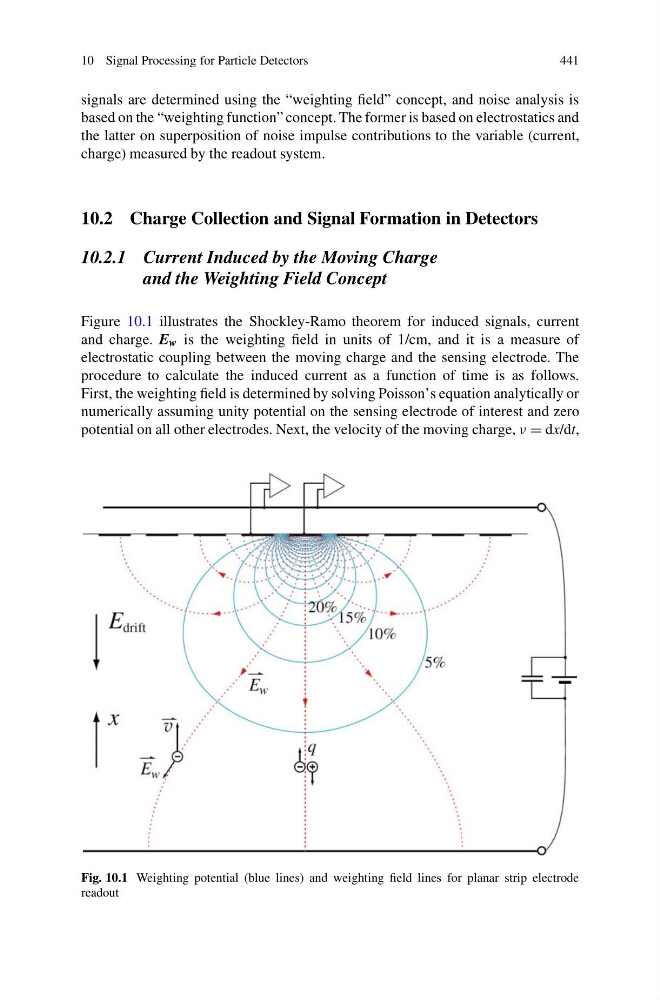
Figure 10.1 illustrates the Shockley-Ramo theorem for induced signals, current
and charge. E w is the weighting field in units of 1/cm, and it is a measure of
electrostatic coupling between the moving charge and the sensing electrode. The
procedure to calculate the induced current as a function of time is as follows.
First, the weighting field is determined by solving Poisson’s equation analytically or
numerically assuming unity potential on the sensing electrode of interest and zero
potential on all other electrodes. Next, the velocity of the moving charge, ν = dx/dt,
Fig. 10.1 Weighting potential (blue lines) and weighting field lines for planar strip electrode
readout
441
signals are determined using the “weighting field” concept, and noise analysis is
based on the “weighting function” concept. The former is based on electrostatics and
the latter on superposition of noise impulse contributions to the variable (current,
charge) measured by the readout system.
10.2 Charge Collection and Signal Formation in Detectors
10.2.1 Current Induced by the Moving Charge
and the Weighting Field Concept
Figure 10.1 illustrates the Shockley-Ramo theorem for induced signals, current
and charge. E w is the weighting field in units of 1/cm, and it is a measure of
electrostatic coupling between the moving charge and the sensing electrode. The
procedure to calculate the induced current as a function of time is as follows.
First, the weighting field is determined by solving Poisson’s equation analytically or
numerically assuming unity potential on the sensing electrode of interest and zero
potential on all other electrodes. Next, the velocity of the moving charge, ν = dx/dt,
Fig. 10.1 Weighting potential (blue lines) and weighting field lines for planar strip electrode
readout