

9 Nuclear Emulsions
427
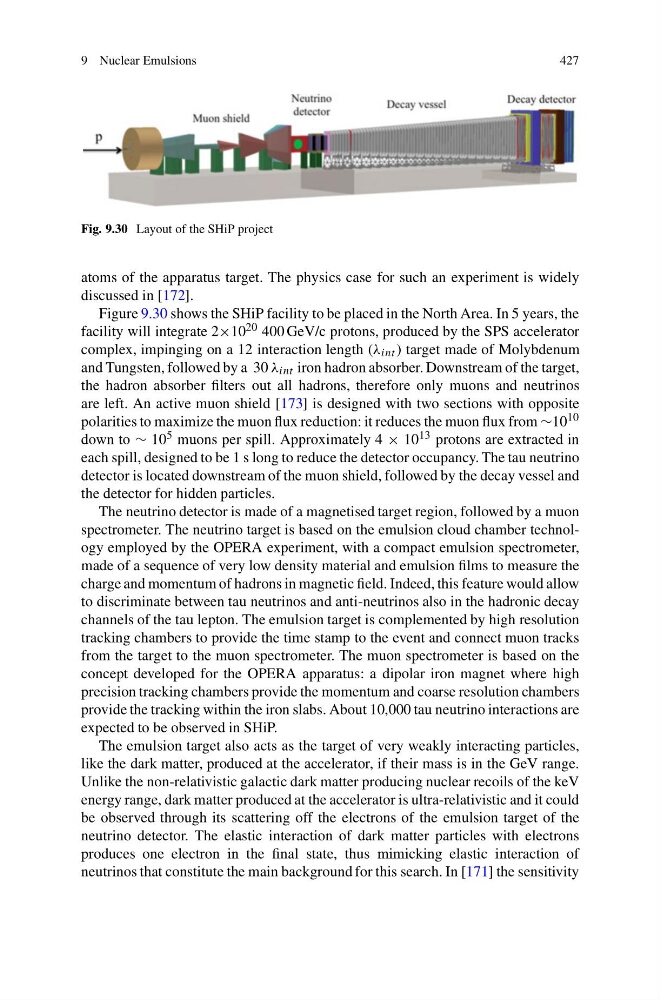
Fig. 9.30 Layout of the SHiP project
atoms of the apparatus target. The physics case for such an experiment is widely
discussed in [172].
Figure 9.30 shows the SHiP facility to be placed in the North Area. In 5 years, the
facility will integrate 2×10 20 400 GeV/c protons, produced by the SPS accelerator
complex, impinging on a 12 interaction length (λ int ) target made of Molybdenum
and Tungsten, followed by a 30 λ int iron hadron absorber. Downstream of the target,
the hadron absorber filters out all hadrons, therefore only muons and neutrinos
are left. An active muon shield [173] is designed with two sections with opposite
polarities to maximize the muon flux reduction: it reduces the muon flux from ∼10 10
down to ∼ 10 5 muons per spill. Approximately 4 × 10 13 protons are extracted in
each spill, designed to be 1 s long to reduce the detector occupancy. The tau neutrino
detector is located downstream of the muon shield, followed by the decay vessel and
the detector for hidden particles.
The neutrino detector is made of a magnetised target region, followed by a muon
spectrometer. The neutrino target is based on the emulsion cloud chamber technology employed by the OPERA experiment, with a compact emulsion spectrometer,
made of a sequence of very low density material and emulsion films to measure the
charge and momentum of hadrons in magnetic field. Indeed, this feature would allow
to discriminate between tau neutrinos and anti-neutrinos also in the hadronic decay
channels of the tau lepton. The emulsion target is complemented by high resolution
tracking chambers to provide the time stamp to the event and connect muon tracks
from the target to the muon spectrometer. The muon spectrometer is based on the
concept developed for the OPERA apparatus: a dipolar iron magnet where high
precision tracking chambers provide the momentum and coarse resolution chambers
provide the tracking within the iron slabs. About 10,000 tau neutrino interactions are
expected to be observed in SHiP.
The emulsion target also acts as the target of very weakly interacting particles,
like the dark matter, produced at the accelerator, if their mass is in the GeV range.
Unlike the non-relativistic galactic dark matter producing nuclear recoils of the keV
energy range, dark matter produced at the accelerator is ultra-relativistic and it could
be observed through its scattering off the electrons of the emulsion target of the
neutrino detector. The elastic interaction of dark matter particles with electrons
produces one electron in the final state, thus mimicking elastic interaction of
neutrinos that constitute the main background for this search. In [171] the sensitivity
427
Fig. 9.30 Layout of the SHiP project
atoms of the apparatus target. The physics case for such an experiment is widely
discussed in [172].
Figure 9.30 shows the SHiP facility to be placed in the North Area. In 5 years, the
facility will integrate 2×10 20 400 GeV/c protons, produced by the SPS accelerator
complex, impinging on a 12 interaction length (λ int ) target made of Molybdenum
and Tungsten, followed by a 30 λ int iron hadron absorber. Downstream of the target,
the hadron absorber filters out all hadrons, therefore only muons and neutrinos
are left. An active muon shield [173] is designed with two sections with opposite
polarities to maximize the muon flux reduction: it reduces the muon flux from ∼10 10
down to ∼ 10 5 muons per spill. Approximately 4 × 10 13 protons are extracted in
each spill, designed to be 1 s long to reduce the detector occupancy. The tau neutrino
detector is located downstream of the muon shield, followed by the decay vessel and
the detector for hidden particles.
The neutrino detector is made of a magnetised target region, followed by a muon
spectrometer. The neutrino target is based on the emulsion cloud chamber technology employed by the OPERA experiment, with a compact emulsion spectrometer,
made of a sequence of very low density material and emulsion films to measure the
charge and momentum of hadrons in magnetic field. Indeed, this feature would allow
to discriminate between tau neutrinos and anti-neutrinos also in the hadronic decay
channels of the tau lepton. The emulsion target is complemented by high resolution
tracking chambers to provide the time stamp to the event and connect muon tracks
from the target to the muon spectrometer. The muon spectrometer is based on the
concept developed for the OPERA apparatus: a dipolar iron magnet where high
precision tracking chambers provide the momentum and coarse resolution chambers
provide the tracking within the iron slabs. About 10,000 tau neutrino interactions are
expected to be observed in SHiP.
The emulsion target also acts as the target of very weakly interacting particles,
like the dark matter, produced at the accelerator, if their mass is in the GeV range.
Unlike the non-relativistic galactic dark matter producing nuclear recoils of the keV
energy range, dark matter produced at the accelerator is ultra-relativistic and it could
be observed through its scattering off the electrons of the emulsion target of the
neutrino detector. The elastic interaction of dark matter particles with electrons
produces one electron in the final state, thus mimicking elastic interaction of
neutrinos that constitute the main background for this search. In [171] the sensitivity