

420
A. Ariga et al.
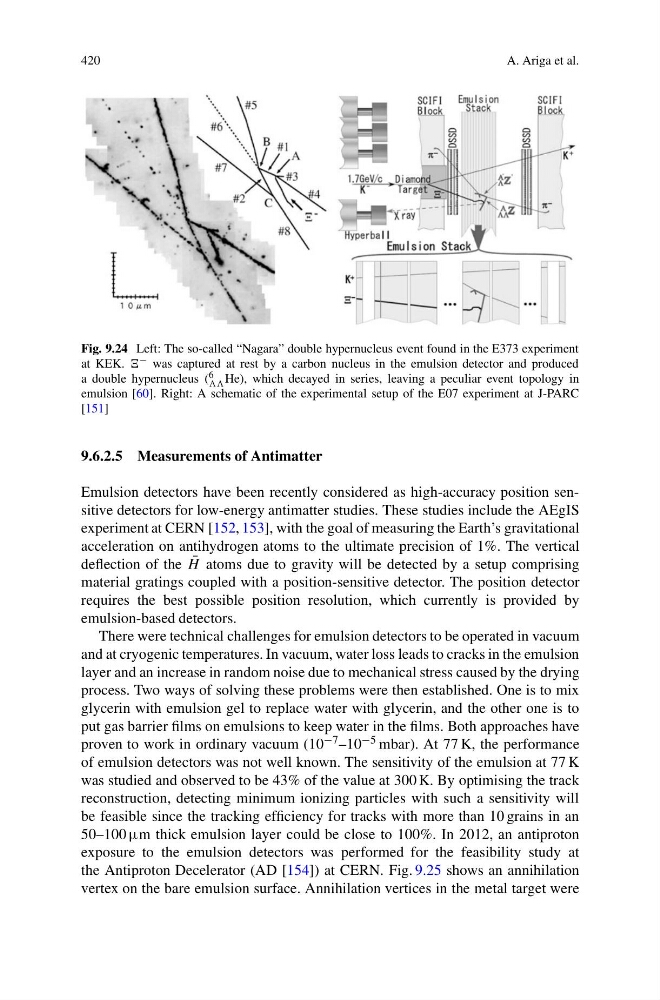
Fig. 9.24 Left: The so-called “Nagara” double hypernucleus event found in the E373 experiment
at KEK. − was captured at rest by a carbon nucleus in the emulsion detector and produced
a double hypernucleus ( 6
He), which decayed in series, leaving a peculiar event topology in
emulsion [60]. Right: A schematic of the experimental setup of the E07 experiment at J-PARC
[151]
9.6.2.5 Measurements of Antimatter
Emulsion detectors have been recently considered as high-accuracy position sensitive detectors for low-energy antimatter studies. These studies include the AEgIS
experiment at CERN [152, 153], with the goal of measuring the Earth’s gravitational
acceleration on antihydrogen atoms to the ultimate precision of 1%. The vertical
deflection of the ¯
H atoms due to gravity will be detected by a setup comprising
material gratings coupled with a position-sensitive detector. The position detector
requires the best possible position resolution, which currently is provided by
emulsion-based detectors.
There were technical challenges for emulsion detectors to be operated in vacuum
and at cryogenic temperatures. In vacuum, water loss leads to cracks in the emulsion
layer and an increase in random noise due to mechanical stress caused by the drying
process. Two ways of solving these problems were then established. One is to mix
glycerin with emulsion gel to replace water with glycerin, and the other one is to
put gas barrier films on emulsions to keep water in the films. Both approaches have
proven to work in ordinary vacuum (10 −7 –10 −5 mbar). At 77 K, the performance
of emulsion detectors was not well known. The sensitivity of the emulsion at 77 K
was studied and observed to be 43% of the value at 300 K. By optimising the track
reconstruction, detecting minimum ionizing particles with such a sensitivity will
be feasible since the tracking efficiency for tracks with more than 10 grains in an
50–100 μm thick emulsion layer could be close to 100%. In 2012, an antiproton
exposure to the emulsion detectors was performed for the feasibility study at
the Antiproton Decelerator (AD [154]) at CERN. Fig. 9.25 shows an annihilation
vertex on the bare emulsion surface. Annihilation vertices in the metal target were
A. Ariga et al.
Fig. 9.24 Left: The so-called “Nagara” double hypernucleus event found in the E373 experiment
at KEK. − was captured at rest by a carbon nucleus in the emulsion detector and produced
a double hypernucleus ( 6
He), which decayed in series, leaving a peculiar event topology in
emulsion [60]. Right: A schematic of the experimental setup of the E07 experiment at J-PARC
[151]
9.6.2.5 Measurements of Antimatter
Emulsion detectors have been recently considered as high-accuracy position sensitive detectors for low-energy antimatter studies. These studies include the AEgIS
experiment at CERN [152, 153], with the goal of measuring the Earth’s gravitational
acceleration on antihydrogen atoms to the ultimate precision of 1%. The vertical
deflection of the ¯
H atoms due to gravity will be detected by a setup comprising
material gratings coupled with a position-sensitive detector. The position detector
requires the best possible position resolution, which currently is provided by
emulsion-based detectors.
There were technical challenges for emulsion detectors to be operated in vacuum
and at cryogenic temperatures. In vacuum, water loss leads to cracks in the emulsion
layer and an increase in random noise due to mechanical stress caused by the drying
process. Two ways of solving these problems were then established. One is to mix
glycerin with emulsion gel to replace water with glycerin, and the other one is to
put gas barrier films on emulsions to keep water in the films. Both approaches have
proven to work in ordinary vacuum (10 −7 –10 −5 mbar). At 77 K, the performance
of emulsion detectors was not well known. The sensitivity of the emulsion at 77 K
was studied and observed to be 43% of the value at 300 K. By optimising the track
reconstruction, detecting minimum ionizing particles with such a sensitivity will
be feasible since the tracking efficiency for tracks with more than 10 grains in an
50–100 μm thick emulsion layer could be close to 100%. In 2012, an antiproton
exposure to the emulsion detectors was performed for the feasibility study at
the Antiproton Decelerator (AD [154]) at CERN. Fig. 9.25 shows an annihilation
vertex on the bare emulsion surface. Annihilation vertices in the metal target were