

414
A. Ariga et al.
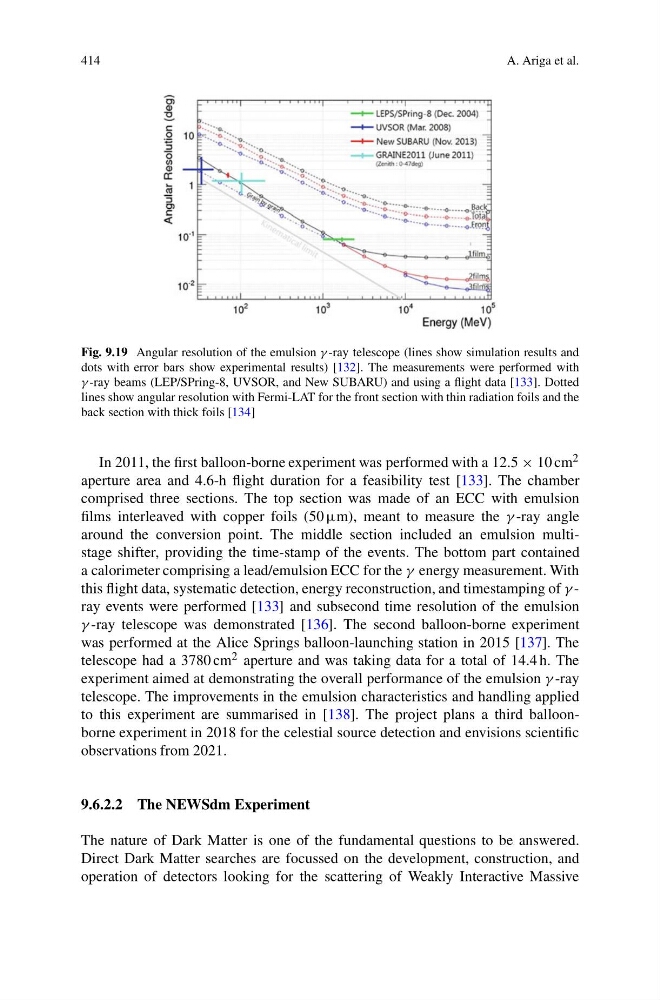
Fig. 9.19 Angular resolution of the emulsion γ -ray telescope (lines show simulation results and
dots with error bars show experimental results) [132]. The measurements were performed with
γ -ray beams (LEP/SPring-8, UVSOR, and New SUBARU) and using a flight data [133]. Dotted
lines show angular resolution with Fermi-LAT for the front section with thin radiation foils and the
back section with thick foils [134]
In 2011, the first balloon-borne experiment was performed with a 12.5 × 10 cm 2
aperture area and 4.6-h flight duration for a feasibility test [133]. The chamber
comprised three sections. The top section was made of an ECC with emulsion
films interleaved with copper foils (50 μm), meant to measure the γ -ray angle
around the conversion point. The middle section included an emulsion multistage shifter, providing the time-stamp of the events. The bottom part contained
a calorimeter comprising a lead/emulsion ECC for the γ energy measurement. With
this flight data, systematic detection, energy reconstruction, and timestamping of γ -
ray events were performed [133] and subsecond time resolution of the emulsion
γ -ray telescope was demonstrated [136]. The second balloon-borne experiment
was performed at the Alice Springs balloon-launching station in 2015 [137]. The
telescope had a 3780 cm 2 aperture and was taking data for a total of 14.4 h. The
experiment aimed at demonstrating the overall performance of the emulsion γ -ray
telescope. The improvements in the emulsion characteristics and handling applied
to this experiment are summarised in [138]. The project plans a third balloonborne experiment in 2018 for the celestial source detection and envisions scientific
observations from 2021.
9.6.2.2 The NEWSdm Experiment
The nature of Dark Matter is one of the fundamental questions to be answered.
Direct Dark Matter searches are focussed on the development, construction, and
operation of detectors looking for the scattering of Weakly Interactive Massive
A. Ariga et al.
Fig. 9.19 Angular resolution of the emulsion γ -ray telescope (lines show simulation results and
dots with error bars show experimental results) [132]. The measurements were performed with
γ -ray beams (LEP/SPring-8, UVSOR, and New SUBARU) and using a flight data [133]. Dotted
lines show angular resolution with Fermi-LAT for the front section with thin radiation foils and the
back section with thick foils [134]
In 2011, the first balloon-borne experiment was performed with a 12.5 × 10 cm 2
aperture area and 4.6-h flight duration for a feasibility test [133]. The chamber
comprised three sections. The top section was made of an ECC with emulsion
films interleaved with copper foils (50 μm), meant to measure the γ -ray angle
around the conversion point. The middle section included an emulsion multistage shifter, providing the time-stamp of the events. The bottom part contained
a calorimeter comprising a lead/emulsion ECC for the γ energy measurement. With
this flight data, systematic detection, energy reconstruction, and timestamping of γ -
ray events were performed [133] and subsecond time resolution of the emulsion
γ -ray telescope was demonstrated [136]. The second balloon-borne experiment
was performed at the Alice Springs balloon-launching station in 2015 [137]. The
telescope had a 3780 cm 2 aperture and was taking data for a total of 14.4 h. The
experiment aimed at demonstrating the overall performance of the emulsion γ -ray
telescope. The improvements in the emulsion characteristics and handling applied
to this experiment are summarised in [138]. The project plans a third balloonborne experiment in 2018 for the celestial source detection and envisions scientific
observations from 2021.
9.6.2.2 The NEWSdm Experiment
The nature of Dark Matter is one of the fundamental questions to be answered.
Direct Dark Matter searches are focussed on the development, construction, and
operation of detectors looking for the scattering of Weakly Interactive Massive