

406
A. Ariga et al.
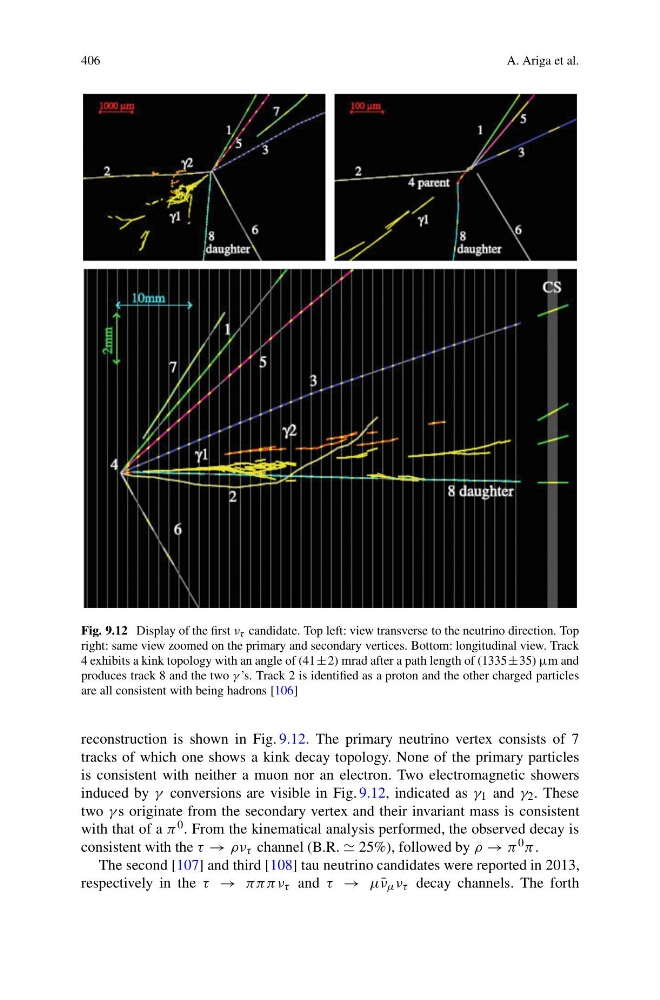
Fig. 9.12 Display of the first ν τ candidate. Top left: view transverse to the neutrino direction. Top
right: same view zoomed on the primary and secondary vertices. Bottom: longitudinal view. Track
4 exhibits a kink topology with an angle of (41±2) mrad after a path length of (1335±35) μm and
produces track 8 and the two γ ’s. Track 2 is identified as a proton and the other charged particles
are all consistent with being hadrons [106]
reconstruction is shown in Fig. 9.12. The primary neutrino vertex consists of 7
tracks of which one shows a kink decay topology. None of the primary particles
is consistent with neither a muon nor an electron. Two electromagnetic showers
induced by γ conversions are visible in Fig. 9.12, indicated as γ 1 and γ 2 . These
two γ s originate from the secondary vertex and their invariant mass is consistent
with that of a π 0 . From the kinematical analysis performed, the observed decay is
consistent with the τ → ρν τ channel (B.R. 25%), followed by ρ → π 0 π.
The second [107] and third [108] tau neutrino candidates were reported in 2013,
respectively in the τ → πππν τ and τ → μ¯ ν μ ν τ decay channels. The forth
A. Ariga et al.
Fig. 9.12 Display of the first ν τ candidate. Top left: view transverse to the neutrino direction. Top
right: same view zoomed on the primary and secondary vertices. Bottom: longitudinal view. Track
4 exhibits a kink topology with an angle of (41±2) mrad after a path length of (1335±35) μm and
produces track 8 and the two γ ’s. Track 2 is identified as a proton and the other charged particles
are all consistent with being hadrons [106]
reconstruction is shown in Fig. 9.12. The primary neutrino vertex consists of 7
tracks of which one shows a kink decay topology. None of the primary particles
is consistent with neither a muon nor an electron. Two electromagnetic showers
induced by γ conversions are visible in Fig. 9.12, indicated as γ 1 and γ 2 . These
two γ s originate from the secondary vertex and their invariant mass is consistent
with that of a π 0 . From the kinematical analysis performed, the observed decay is
consistent with the τ → ρν τ channel (B.R. 25%), followed by ρ → π 0 π.
The second [107] and third [108] tau neutrino candidates were reported in 2013,
respectively in the τ → πππν τ and τ → μ¯ ν μ ν τ decay channels. The forth