

396
A. Ariga et al.
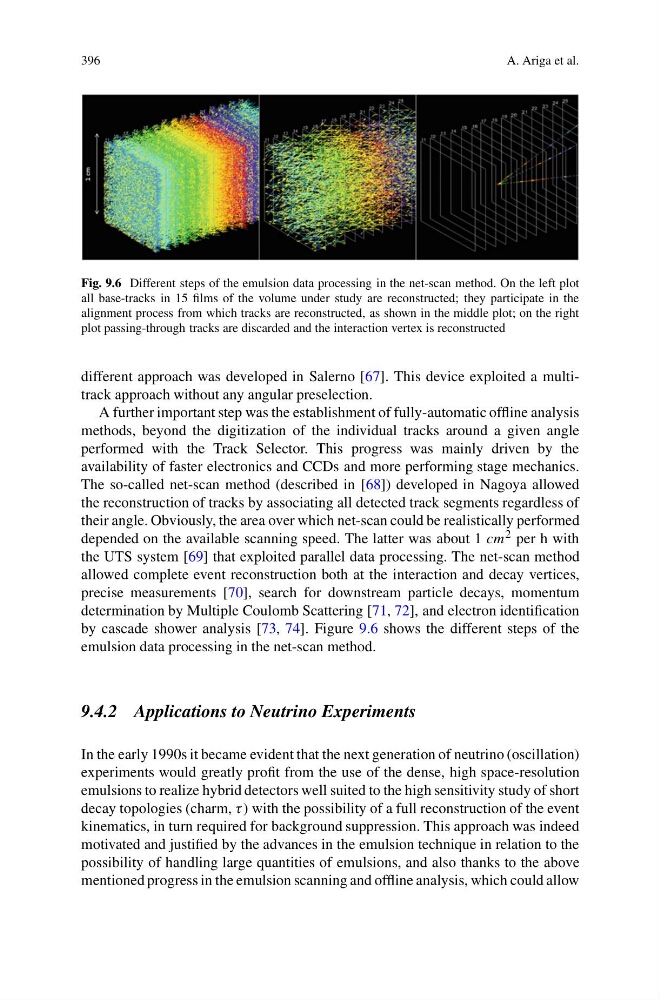
Fig. 9.6 Different steps of the emulsion data processing in the net-scan method. On the left plot
all base-tracks in 15 films of the volume under study are reconstructed; they participate in the
alignment process from which tracks are reconstructed, as shown in the middle plot; on the right
plot passing-through tracks are discarded and the interaction vertex is reconstructed
different approach was developed in Salerno [67]. This device exploited a multitrack approach without any angular preselection.
A further important step was the establishment of fully-automatic offline analysis
methods, beyond the digitization of the individual tracks around a given angle
performed with the Track Selector. This progress was mainly driven by the
availability of faster electronics and CCDs and more performing stage mechanics.
The so-called net-scan method (described in [68]) developed in Nagoya allowed
the reconstruction of tracks by associating all detected track segments regardless of
their angle. Obviously, the area over which net-scan could be realistically performed
depended on the available scanning speed. The latter was about 1 cm 2 per h with
the UTS system [69] that exploited parallel data processing. The net-scan method
allowed complete event reconstruction both at the interaction and decay vertices,
precise measurements [70], search for downstream particle decays, momentum
determination by Multiple Coulomb Scattering [71, 72], and electron identification
by cascade shower analysis [73, 74]. Figure 9.6 shows the different steps of the
emulsion data processing in the net-scan method.
9.4.2 Applications to Neutrino Experiments
In the early 1990s it became evident that the next generation of neutrino (oscillation)
experiments would greatly profit from the use of the dense, high space-resolution
emulsions to realize hybrid detectors well suited to the high sensitivity study of short
decay topologies (charm, τ ) with the possibility of a full reconstruction of the event
kinematics, in turn required for background suppression. This approach was indeed
motivated and justified by the advances in the emulsion technique in relation to the
possibility of handling large quantities of emulsions, and also thanks to the above
mentioned progress in the emulsion scanning and offline analysis, which could allow
A. Ariga et al.
Fig. 9.6 Different steps of the emulsion data processing in the net-scan method. On the left plot
all base-tracks in 15 films of the volume under study are reconstructed; they participate in the
alignment process from which tracks are reconstructed, as shown in the middle plot; on the right
plot passing-through tracks are discarded and the interaction vertex is reconstructed
different approach was developed in Salerno [67]. This device exploited a multitrack approach without any angular preselection.
A further important step was the establishment of fully-automatic offline analysis
methods, beyond the digitization of the individual tracks around a given angle
performed with the Track Selector. This progress was mainly driven by the
availability of faster electronics and CCDs and more performing stage mechanics.
The so-called net-scan method (described in [68]) developed in Nagoya allowed
the reconstruction of tracks by associating all detected track segments regardless of
their angle. Obviously, the area over which net-scan could be realistically performed
depended on the available scanning speed. The latter was about 1 cm 2 per h with
the UTS system [69] that exploited parallel data processing. The net-scan method
allowed complete event reconstruction both at the interaction and decay vertices,
precise measurements [70], search for downstream particle decays, momentum
determination by Multiple Coulomb Scattering [71, 72], and electron identification
by cascade shower analysis [73, 74]. Figure 9.6 shows the different steps of the
emulsion data processing in the net-scan method.
9.4.2 Applications to Neutrino Experiments
In the early 1990s it became evident that the next generation of neutrino (oscillation)
experiments would greatly profit from the use of the dense, high space-resolution
emulsions to realize hybrid detectors well suited to the high sensitivity study of short
decay topologies (charm, τ ) with the possibility of a full reconstruction of the event
kinematics, in turn required for background suppression. This approach was indeed
motivated and justified by the advances in the emulsion technique in relation to the
possibility of handling large quantities of emulsions, and also thanks to the above
mentioned progress in the emulsion scanning and offline analysis, which could allow