

9 Nuclear Emulsions
393
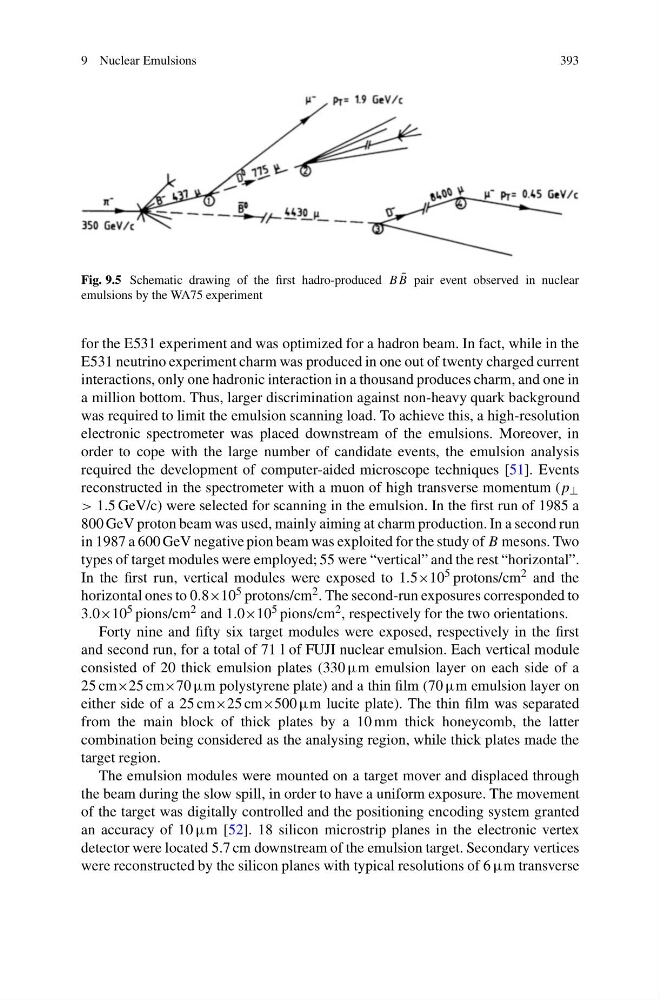
Fig. 9.5 Schematic drawing of the first hadro-produced B ¯
B pair event observed in nuclear
emulsions by the WA75 experiment
for the E531 experiment and was optimized for a hadron beam. In fact, while in the
E531 neutrino experiment charm was produced in one out of twenty charged current
interactions, only one hadronic interaction in a thousand produces charm, and one in
a million bottom. Thus, larger discrimination against non-heavy quark background
was required to limit the emulsion scanning load. To achieve this, a high-resolution
electronic spectrometer was placed downstream of the emulsions. Moreover, in
order to cope with the large number of candidate events, the emulsion analysis
required the development of computer-aided microscope techniques [51]. Events
reconstructed in the spectrometer with a muon of high transverse momentum (p ⊥
> 1.5 GeV/c) were selected for scanning in the emulsion. In the first run of 1985 a
800 GeV proton beam was used, mainly aiming at charm production. In a second run
in 1987 a 600 GeV negative pion beam was exploited for the study of B mesons. Two
types of target modules were employed; 55 were “vertical” and the rest “horizontal”.
In the first run, vertical modules were exposed to 1.5×10 5 protons/cm 2 and the
horizontal ones to 0.8×10 5 protons/cm 2 . The second-run exposures corresponded to
3.0×10 5 pions/cm 2 and 1.0×10 5 pions/cm 2 , respectively for the two orientations.
Forty nine and fifty six target modules were exposed, respectively in the first
and second run, for a total of 71 l of FUJI nuclear emulsion. Each vertical module
consisted of 20 thick emulsion plates (330 μm emulsion layer on each side of a
25 cm×25 cm×70 μm polystyrene plate) and a thin film (70 μm emulsion layer on
either side of a 25 cm×25 cm×500 μm lucite plate). The thin film was separated
from the main block of thick plates by a 10 mm thick honeycomb, the latter
combination being considered as the analysing region, while thick plates made the
target region.
The emulsion modules were mounted on a target mover and displaced through
the beam during the slow spill, in order to have a uniform exposure. The movement
of the target was digitally controlled and the positioning encoding system granted
an accuracy of 10 μm [52]. 18 silicon microstrip planes in the electronic vertex
detector were located 5.7 cm downstream of the emulsion target. Secondary vertices
were reconstructed by the silicon planes with typical resolutions of 6 μm transverse
393
Fig. 9.5 Schematic drawing of the first hadro-produced B ¯
B pair event observed in nuclear
emulsions by the WA75 experiment
for the E531 experiment and was optimized for a hadron beam. In fact, while in the
E531 neutrino experiment charm was produced in one out of twenty charged current
interactions, only one hadronic interaction in a thousand produces charm, and one in
a million bottom. Thus, larger discrimination against non-heavy quark background
was required to limit the emulsion scanning load. To achieve this, a high-resolution
electronic spectrometer was placed downstream of the emulsions. Moreover, in
order to cope with the large number of candidate events, the emulsion analysis
required the development of computer-aided microscope techniques [51]. Events
reconstructed in the spectrometer with a muon of high transverse momentum (p ⊥
> 1.5 GeV/c) were selected for scanning in the emulsion. In the first run of 1985 a
800 GeV proton beam was used, mainly aiming at charm production. In a second run
in 1987 a 600 GeV negative pion beam was exploited for the study of B mesons. Two
types of target modules were employed; 55 were “vertical” and the rest “horizontal”.
In the first run, vertical modules were exposed to 1.5×10 5 protons/cm 2 and the
horizontal ones to 0.8×10 5 protons/cm 2 . The second-run exposures corresponded to
3.0×10 5 pions/cm 2 and 1.0×10 5 pions/cm 2 , respectively for the two orientations.
Forty nine and fifty six target modules were exposed, respectively in the first
and second run, for a total of 71 l of FUJI nuclear emulsion. Each vertical module
consisted of 20 thick emulsion plates (330 μm emulsion layer on each side of a
25 cm×25 cm×70 μm polystyrene plate) and a thin film (70 μm emulsion layer on
either side of a 25 cm×25 cm×500 μm lucite plate). The thin film was separated
from the main block of thick plates by a 10 mm thick honeycomb, the latter
combination being considered as the analysing region, while thick plates made the
target region.
The emulsion modules were mounted on a target mover and displaced through
the beam during the slow spill, in order to have a uniform exposure. The movement
of the target was digitally controlled and the positioning encoding system granted
an accuracy of 10 μm [52]. 18 silicon microstrip planes in the electronic vertex
detector were located 5.7 cm downstream of the emulsion target. Secondary vertices
were reconstructed by the silicon planes with typical resolutions of 6 μm transverse