

9 Nuclear Emulsions
389
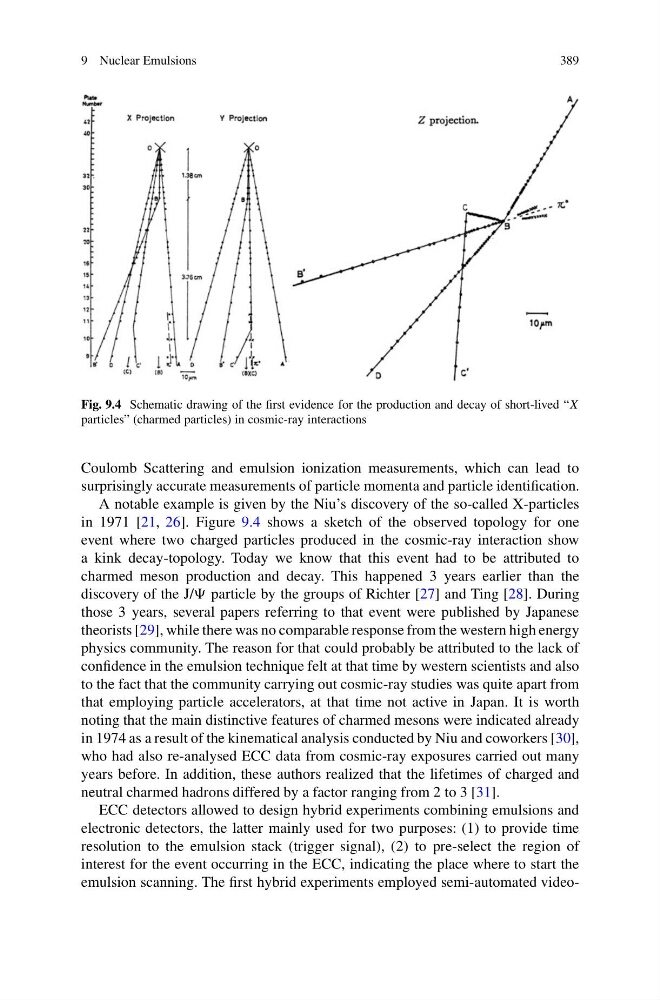
Fig. 9.4 Schematic drawing of the first evidence for the production and decay of short-lived “X
particles” (charmed particles) in cosmic-ray interactions
Coulomb Scattering and emulsion ionization measurements, which can lead to
surprisingly accurate measurements of particle momenta and particle identification.
A notable example is given by the Niu’s discovery of the so-called X-particles
in 1971 [21, 26]. Figure 9.4 shows a sketch of the observed topology for one
event where two charged particles produced in the cosmic-ray interaction show
a kink decay-topology. Today we know that this event had to be attributed to
charmed meson production and decay. This happened 3 years earlier than the
discovery of the J/ particle by the groups of Richter [27] and Ting [28]. During
those 3 years, several papers referring to that event were published by Japanese
theorists [29], while there was no comparable response from the western high energy
physics community. The reason for that could probably be attributed to the lack of
confidence in the emulsion technique felt at that time by western scientists and also
to the fact that the community carrying out cosmic-ray studies was quite apart from
that employing particle accelerators, at that time not active in Japan. It is worth
noting that the main distinctive features of charmed mesons were indicated already
in 1974 as a result of the kinematical analysis conducted by Niu and coworkers [30],
who had also re-analysed ECC data from cosmic-ray exposures carried out many
years before. In addition, these authors realized that the lifetimes of charged and
neutral charmed hadrons differed by a factor ranging from 2 to 3 [31].
ECC detectors allowed to design hybrid experiments combining emulsions and
electronic detectors, the latter mainly used for two purposes: (1) to provide time
resolution to the emulsion stack (trigger signal), (2) to pre-select the region of
interest for the event occurring in the ECC, indicating the place where to start the
emulsion scanning. The first hybrid experiments employed semi-automated video-
389
Fig. 9.4 Schematic drawing of the first evidence for the production and decay of short-lived “X
particles” (charmed particles) in cosmic-ray interactions
Coulomb Scattering and emulsion ionization measurements, which can lead to
surprisingly accurate measurements of particle momenta and particle identification.
A notable example is given by the Niu’s discovery of the so-called X-particles
in 1971 [21, 26]. Figure 9.4 shows a sketch of the observed topology for one
event where two charged particles produced in the cosmic-ray interaction show
a kink decay-topology. Today we know that this event had to be attributed to
charmed meson production and decay. This happened 3 years earlier than the
discovery of the J/ particle by the groups of Richter [27] and Ting [28]. During
those 3 years, several papers referring to that event were published by Japanese
theorists [29], while there was no comparable response from the western high energy
physics community. The reason for that could probably be attributed to the lack of
confidence in the emulsion technique felt at that time by western scientists and also
to the fact that the community carrying out cosmic-ray studies was quite apart from
that employing particle accelerators, at that time not active in Japan. It is worth
noting that the main distinctive features of charmed mesons were indicated already
in 1974 as a result of the kinematical analysis conducted by Niu and coworkers [30],
who had also re-analysed ECC data from cosmic-ray exposures carried out many
years before. In addition, these authors realized that the lifetimes of charged and
neutral charmed hadrons differed by a factor ranging from 2 to 3 [31].
ECC detectors allowed to design hybrid experiments combining emulsions and
electronic detectors, the latter mainly used for two purposes: (1) to provide time
resolution to the emulsion stack (trigger signal), (2) to pre-select the region of
interest for the event occurring in the ECC, indicating the place where to start the
emulsion scanning. The first hybrid experiments employed semi-automated video-