

384
A. Ariga et al.
A nuclear emulsion comprises a large number of small silver halide crystals,
uniformly dispersed in gelatine. Each crystal has a typical diameter of 200 nm
and works as an independent detection channel, which results in a very high
detection channel density of O (10 14 ) channels/cm 3 in emulsion detectors. This
makes emulsion detectors unique as particle detectors. The latest knowledge of the
general photographic process is described in [1]. Herein, we discuss the detection
principle of nuclear emulsions for ionizing particles.
The recent nuclear emulsion is made from silver bromide with a small fraction
of iodide (AgBr 1 − x I x , x being the fraction of iodide, about a few mol%). The
crystal structure of AgBr used for nuclear emulsions is face-centred cubic, and
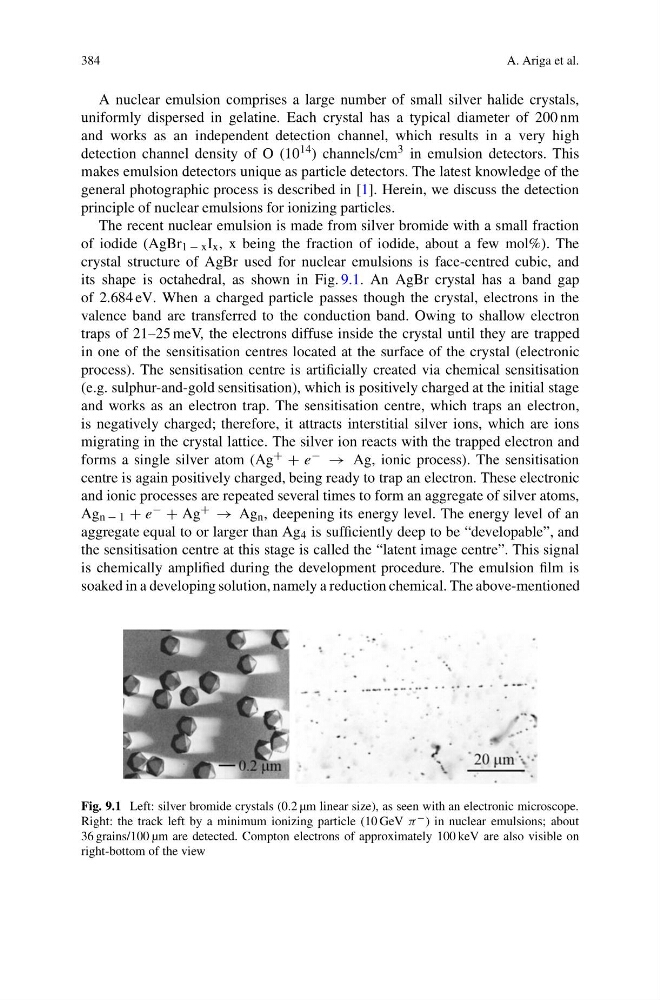
its shape is octahedral, as shown in Fig. 9.1. An AgBr crystal has a band gap
of 2.684 eV. When a charged particle passes though the crystal, electrons in the
valence band are transferred to the conduction band. Owing to shallow electron
traps of 21–25 meV, the electrons diffuse inside the crystal until they are trapped
in one of the sensitisation centres located at the surface of the crystal (electronic
process). The sensitisation centre is artificially created via chemical sensitisation
(e.g. sulphur-and-gold sensitisation), which is positively charged at the initial stage
and works as an electron trap. The sensitisation centre, which traps an electron,
is negatively charged; therefore, it attracts interstitial silver ions, which are ions
migrating in the crystal lattice. The silver ion reacts with the trapped electron and
forms a single silver atom (Ag + + e − → Ag, ionic process). The sensitisation
centre is again positively charged, being ready to trap an electron. These electronic
and ionic processes are repeated several times to form an aggregate of silver atoms,
Ag n − 1 + e − + Ag + → Ag n , deepening its energy level. The energy level of an
aggregate equal to or larger than Ag 4 is sufficiently deep to be “developable”, and
the sensitisation centre at this stage is called the “latent image centre”. This signal
is chemically amplified during the development procedure. The emulsion film is
soaked in a developing solution, namely a reduction chemical. The above-mentioned
Fig. 9.1 Left: silver bromide crystals (0.2 µm linear size), as seen with an electronic microscope.
Right: the track left by a minimum ionizing particle (10 GeV π − ) in nuclear emulsions; about
36 grains/100 µm are detected. Compton electrons of approximately 100 keV are also visible on
right-bottom of the view
A. Ariga et al.
A nuclear emulsion comprises a large number of small silver halide crystals,
uniformly dispersed in gelatine. Each crystal has a typical diameter of 200 nm
and works as an independent detection channel, which results in a very high
detection channel density of O (10 14 ) channels/cm 3 in emulsion detectors. This
makes emulsion detectors unique as particle detectors. The latest knowledge of the
general photographic process is described in [1]. Herein, we discuss the detection
principle of nuclear emulsions for ionizing particles.
The recent nuclear emulsion is made from silver bromide with a small fraction
of iodide (AgBr 1 − x I x , x being the fraction of iodide, about a few mol%). The
crystal structure of AgBr used for nuclear emulsions is face-centred cubic, and
its shape is octahedral, as shown in Fig. 9.1. An AgBr crystal has a band gap
of 2.684 eV. When a charged particle passes though the crystal, electrons in the
valence band are transferred to the conduction band. Owing to shallow electron
traps of 21–25 meV, the electrons diffuse inside the crystal until they are trapped
in one of the sensitisation centres located at the surface of the crystal (electronic
process). The sensitisation centre is artificially created via chemical sensitisation
(e.g. sulphur-and-gold sensitisation), which is positively charged at the initial stage
and works as an electron trap. The sensitisation centre, which traps an electron,
is negatively charged; therefore, it attracts interstitial silver ions, which are ions
migrating in the crystal lattice. The silver ion reacts with the trapped electron and
forms a single silver atom (Ag + + e − → Ag, ionic process). The sensitisation
centre is again positively charged, being ready to trap an electron. These electronic
and ionic processes are repeated several times to form an aggregate of silver atoms,
Ag n − 1 + e − + Ag + → Ag n , deepening its energy level. The energy level of an
aggregate equal to or larger than Ag 4 is sufficiently deep to be “developable”, and
the sensitisation centre at this stage is called the “latent image centre”. This signal
is chemically amplified during the development procedure. The emulsion film is
soaked in a developing solution, namely a reduction chemical. The above-mentioned
Fig. 9.1 Left: silver bromide crystals (0.2 µm linear size), as seen with an electronic microscope.
Right: the track left by a minimum ionizing particle (10 GeV π − ) in nuclear emulsions; about
36 grains/100 µm are detected. Compton electrons of approximately 100 keV are also visible on
right-bottom of the view