

360
L. Camilleri
8 ms encompassing the trigger. This long recording time relative to the maximum
drift time allows the complete reconstruction of cosmic rays traversing the TPC
before or after the trigger but having part of their tracks reaching the wires during
the event drift time. The second stream, intended for non-beam physics studies
such as supernovae neutrinos, records all the data continuously but applies a zero
suppression algorithm. Both the fast (6 ns) and slow (∼1μs) components of the
argon ultra violet scintillation light are recorded by 35 Hamamatsu 5912-02MOD
photomultipliers installed behind the anode wires and coated with Tetraphenyl
Butadiene (TPB) to wave length shift the light from the ultra violet to the visible.
The fast component is used to provide a trigger in time with the 1.6 μs beam spill and
to tag cosmic ray tracks entering the detector during the event drift time. These are
also tagged by a cosmic ray detector surrounding the cryostat and assembeled out
of scintillation bars read by Kuraray WLS Y11 (200) S-type multiclad wave length
shifting fibers and Hamamatsu S12825-050P multi-pixel silicon photomultipliers.
A UV laser is used to map the TPC electric field, especially in the regions of
non-uniformity caused by space charge effects. MicroBooNE has been collecting
data since 2015. It has developed algorithms to distinguish between cosmic rays
entering the detector at a rate of 4 kHz (because of its surface location) and neutrino
interactions. It is also in the process of developing recontruction algorithms for
electromagnetic showers that, at these low energies, can include gaps due to the
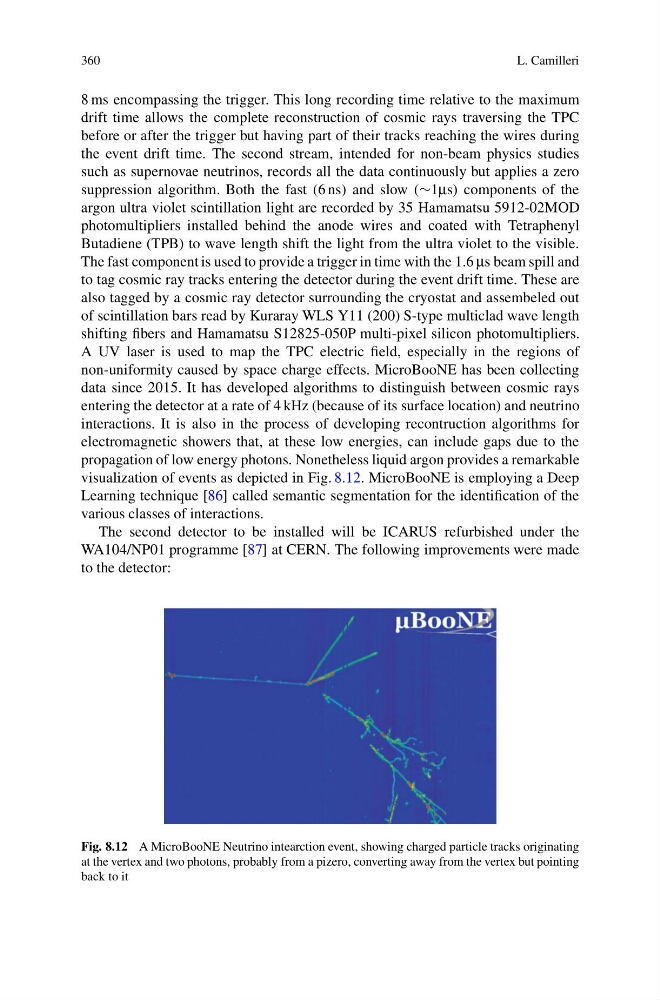
propagation of low energy photons. Nonetheless liquid argon provides a remarkable
visualization of events as depicted in Fig. 8.12. MicroBooNE is employing a Deep
Learning technique [86] called semantic segmentation for the identification of the
various classes of interactions.
The second detector to be installed will be ICARUS refurbished under the
WA104/NP01 programme [87] at CERN. The following improvements were made
to the detector:
Fig. 8.12 A MicroBooNE Neutrino intearction event, showing charged particle tracks originating
at the vertex and two photons, probably from a pizero, converting away from the vertex but pointing
back to it
L. Camilleri
8 ms encompassing the trigger. This long recording time relative to the maximum
drift time allows the complete reconstruction of cosmic rays traversing the TPC
before or after the trigger but having part of their tracks reaching the wires during
the event drift time. The second stream, intended for non-beam physics studies
such as supernovae neutrinos, records all the data continuously but applies a zero
suppression algorithm. Both the fast (6 ns) and slow (∼1μs) components of the
argon ultra violet scintillation light are recorded by 35 Hamamatsu 5912-02MOD
photomultipliers installed behind the anode wires and coated with Tetraphenyl
Butadiene (TPB) to wave length shift the light from the ultra violet to the visible.
The fast component is used to provide a trigger in time with the 1.6 μs beam spill and
to tag cosmic ray tracks entering the detector during the event drift time. These are
also tagged by a cosmic ray detector surrounding the cryostat and assembeled out
of scintillation bars read by Kuraray WLS Y11 (200) S-type multiclad wave length
shifting fibers and Hamamatsu S12825-050P multi-pixel silicon photomultipliers.
A UV laser is used to map the TPC electric field, especially in the regions of
non-uniformity caused by space charge effects. MicroBooNE has been collecting
data since 2015. It has developed algorithms to distinguish between cosmic rays
entering the detector at a rate of 4 kHz (because of its surface location) and neutrino
interactions. It is also in the process of developing recontruction algorithms for
electromagnetic showers that, at these low energies, can include gaps due to the
propagation of low energy photons. Nonetheless liquid argon provides a remarkable
visualization of events as depicted in Fig. 8.12. MicroBooNE is employing a Deep
Learning technique [86] called semantic segmentation for the identification of the
various classes of interactions.
The second detector to be installed will be ICARUS refurbished under the
WA104/NP01 programme [87] at CERN. The following improvements were made
to the detector:
Fig. 8.12 A MicroBooNE Neutrino intearction event, showing charged particle tracks originating
at the vertex and two photons, probably from a pizero, converting away from the vertex but pointing
back to it