

358
L. Camilleri
8.3.2.1 Liquid Argon
The Liquid Argon Time Projection Chamber (TPC) is a detector technique that
provides accurate imaging of interactions while providing a moderately dense
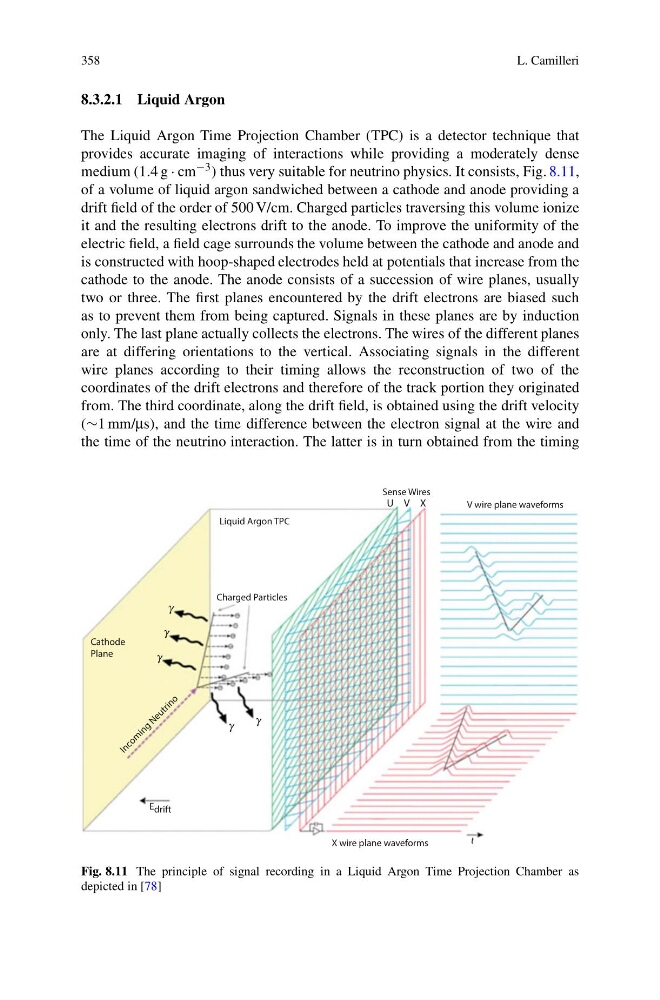
medium (1.4 g · cm −3 ) thus very suitable for neutrino physics. It consists, Fig. 8.11,
of a volume of liquid argon sandwiched between a cathode and anode providing a
drift field of the order of 500 V/cm. Charged particles traversing this volume ionize
it and the resulting electrons drift to the anode. To improve the uniformity of the
electric field, a field cage surrounds the volume between the cathode and anode and
is constructed with hoop-shaped electrodes held at potentials that increase from the
cathode to the anode. The anode consists of a succession of wire planes, usually
two or three. The first planes encountered by the drift electrons are biased such
as to prevent them from being captured. Signals in these planes are by induction
only. The last plane actually collects the electrons. The wires of the different planes
are at differing orientations to the vertical. Associating signals in the different
wire planes according to their timing allows the reconstruction of two of the
coordinates of the drift electrons and therefore of the track portion they originated
from. The third coordinate, along the drift field, is obtained using the drift velocity
(∼1 mm/μs), and the time difference between the electron signal at the wire and
the time of the neutrino interaction. The latter is in turn obtained from the timing
Liquid Argon TPC
Charged Particles
γ
γ
γ
γ
γ
I n c o m
i n g
N e u t r i n o
E drift
Cathode
Plane
Sense Wires
V wire plane waveforms
X wire plane waveforms
t
U V X
Fig. 8.11 The principle of signal recording in a Liquid Argon Time Projection Chamber as
depicted in [78]
L. Camilleri
8.3.2.1 Liquid Argon
The Liquid Argon Time Projection Chamber (TPC) is a detector technique that
provides accurate imaging of interactions while providing a moderately dense
medium (1.4 g · cm −3 ) thus very suitable for neutrino physics. It consists, Fig. 8.11,
of a volume of liquid argon sandwiched between a cathode and anode providing a
drift field of the order of 500 V/cm. Charged particles traversing this volume ionize
it and the resulting electrons drift to the anode. To improve the uniformity of the
electric field, a field cage surrounds the volume between the cathode and anode and
is constructed with hoop-shaped electrodes held at potentials that increase from the
cathode to the anode. The anode consists of a succession of wire planes, usually
two or three. The first planes encountered by the drift electrons are biased such
as to prevent them from being captured. Signals in these planes are by induction
only. The last plane actually collects the electrons. The wires of the different planes
are at differing orientations to the vertical. Associating signals in the different
wire planes according to their timing allows the reconstruction of two of the
coordinates of the drift electrons and therefore of the track portion they originated
from. The third coordinate, along the drift field, is obtained using the drift velocity
(∼1 mm/μs), and the time difference between the electron signal at the wire and
the time of the neutrino interaction. The latter is in turn obtained from the timing
Liquid Argon TPC
Charged Particles
γ
γ
γ
γ
γ
I n c o m
i n g
N e u t r i n o
E drift
Cathode
Plane
Sense Wires
V wire plane waveforms
X wire plane waveforms
t
U V X
Fig. 8.11 The principle of signal recording in a Liquid Argon Time Projection Chamber as
depicted in [78]