

350
L. Camilleri
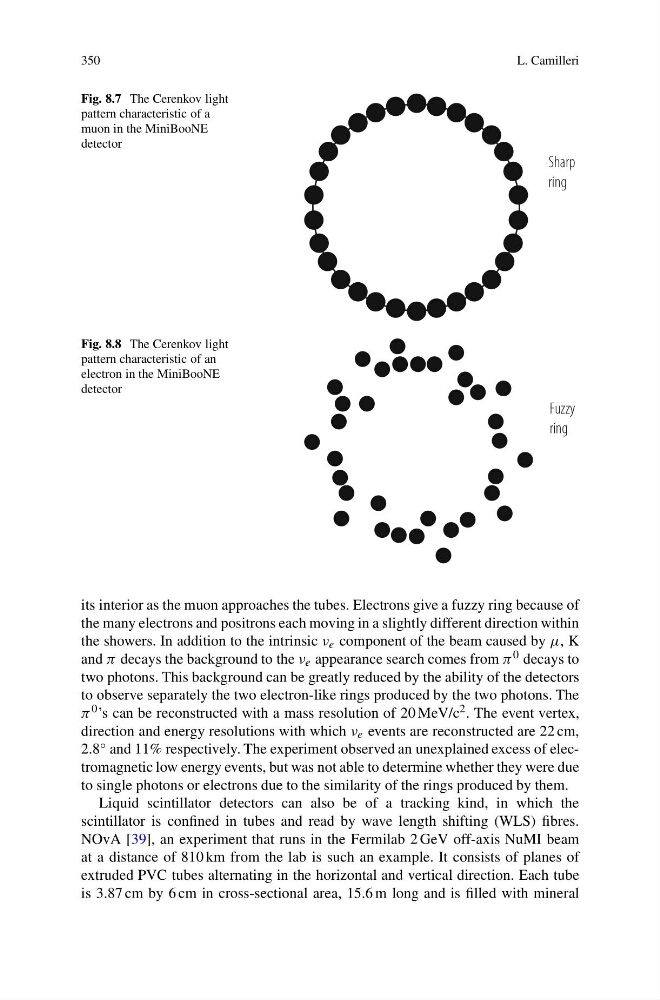
Fig. 8.7 The Cerenkov light
pattern characteristic of a
muon in the MiniBooNE
detector
Sharp
ring
Fig. 8.8 The Cerenkov light
pattern characteristic of an
electron in the MiniBooNE
detector
Fuzzy
ring
its interior as the muon approaches the tubes. Electrons give a fuzzy ring because of
the many electrons and positrons each moving in a slightly different direction within
the showers. In addition to the intrinsic ν e component of the beam caused by μ, K
and π decays the background to the ν e appearance search comes from π 0 decays to
two photons. This background can be greatly reduced by the ability of the detectors
to observe separately the two electron-like rings produced by the two photons. The
π 0 ’s can be reconstructed with a mass resolution of 20 MeV/c 2 . The event vertex,
direction and energy resolutions with which ν e events are reconstructed are 22 cm,
2.8 ◦ and 11% respectively. The experiment observed an unexplained excess of electromagnetic low energy events, but was not able to determine whether they were due
to single photons or electrons due to the similarity of the rings produced by them.
Liquid scintillator detectors can also be of a tracking kind, in which the
scintillator is confined in tubes and read by wave length shifting (WLS) fibres.
NOvA [39], an experiment that runs in the Fermilab 2 GeV off-axis NuMI beam
at a distance of 810 km from the lab is such an example. It consists of planes of
extruded PVC tubes alternating in the horizontal and vertical direction. Each tube
is 3.87 cm by 6 cm in cross-sectional area, 15.6 m long and is filled with mineral
L. Camilleri
Fig. 8.7 The Cerenkov light
pattern characteristic of a
muon in the MiniBooNE
detector
Sharp
ring
Fig. 8.8 The Cerenkov light
pattern characteristic of an
electron in the MiniBooNE
detector
Fuzzy
ring
its interior as the muon approaches the tubes. Electrons give a fuzzy ring because of
the many electrons and positrons each moving in a slightly different direction within
the showers. In addition to the intrinsic ν e component of the beam caused by μ, K
and π decays the background to the ν e appearance search comes from π 0 decays to
two photons. This background can be greatly reduced by the ability of the detectors
to observe separately the two electron-like rings produced by the two photons. The
π 0 ’s can be reconstructed with a mass resolution of 20 MeV/c 2 . The event vertex,
direction and energy resolutions with which ν e events are reconstructed are 22 cm,
2.8 ◦ and 11% respectively. The experiment observed an unexplained excess of electromagnetic low energy events, but was not able to determine whether they were due
to single photons or electrons due to the similarity of the rings produced by them.
Liquid scintillator detectors can also be of a tracking kind, in which the
scintillator is confined in tubes and read by wave length shifting (WLS) fibres.
NOvA [39], an experiment that runs in the Fermilab 2 GeV off-axis NuMI beam
at a distance of 810 km from the lab is such an example. It consists of planes of
extruded PVC tubes alternating in the horizontal and vertical direction. Each tube
is 3.87 cm by 6 cm in cross-sectional area, 15.6 m long and is filled with mineral