

344
L. Camilleri
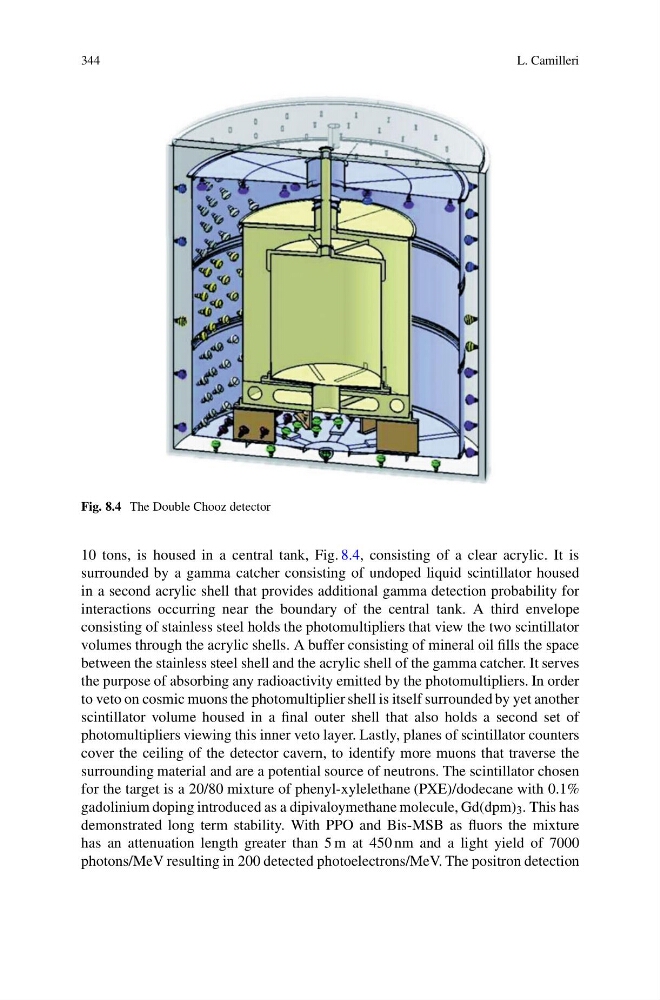
Fig. 8.4 The Double Chooz detector
10 tons, is housed in a central tank, Fig. 8.4, consisting of a clear acrylic. It is
surrounded by a gamma catcher consisting of undoped liquid scintillator housed
in a second acrylic shell that provides additional gamma detection probability for
interactions occurring near the boundary of the central tank. A third envelope
consisting of stainless steel holds the photomultipliers that view the two scintillator
volumes through the acrylic shells. A buffer consisting of mineral oil fills the space
between the stainless steel shell and the acrylic shell of the gamma catcher. It serves
the purpose of absorbing any radioactivity emitted by the photomultipliers. In order
to veto on cosmic muons the photomultiplier shell is itself surrounded by yet another
scintillator volume housed in a final outer shell that also holds a second set of
photomultipliers viewing this inner veto layer. Lastly, planes of scintillator counters
cover the ceiling of the detector cavern, to identify more muons that traverse the
surrounding material and are a potential source of neutrons. The scintillator chosen
for the target is a 20/80 mixture of phenyl-xylelethane (PXE)/dodecane with 0.1%
gadolinium doping introduced as a dipivaloymethane molecule, Gd(dpm) 3 . This has
demonstrated long term stability. With PPO and Bis-MSB as fluors the mixture
has an attenuation length greater than 5 m at 450 nm and a light yield of 7000
photons/MeV resulting in 200 detected photoelectrons/MeV. The positron detection
L. Camilleri
Fig. 8.4 The Double Chooz detector
10 tons, is housed in a central tank, Fig. 8.4, consisting of a clear acrylic. It is
surrounded by a gamma catcher consisting of undoped liquid scintillator housed
in a second acrylic shell that provides additional gamma detection probability for
interactions occurring near the boundary of the central tank. A third envelope
consisting of stainless steel holds the photomultipliers that view the two scintillator
volumes through the acrylic shells. A buffer consisting of mineral oil fills the space
between the stainless steel shell and the acrylic shell of the gamma catcher. It serves
the purpose of absorbing any radioactivity emitted by the photomultipliers. In order
to veto on cosmic muons the photomultiplier shell is itself surrounded by yet another
scintillator volume housed in a final outer shell that also holds a second set of
photomultipliers viewing this inner veto layer. Lastly, planes of scintillator counters
cover the ceiling of the detector cavern, to identify more muons that traverse the
surrounding material and are a potential source of neutrons. The scintillator chosen
for the target is a 20/80 mixture of phenyl-xylelethane (PXE)/dodecane with 0.1%
gadolinium doping introduced as a dipivaloymethane molecule, Gd(dpm) 3 . This has
demonstrated long term stability. With PPO and Bis-MSB as fluors the mixture
has an attenuation length greater than 5 m at 450 nm and a light yield of 7000
photons/MeV resulting in 200 detected photoelectrons/MeV. The positron detection