

7 Particle Detectors and Detector Systems
303
0
0.1
0.2
0.3
0.4
0.5
5
6
7
8
9
Photon energy (eV)
CsI quantum efficiency
(a)
CsI photo cathode
Cathode read-out
20 μm anode wire
100 μm field wire
e -
Quartz window
photon
Q u a rt z w in d o w
A
n
o d e
w
i r e
s
C at h o d e p ad s
F ie ld w ir e s
(b)
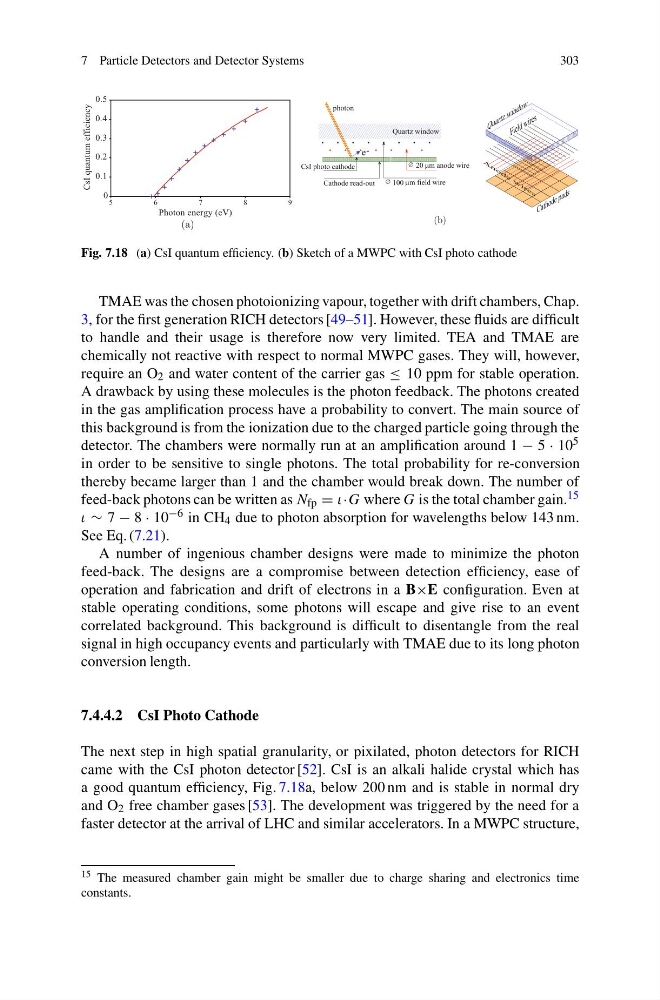
Fig. 7.18 (a) CsI quantum efficiency. (b) Sketch of a MWPC with CsI photo cathode
TMAE was the chosen photoionizing vapour, together with drift chambers, Chap.
3, for the first generation RICH detectors [49–51]. However, these fluids are difficult
to handle and their usage is therefore now very limited. TEA and TMAE are
chemically not reactive with respect to normal MWPC gases. They will, however,
require an O 2 and water content of the carrier gas ≤ 10 ppm for stable operation.
A drawback by using these molecules is the photon feedback. The photons created
in the gas amplification process have a probability to convert. The main source of
this background is from the ionization due to the charged particle going through the
detector. The chambers were normally run at an amplification around 1 − 5 · 10 5
in order to be sensitive to single photons. The total probability for re-conversion
thereby became larger than 1 and the chamber would break down. The number of
feed-back photons can be written as N fp = ι·G where G is the total chamber gain. 15
ι ∼ 7 − 8 · 10 −6 in CH 4 due to photon absorption for wavelengths below 143 nm.
See Eq. (7.21).
A number of ingenious chamber designs were made to minimize the photon
feed-back. The designs are a compromise between detection efficiency, ease of
operation and fabrication and drift of electrons in a B×E configuration. Even at
stable operating conditions, some photons will escape and give rise to an event
correlated background. This background is difficult to disentangle from the real
signal in high occupancy events and particularly with TMAE due to its long photon
conversion length.
7.4.4.2 CsI Photo Cathode
The next step in high spatial granularity, or pixilated, photon detectors for RICH
came with the CsI photon detector [52]. CsI is an alkali halide crystal which has
a good quantum efficiency, Fig. 7.18a, below 200 nm and is stable in normal dry
and O 2 free chamber gases [53]. The development was triggered by the need for a
faster detector at the arrival of LHC and similar accelerators. In a MWPC structure,
15 The measured chamber gain might be smaller due to charge sharing and electronics time
constants.
303
0
0.1
0.2
0.3
0.4
0.5
5
6
7
8
9
Photon energy (eV)
CsI quantum efficiency
(a)
CsI photo cathode
Cathode read-out
20 μm anode wire
100 μm field wire
e -
Quartz window
photon
Q u a rt z w in d o w
A
n
o d e
w
i r e
s
C at h o d e p ad s
F ie ld w ir e s
(b)
Fig. 7.18 (a) CsI quantum efficiency. (b) Sketch of a MWPC with CsI photo cathode
TMAE was the chosen photoionizing vapour, together with drift chambers, Chap.
3, for the first generation RICH detectors [49–51]. However, these fluids are difficult
to handle and their usage is therefore now very limited. TEA and TMAE are
chemically not reactive with respect to normal MWPC gases. They will, however,
require an O 2 and water content of the carrier gas ≤ 10 ppm for stable operation.
A drawback by using these molecules is the photon feedback. The photons created
in the gas amplification process have a probability to convert. The main source of
this background is from the ionization due to the charged particle going through the
detector. The chambers were normally run at an amplification around 1 − 5 · 10 5
in order to be sensitive to single photons. The total probability for re-conversion
thereby became larger than 1 and the chamber would break down. The number of
feed-back photons can be written as N fp = ι·G where G is the total chamber gain. 15
ι ∼ 7 − 8 · 10 −6 in CH 4 due to photon absorption for wavelengths below 143 nm.
See Eq. (7.21).
A number of ingenious chamber designs were made to minimize the photon
feed-back. The designs are a compromise between detection efficiency, ease of
operation and fabrication and drift of electrons in a B×E configuration. Even at
stable operating conditions, some photons will escape and give rise to an event
correlated background. This background is difficult to disentangle from the real
signal in high occupancy events and particularly with TMAE due to its long photon
conversion length.
7.4.4.2 CsI Photo Cathode
The next step in high spatial granularity, or pixilated, photon detectors for RICH
came with the CsI photon detector [52]. CsI is an alkali halide crystal which has
a good quantum efficiency, Fig. 7.18a, below 200 nm and is stable in normal dry
and O 2 free chamber gases [53]. The development was triggered by the need for a
faster detector at the arrival of LHC and similar accelerators. In a MWPC structure,
15 The measured chamber gain might be smaller due to charge sharing and electronics time
constants.