

6 Calorimetry
275
“Future Circular Collider” (FCC). A center-of-mass energy for proton-proton
collisions in the 100 TeV regime is envisaged, implying a collider circumference
of about 100 km. The physics research determines the peak luminosity of about
3.10 35 cm −2 s −1 . These key parameters shape the detector design and performance specifications, which are intensively studied [145]. The electromagnetic
and hadronic calorimetry emphasizes very high granularity to cope with particle
multiplicity and event pile-up, tight control of systematic effects (small constant
term), very good linearity and—unsurprisingly—taming the ferocious radiation
environment. The calorimeters are of the sampling type, because the stochastic
term in the calorimeter performance is less an issue, given that the typical energy
scales are in the TeV regime. Simulations show that rather conventional, LHC
type calorimeter instrumentation will deliver the desired performance, without
excluding novel developments with more “aggressive” technologies. LAr is the
technology of choice, except for a possible scintillator option for the central hadron
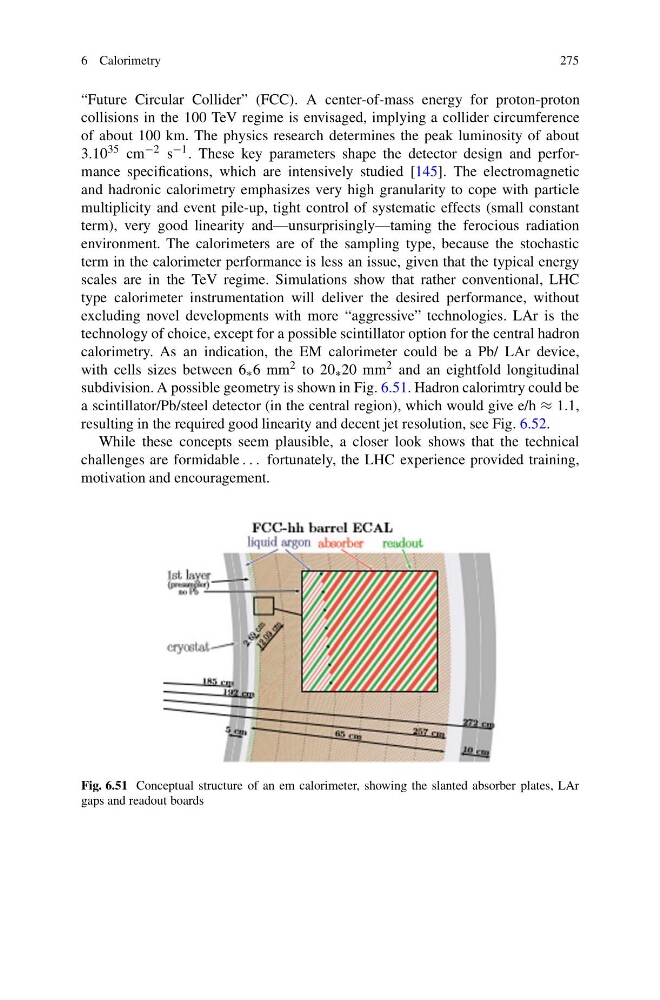
calorimetry. As an indication, the EM calorimeter could be a Pb/ LAr device,
with cells sizes between 6 ∗ 6 mm 2 to 20 ∗ 20 mm 2 and an eightfold longitudinal
subdivision. A possible geometry is shown in Fig. 6.51. Hadron calorimtry could be
a scintillator/Pb/steel detector (in the central region), which would give e/h ≈ 1.1,
resulting in the required good linearity and decent jet resolution, see Fig. 6.52.
While these concepts seem plausible, a closer look shows that the technical
challenges are formidable . . . fortunately, the LHC experience provided training,
motivation and encouragement.
Fig. 6.51 Conceptual structure of an em calorimeter, showing the slanted absorber plates, LAr
gaps and readout boards
275
“Future Circular Collider” (FCC). A center-of-mass energy for proton-proton
collisions in the 100 TeV regime is envisaged, implying a collider circumference
of about 100 km. The physics research determines the peak luminosity of about
3.10 35 cm −2 s −1 . These key parameters shape the detector design and performance specifications, which are intensively studied [145]. The electromagnetic
and hadronic calorimetry emphasizes very high granularity to cope with particle
multiplicity and event pile-up, tight control of systematic effects (small constant
term), very good linearity and—unsurprisingly—taming the ferocious radiation
environment. The calorimeters are of the sampling type, because the stochastic
term in the calorimeter performance is less an issue, given that the typical energy
scales are in the TeV regime. Simulations show that rather conventional, LHC
type calorimeter instrumentation will deliver the desired performance, without
excluding novel developments with more “aggressive” technologies. LAr is the
technology of choice, except for a possible scintillator option for the central hadron
calorimetry. As an indication, the EM calorimeter could be a Pb/ LAr device,
with cells sizes between 6 ∗ 6 mm 2 to 20 ∗ 20 mm 2 and an eightfold longitudinal
subdivision. A possible geometry is shown in Fig. 6.51. Hadron calorimtry could be
a scintillator/Pb/steel detector (in the central region), which would give e/h ≈ 1.1,
resulting in the required good linearity and decent jet resolution, see Fig. 6.52.
While these concepts seem plausible, a closer look shows that the technical
challenges are formidable . . . fortunately, the LHC experience provided training,
motivation and encouragement.
Fig. 6.51 Conceptual structure of an em calorimeter, showing the slanted absorber plates, LAr
gaps and readout boards