

270
C. W. Fabjan and D. Fournier
the electron channel to the recent measurement of the W-mass, 80,370 ± 19 MeV
in the muon and electron channels together [137].
6.7.5 The ZEUS Calorimeter at HERA
Research at the electron-proton collider HERA required precision jet spectroscopy
at the 100 GeV level to study the underlying dynamics of e-quark collisions. Energy
and position resolution for jets were at a premium.
The H1 Collaboration developed a calorimeter based on the LAr-Pb and LArFe sampling technology. A certain level of ‘off-line’ compensation was achieved
because hadron showers were measured longitudinally up to ten times and longitudinal shower-weighting could be applied [139].
The ZEUS Collaboration at HERA developed an intrinsically compensated
calorimeter using the U-scintillator sampling technique [43, 138], modeled after
the Axial Field Spectrometer facility [140]. The calorimeter is constructed in a
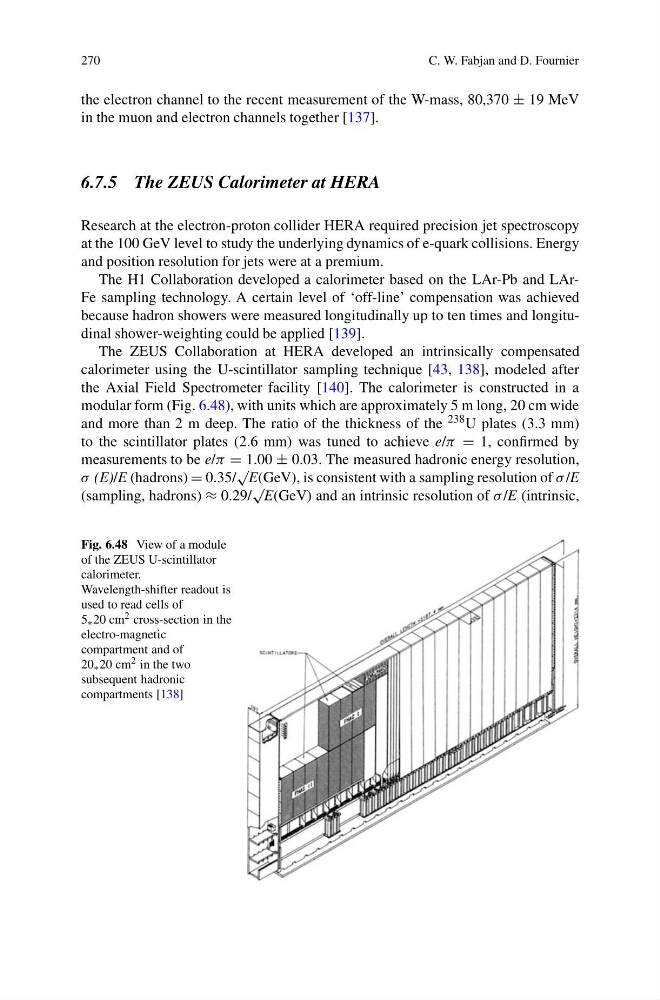
modular form (Fig. 6.48), with units which are approximately 5 m long, 20 cm wide
and more than 2 m deep. The ratio of the thickness of the 238 U plates (3.3 mm)
to the scintillator plates (2.6 mm) was tuned to achieve e/π = 1, confirmed by
measurements to be e/π = 1.00 ± 0.03. The measured hadronic energy resolution,
σ (E)/E (hadrons) = 0.35/
√
E(GeV), is consistent with a sampling resolution of σ /E
(sampling, hadrons) ≈ 0.29/
√
E(GeV) and an intrinsic resolution of σ /E (intrinsic,
Fig. 6.48 View of a module
of the ZEUS U-scintillator
calorimeter.
Wavelength-shifter readout is
used to read cells of
5 ∗ 20 cm 2 cross-section in the
electro-magnetic
compartment and of
20 ∗ 20 cm 2 in the two
subsequent hadronic
compartments [138]
C. W. Fabjan and D. Fournier
the electron channel to the recent measurement of the W-mass, 80,370 ± 19 MeV
in the muon and electron channels together [137].
6.7.5 The ZEUS Calorimeter at HERA
Research at the electron-proton collider HERA required precision jet spectroscopy
at the 100 GeV level to study the underlying dynamics of e-quark collisions. Energy
and position resolution for jets were at a premium.
The H1 Collaboration developed a calorimeter based on the LAr-Pb and LArFe sampling technology. A certain level of ‘off-line’ compensation was achieved
because hadron showers were measured longitudinally up to ten times and longitudinal shower-weighting could be applied [139].
The ZEUS Collaboration at HERA developed an intrinsically compensated
calorimeter using the U-scintillator sampling technique [43, 138], modeled after
the Axial Field Spectrometer facility [140]. The calorimeter is constructed in a
modular form (Fig. 6.48), with units which are approximately 5 m long, 20 cm wide
and more than 2 m deep. The ratio of the thickness of the 238 U plates (3.3 mm)
to the scintillator plates (2.6 mm) was tuned to achieve e/π = 1, confirmed by
measurements to be e/π = 1.00 ± 0.03. The measured hadronic energy resolution,
σ (E)/E (hadrons) = 0.35/
√
E(GeV), is consistent with a sampling resolution of σ /E
(sampling, hadrons) ≈ 0.29/
√
E(GeV) and an intrinsic resolution of σ /E (intrinsic,
Fig. 6.48 View of a module
of the ZEUS U-scintillator
calorimeter.
Wavelength-shifter readout is
used to read cells of
5 ∗ 20 cm 2 cross-section in the
electro-magnetic
compartment and of
20 ∗ 20 cm 2 in the two
subsequent hadronic
compartments [138]