

252
C. W. Fabjan and D. Fournier
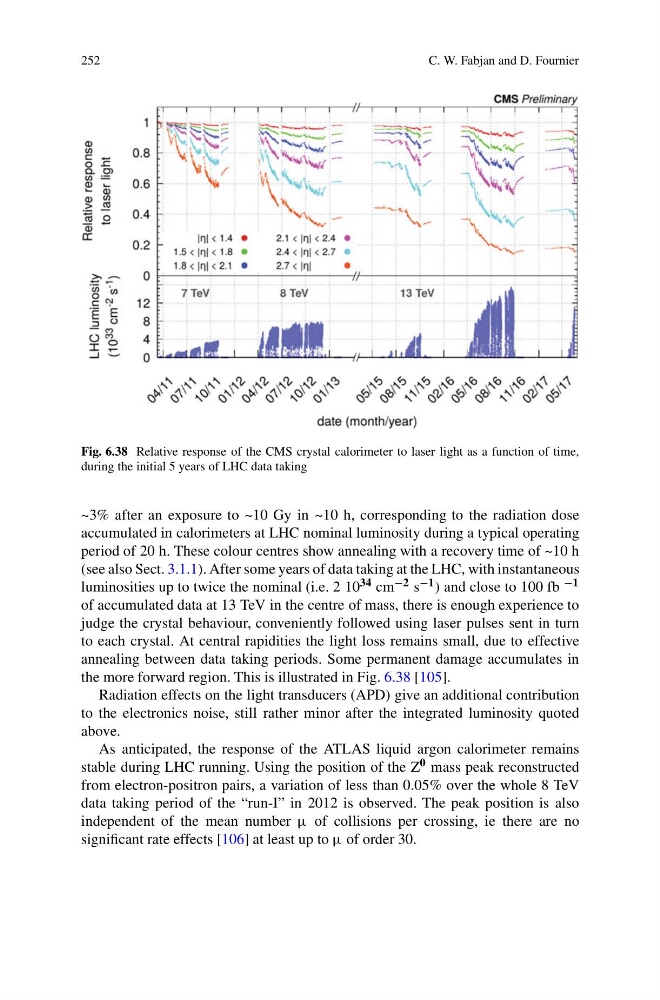
Fig. 6.38 Relative response of the CMS crystal calorimeter to laser light as a function of time,
during the initial 5 years of LHC data taking
~3% after an exposure to ~10 Gy in ~10 h, corresponding to the radiation dose
accumulated in calorimeters at LHC nominal luminosity during a typical operating
period of 20 h. These colour centres show annealing with a recovery time of ~10 h
(see also Sect. 3.1.1). After some years of data taking at the LHC, with instantaneous
luminosities up to twice the nominal (i.e. 2 10 34 cm −2 s −1 ) and close to 100 fb −1
of accumulated data at 13 TeV in the centre of mass, there is enough experience to
judge the crystal behaviour, conveniently followed using laser pulses sent in turn
to each crystal. At central rapidities the light loss remains small, due to effective
annealing between data taking periods. Some permanent damage accumulates in
the more forward region. This is illustrated in Fig. 6.38 [105].
Radiation effects on the light transducers (APD) give an additional contribution
to the electronics noise, still rather minor after the integrated luminosity quoted
above.
As anticipated, the response of the ATLAS liquid argon calorimeter remains
stable during LHC running. Using the position of the Z 0 mass peak reconstructed
from electron-positron pairs, a variation of less than 0.05% over the whole 8 TeV
data taking period of the “run-I” in 2012 is observed. The peak position is also
independent of the mean number μ of collisions per crossing, ie there are no
significant rate effects [106] at least up to μ of order 30.
C. W. Fabjan and D. Fournier
Fig. 6.38 Relative response of the CMS crystal calorimeter to laser light as a function of time,
during the initial 5 years of LHC data taking
~3% after an exposure to ~10 Gy in ~10 h, corresponding to the radiation dose
accumulated in calorimeters at LHC nominal luminosity during a typical operating
period of 20 h. These colour centres show annealing with a recovery time of ~10 h
(see also Sect. 3.1.1). After some years of data taking at the LHC, with instantaneous
luminosities up to twice the nominal (i.e. 2 10 34 cm −2 s −1 ) and close to 100 fb −1
of accumulated data at 13 TeV in the centre of mass, there is enough experience to
judge the crystal behaviour, conveniently followed using laser pulses sent in turn
to each crystal. At central rapidities the light loss remains small, due to effective
annealing between data taking periods. Some permanent damage accumulates in
the more forward region. This is illustrated in Fig. 6.38 [105].
Radiation effects on the light transducers (APD) give an additional contribution
to the electronics noise, still rather minor after the integrated luminosity quoted
above.
As anticipated, the response of the ATLAS liquid argon calorimeter remains
stable during LHC running. Using the position of the Z 0 mass peak reconstructed
from electron-positron pairs, a variation of less than 0.05% over the whole 8 TeV
data taking period of the “run-I” in 2012 is observed. The peak position is also
independent of the mean number μ of collisions per crossing, ie there are no
significant rate effects [106] at least up to μ of order 30.