

6 Calorimetry
247
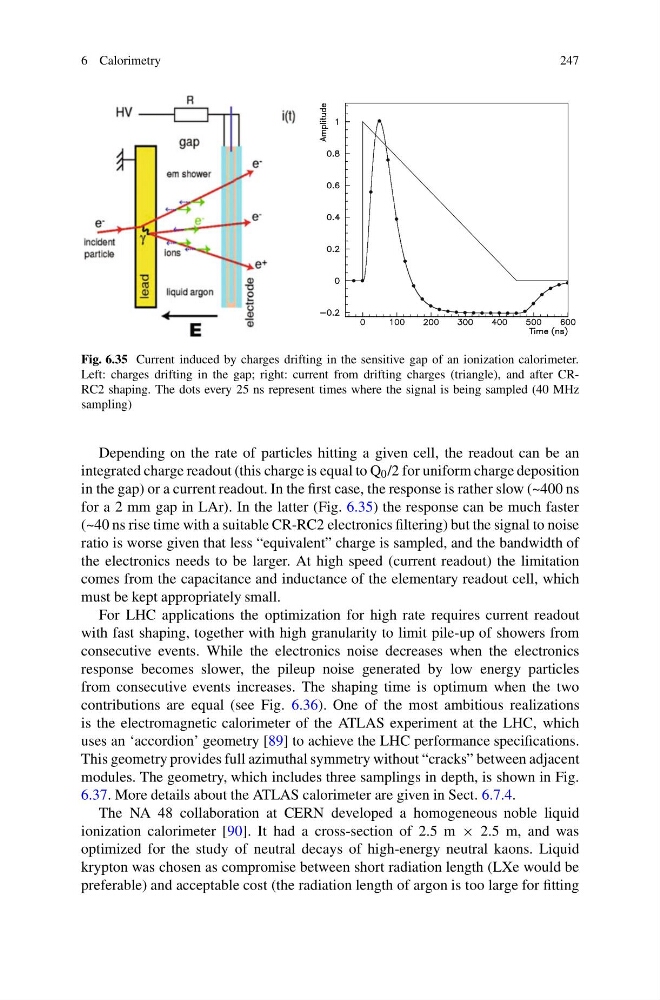
Fig. 6.35 Current induced by charges drifting in the sensitive gap of an ionization calorimeter.
Left: charges drifting in the gap; right: current from drifting charges (triangle), and after CRRC2 shaping. The dots every 25 ns represent times where the signal is being sampled (40 MHz
sampling)
Depending on the rate of particles hitting a given cell, the readout can be an
integrated charge readout (this charge is equal to Q 0 /2 for uniform charge deposition
in the gap) or a current readout. In the first case, the response is rather slow (~400 ns
for a 2 mm gap in LAr). In the latter (Fig. 6.35) the response can be much faster
(~40 ns rise time with a suitable CR-RC2 electronics filtering) but the signal to noise
ratio is worse given that less “equivalent” charge is sampled, and the bandwidth of
the electronics needs to be larger. At high speed (current readout) the limitation
comes from the capacitance and inductance of the elementary readout cell, which
must be kept appropriately small.
For LHC applications the optimization for high rate requires current readout
with fast shaping, together with high granularity to limit pile-up of showers from
consecutive events. While the electronics noise decreases when the electronics
response becomes slower, the pileup noise generated by low energy particles
from consecutive events increases. The shaping time is optimum when the two
contributions are equal (see Fig. 6.36). One of the most ambitious realizations
is the electromagnetic calorimeter of the ATLAS experiment at the LHC, which
uses an ‘accordion’ geometry [89] to achieve the LHC performance specifications.
This geometry provides full azimuthal symmetry without “cracks” between adjacent
modules. The geometry, which includes three samplings in depth, is shown in Fig.
6.37. More details about the ATLAS calorimeter are given in Sect. 6.7.4.
The NA 48 collaboration at CERN developed a homogeneous noble liquid
ionization calorimeter [90]. It had a cross-section of 2.5 m × 2.5 m, and was
optimized for the study of neutral decays of high-energy neutral kaons. Liquid
krypton was chosen as compromise between short radiation length (LXe would be
preferable) and acceptable cost (the radiation length of argon is too large for fitting
247
Fig. 6.35 Current induced by charges drifting in the sensitive gap of an ionization calorimeter.
Left: charges drifting in the gap; right: current from drifting charges (triangle), and after CRRC2 shaping. The dots every 25 ns represent times where the signal is being sampled (40 MHz
sampling)
Depending on the rate of particles hitting a given cell, the readout can be an
integrated charge readout (this charge is equal to Q 0 /2 for uniform charge deposition
in the gap) or a current readout. In the first case, the response is rather slow (~400 ns
for a 2 mm gap in LAr). In the latter (Fig. 6.35) the response can be much faster
(~40 ns rise time with a suitable CR-RC2 electronics filtering) but the signal to noise
ratio is worse given that less “equivalent” charge is sampled, and the bandwidth of
the electronics needs to be larger. At high speed (current readout) the limitation
comes from the capacitance and inductance of the elementary readout cell, which
must be kept appropriately small.
For LHC applications the optimization for high rate requires current readout
with fast shaping, together with high granularity to limit pile-up of showers from
consecutive events. While the electronics noise decreases when the electronics
response becomes slower, the pileup noise generated by low energy particles
from consecutive events increases. The shaping time is optimum when the two
contributions are equal (see Fig. 6.36). One of the most ambitious realizations
is the electromagnetic calorimeter of the ATLAS experiment at the LHC, which
uses an ‘accordion’ geometry [89] to achieve the LHC performance specifications.
This geometry provides full azimuthal symmetry without “cracks” between adjacent
modules. The geometry, which includes three samplings in depth, is shown in Fig.
6.37. More details about the ATLAS calorimeter are given in Sect. 6.7.4.
The NA 48 collaboration at CERN developed a homogeneous noble liquid
ionization calorimeter [90]. It had a cross-section of 2.5 m × 2.5 m, and was
optimized for the study of neutral decays of high-energy neutral kaons. Liquid
krypton was chosen as compromise between short radiation length (LXe would be
preferable) and acceptable cost (the radiation length of argon is too large for fitting